WikiGap: Promoting Epistemic Equity by Surfacing Knowledge Gaps Between English Wikipedia and other Language Editions
v4
Paper introduction · English narration and external captions
v4
Paper: WikiGap: Promoting Epistemic Equity by Surfacing Knowledge Gaps Between English Wikipedia and other Language Editions (v4) https://arxiv.org/html/2505.24195v4
This explainer follows the mechanism before interpreting its reported results.
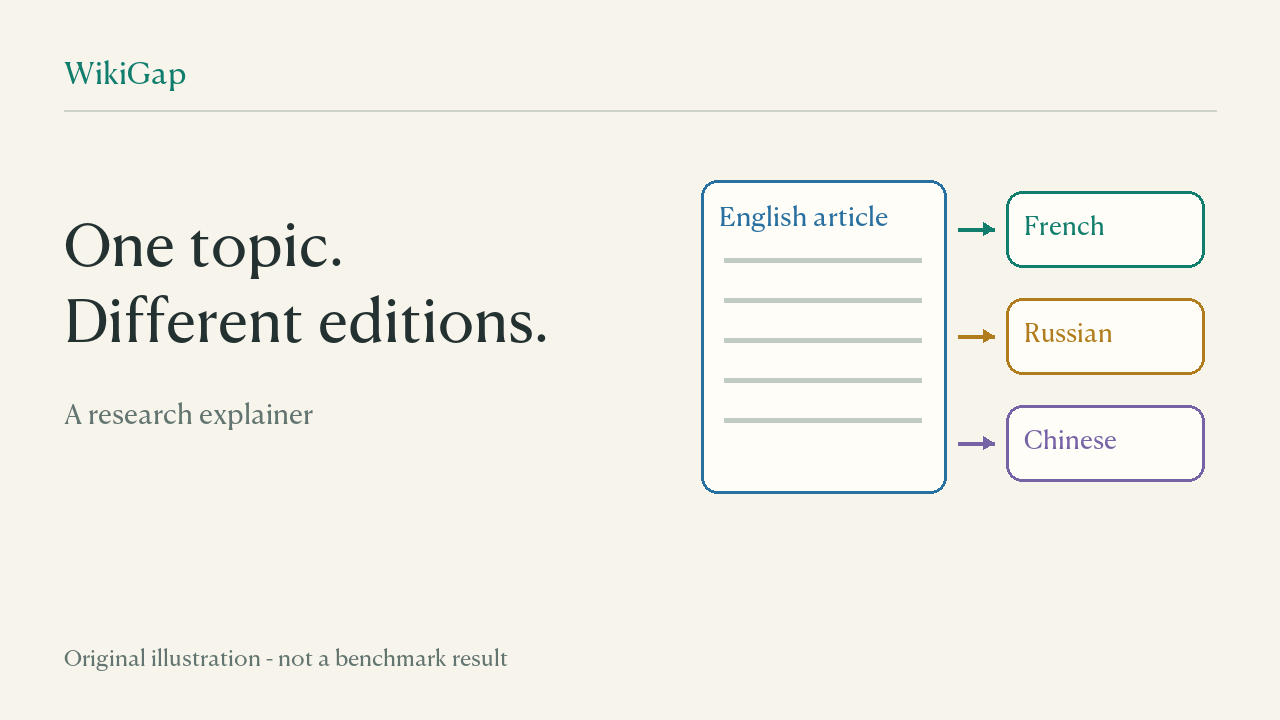
An English Wikipedia article can feel like a complete account of a topic. Switching languages may then seem like reading the same account in different words. WikiGap starts from a different observation: language editions can contain complementary knowledge.
The interface keeps the English article as the reading surface. Markers open a side panel with facts translated into English and labelled by source language. Links return readers to the original sentence context. Our original cards are schematic illustrations of that navigation, not quotations from Wikipedia or newly asserted facts about a real topic.
Finding a knowledge gap requires more than matching surface wording. WikiGap uses a prior InfoGap pipeline that extracts atomic facts, retrieves potential matches across languages and verifies inferability. It surfaces selected facts from French, Russian and Chinese editions that are not aligned with the English account. A different phrase does not automatically count as a different fact.
Readers can filter languages, search facts and enter through an article marker or a question. The interaction makes complementary material visible while preserving a route back to its source, rather than turning every foreign-language sentence into an untraceable summary.
The evaluation studies 21 participants in a within-subject food-topic quiz, with treatment order randomized. Reported quiz accuracy rises from 73% with default Wikipedia to 91% with WikiGap. Average completion time decreases from 20.84 to 12.39 minutes. The quiz questions were built from InfoGap facts. These observations concern that quiz, not unrestricted browsing or every possible topic.
The reported usability comparison gives System Usability Scale scores of 82.5 and 48.2 under the study conditions. That result complements the task measurements without establishing universal usability.
The paper’s useful idea is a reading interface that reveals where editions add knowledge and lets a reader inspect the source context. Translation makes the content accessible; fact alignment and traceability explain why it belongs in the panel.
Clean English video. Choose English, Simplified Chinese or bilingual captions in the player.