目录Table of Contents
AutoResearch:从可证伪的研究循环到证据地图
AutoResearch(自主研究系统)最值得研究的地方,不是它能否一夜之间"成为科学家",而是它迫使我们把研究工作拆成一个可审计的闭环:提出改动、执行实验、读取由评测器产生的结果、保留或否决工件,再决定下一步。这个闭环很有用,但它本身既不是 benchmark,也不自动构成递归自我改进(RSI)。这篇长文用五个部分展开一个连续论证:第一部分是 AutoResearch 的方法论骨架;第二部分是 Deep Research Agent 的检索—资格—证据—引文协议;第三部分把 RSI、Auto Research、long horizon、RL environments 与合成实例训练收束成一张证据地图;第四部分是把项目进展写成可审计证据的研究路线图;第五部分把九条相邻热门方向约束回五个核心问题。
第一部分 · AutoResearch:把研究循环变成可证伪的系统
I-1. 先分清四件不同的事
| 名称 | 它是什么 | 它不自动证明什么 |
|---|---|---|
| 研究循环 | 提议、实现、运行、测量、据此修订的连续过程 | 新颖性、可迁移性或自主性 |
| benchmark | 任务分布、协议、计分规则与基线 | 一个具体 agent 或 harness 有效 |
| 智能体运行支架(harness) | 工具、状态、权限、预算、沙箱、日志和评测钩子的执行系统 | 分数只由模型能力决定 |
| RSI | 系统改进的是未来仍会执行改进的 agent / policy / 工具 | 仅仅把外部训练脚本或某个目标函数刷得更好 |
Karpathy 的 autoresearch 是一个非常清爽的原型:agent 改动受限的训练脚本,准备与评估保持冻结,短训练给出指标,循环保留更好的候选。它说明了有边界的经验优化可以自主运行;它并不声称跨硬件分数可比,也不构成”通用科研能力”或 RSI 的证据。
I-2. 从”会改代码”到”能做研究”,中间缺什么
一个研究循环至少要能回答四个问题:
- 干预是什么? 哪些文件、超参数、工具调用或实验设计允许修改?
- 证据从哪里来? 是可见开发指标、隐藏验证器、物理约束,还是人工反馈?
- 什么被保留? 只保存最终最优工件,还是保存假设、失败实验和决策谱系?
- 如何防止局部刷分? 评测器是否冻结,胜出结果是否在保留种子、保留设置或独立运行时复验?
如果第四个问题没有答案,最诚实的名称通常是”对本地 harness 的优化”,而不是科研。一个更强的研究结论需要把评测代码、数据准备和隐藏测试放在 agent 不能写入的边界后面,并在预先声明的保留设置上重新运行。
I-3. 同样叫”科研任务”,测量对象其实不同
| 测量族 | 代表系统 | 主要工件与接纳信号 | 最窄可支持的结论 |
|---|---|---|---|
| ML 方法泛化 | MLS-Bench | 受限编辑的 ML 机制和跨设置结果 | 一个方法是否在声明的设置间成立 |
| 局部实验循环 | AutoLab、MLAgentBench、MLGym | 预算内改善的代码/模型;本地或环境反馈 | agent 是否能持续诊断、编辑、运行和利用反馈 |
| 长程搜索动态 | EdgeBench、FML-Bench | best-so-far 工件、过程指标和固定 execution interface | 搜索策略如何在一个指定环境中利用反馈 |
| 已有工作的复现 | PaperBench、CORE-Bench | 可执行 repo、结果和分层 rubric / reproduction checks | agent 能否重建已发表工作的指定部分 |
| 隐藏目标下的重发现 | ResearchClawBench | 相关文献与原始数据、隐藏目标论文与专家加权 rubric 组成受限的研究工件重发现任务 | 高分等于独立确认原论文、开放式新发现或同行评审认可 |
| 未实现研究扩展 | RExBench | 在既有论文与代码上实现新 extension,执行输出验收 | agent 能否实现一个已定义但尚未实现的实验扩展 |
| 数据驱动发现 / 全流程 | ScienceAgentBench、AIRS-Bench | 数据分析、想法、实验和迭代任务的 task-specific evaluator | 在受限任务分布上完成指定研究工作流 |
| 科学计算执行 | Terminal-Bench Science | 可完成的科学计算 workflow;计划中的确定性 pytest | 可靠完成受程序验证的科学任务 |
这不是谁”更像科学”的排行榜。它首先说明,得到高分的路径不能彼此借用结论:重现论文不等于提出新机制;实现一个专家写好的 extension 不等于选择了值得做的 hypothesis;在同一环境中搜索更好,不等于跨环境或跨实验室仍能成立。ResearchClawBench 以真实论文、相关文献和原始数据构造任务,但把目标论文保留在评测侧,并用专家 rubric 对研究工件评分;这使”重发现已知目标”比自由写报告更可检查,却仍不是对原结论的独立复验,更不是开放式新发现。PaperBench 特别要求将提交的代码库放入新的 GPU 容器执行,CORE-Bench 则聚焦给定代码与数据的计算复现;它们让”能跑起来”更可检查,却不让原始论文自动成为真,也不让复现任务变成科学发现。FML-Bench 将 strategy 与 execution infrastructure 分开并记录过程指标,这提醒我们不要把更强 harness、更多并行或更便宜 API 调用误归因给”更好的研究策略”。Terminal-Bench Science 仍在建设,不能当作已经发布的完整 benchmark 来引用。
I-4. 候选搜索不能兼任结论接纳
AutoResearch 的开发阶段本来就是自适应的:下一次假设来自上一次指标、日志和失败。这不是缺点,但它意味着”从许多试验中选出的最好候选”不能再由同一反馈通道证明自己。应把探索和接纳做成两个边界不同的循环。
| 阶段 | Agent 可以看到或执行什么 | 必须保持写保护或隔离的对象 | 需要留下的证据 |
|---|---|---|---|
| Explore | 开发任务、允许编辑面、开发数据/种子、失败日志和限定的过程反馈 | 最终 holdout、acceptance code、私密规则和生产凭据 | 每个假设、改动、开发查询、结果与拒绝理由 |
| Freeze candidate | 选择一个候选并提交完整工件 | 不得在看到 final result 后继续修改候选 | Git / artifact hash、环境和数据 digest、依赖锁、预算与选择时点 |
| Accept | 提交冻结候选;只获得预先约定的有限结果 | 选择阶段不可查询的 holdout、独立 verifier、评审规则 | 终态 outcome、verifier version、查询次数、不可判定和安全失败 |
| Replicate / challenge | 独立运行、重建或提出反例 | 原始 agent 对新运行没有写权限 | 新运行环境、差异、负结果、范围修订与是否撤回 |
Generalization in Adaptive Data Analysis and Holdout Reuse 表明,自适应地反复查看同一 holdout 会使它本身被过拟合;The Generic Holdout 进一步讨论了把探索与有限暴露的接纳分开。它们提供的是带条件的统计机制,不是”藏一套测试集”这一工程习惯的自动担保。因此本文的接纳协议只提出一个可审计的工程最低线:记录开发/接纳 query 数,冻结候选再送审,限制 final feedback,并在干净运行时复验;若需要形式化泛化保证,必须采用与任务和查询制度相匹配的正式方法或新鲜 holdout。
这也给出一个更诚实的结果句式:“在 D_dev 上经 q 次开发查询选择的候选,以 hash h 冻结;它在未参与选择的 H_accept 与独立运行 R 上满足预声明后置条件。” 它仍不是新颖性、因果解释或发表的证明,却比”最高分实验”多出了别人可以复查和推翻的对象。
I-5. Frontier Auto Research:任务的产物是可审稿的证据包
Frontier Auto Research(下文简称 ART)在这里是拟议研究路线的工作名,不是已经发布的团队、论文或 leaderboard。它不应与 EdgeBench、AutoLab 或 MLS-Bench 竞争一个”更像研究”的标签,而是改变一个更具体的单位:一次任务的交付物不只是分数或最终代码,而是一个可被外部反驳的窄结论及其证据包。
| 体系 | 它把什么当作主要交付物 | 最适合支持的结论 | 它本身不替代什么 |
|---|---|---|---|
| MLS-Bench | 一个受控改动的 ML 机制及跨设置结果 | 方法是否泛化与可扩展 | 对开放研究问题的完整论证 |
| AutoLab | 在固定墙钟内被持续改进的正确基线 | agent 是否能坚持诊断、编辑和实证优化 | 新颖科学结论或论文质量 |
| EdgeBench | 长程环境互动中的 best-so-far 工件与曲线 | agent 如何从多层反馈学习 | 基础模型权重更新或 RSI |
| ResearchClawBench | 真实论文任务包中的隐藏目标与加权研究工件 rubric | agent 是否能在指定材料和 protocol 下重发现目标工作的一部分 | 原论文真伪、新发现或同行评审认可 |
| Frontier Auto Research(拟议) | 问题、允许干预、代码/数据、对照、失败记录、保留复验与受限结论 | 一个研究主张能否被复跑、质疑和修改 | 发表保证、领域价值判断或同行评审 |
所以”解决一题能否通向顶会论文”需要换成更诚实的判据:该题是否允许形成一份最小但完整的研究证据包。它至少包含明确的问题、预先约束的改动面、可执行工件、合理对照、负结果或失败分析、保留复验和范围受限的解释。发表是外部同行评审的决定,不是环境的 reward。
这一定义也避免了与 EdgeBench 的伪冲突。EdgeBench 关心在真实环境中,持续交互怎样转化为更好的工件和曲线;ResearchClawBench 关心在预构造的隐藏目标任务中能否重发现部分研究工件;Frontier Auto Research 的拟议问题则是,某次改善能否支撑一个独立读者愿意审查的结论。它们可以使用相近的 harness,却回答不同的问题。MLS-Bench、AutoLab、EdgeBench 与 ResearchClawBench 分别提供方法泛化、长程闭环优化、环境内学习和隐藏目标重发现的参照,而不是需要被取代的基线。MLS-Bench · AutoLab · EdgeBench · ResearchClawBench
I-6. 一张值得公开的研究卡
我会把一个严肃的 AutoResearch 实验写成下面这张”研究卡”,而不是只公布一条漂亮轨迹:
| 字段 | 需要固定或公开的内容 |
|---|---|
| 任务与工件 | 问题、允许编辑面、提交产物和禁止修改的部分 |
| 预算 | 墙钟时间、GPU 小时、token、并发与重试规则 |
| 开发与选择 | D_dev、开发 query/试验上限、可见反馈、选择规则与被拒候选 |
| 候选冻结 | 提交前 Git / artifact hash、环境/数据 digest、依赖锁和选择时点 |
| 接纳与复验 | H_accept、verifier 版本、final-feedback policy、独立运行时与不可判定处理 |
| 对照 | 单次尝试、随机搜索、无谱系循环、人工或现有强基线 |
| 谱系 | 每次假设、改动、观测、采用 / 拒绝理由与工件指纹 |
| 资源账本 | 每次尝试的 token、模型/工具调用、GPU 或 worker 小时、环境时间、重试、人工介入与取消原因 |
其中最重要的是谱系消融:用相同模型、工具和预算移除历史实验记录。若优势消失,才有证据说明系统从实验历史中学习,而不只是碰巧采样到更好的候选。
I-7. 研究证据包不是一条日志:五种不能互换的证据
研究 agent 生成代码、运行 notebook 或写出一篇报告,都还不足以构成可审稿的研究结果。近期资料将这个过程拆得更清楚:ResearchClawBench 用隐藏目标论文与专家 rubric 把目标工作重发现写成可评分的研究工件任务,但其任务包和 rubric 是测量协议,不是原论文真伪或新发现的裁决;SciAgentArena 的 interactive、stepwise-verifiable task 支持测量 well-specified scientific workflow,但也报告当前 agent 在开放问题和新颖洞见上仍不稳定;AutoResearchBench 将 literature discovery 分成深度定位和广泛收集;ARA 从论文中抽取 source、method、experiment 与 output 的 workflow graph;SocSci-Repro-Bench 显式区分 agent 失败与原始材料本身不可复现。
| 证据类型 | 研究 agent 要交付什么 | 最窄可支持的结论 | 不能替代什么 |
|---|---|---|---|
| 文献证据 | 查询、检索源、纳入/排除条件、每个 claim 的 source link | 找到了满足条件的材料,且其范围可审计 | 已证明因果结论或找全了全部文献 |
| 工作流证据 | source -> method -> experiment -> output 的依赖图与版本 | 结果生成路径可被理解或重建 | 材料一定能在新环境运行 |
| 材料证据 | 数据、代码、环境、依赖、启动命令与可运行性状态 | 区分执行失败和材料缺失 / 损坏 | 原始论文的结论必然正确 |
| 干预证据 | 明确的改动、对照、消融、负结果与 effect 范围 | 一个受限改动在声明设置下改变了一个 outcome | 未见设置也会保持同样效果 |
| 治理证据 | 权限、Git / artifact 记录、预算、人工接管和 acceptance 轨 | 谁能改什么、谁接纳什么可以被追责 | 设计本身消除了 reward hacking 或人类责任 |
EurekAgent 将 permissions、artifacts、budget 与 human oversight 视为研究 agent 环境的独立工程面;Meta-Agent Challenge 让一个 meta-agent 在 sandbox、时间限制和 held-out evaluation API 下开发 agent artifact,并把 reward-hacking 防御作为框架的一部分。它们支持把”research harness”当作可评测对象,而不允许把 sandbox 或生成出的 agent artifact 误称为已验证的强 RSI。
I-8. ART 的最小接纳协议:从任务完成到可审查结论
Frontier Auto Research 应把一次任务的完成拆成下面五道 gate。它们是拟议设计,不是某个已发布系统的结果。
| Gate | 最小工件 | 外部验收问题 |
|---|---|---|
| Scope | 问题、可编辑面、文献范围、原始假设与禁止主张 | 问题是否足够窄,结论是否可能被证据推翻? |
| Reconstruct | workflow graph、数据/代码/环境 manifest、可运行性标签 | 结果为何可或不可重建,失败应归因给谁? |
| Intervene | 预先声明的改动、baseline、对照和消融 | 是否只改变了目标变量,而没有悄悄改变 evaluator 或资源? |
| Verify | 独立或 held-out rerun、负结果、资源账本和范围受限解释 | 结果是否在未参与选择的条件下存活? |
| Release | append-only trace、artifact hashes、权限/审批记录和回退点 | 外部读者能否审查这一条窄结论,而不是只能相信报告? |
这五道 gate 也给文案一个更稳妥的词汇表:完成一个计算 workflow 可以称为 workflow execution;找到合格论文可以称为 literature discovery;把已有结果跑出来可以称为 reproduction;只有对照、保留复验和范围解释共同成立时,才可写 evidence-supported empirical claim。论文、simulated review 或单一总分不属于这些 gate 的替代物。
I-9. 成本不是一张模型价格表
当一次研究循环使用昂贵的闭源模型、多 worker 或 GPU 集群时,成本本身也是实验条件。不能只报告被选中的最好 run,也不能把某一天的公开单价写成模型的固定属性。一个可靠账本应分开三件事:不可变的measured usage(token、请求、GPU/环境时间、重试、并发和人工分钟),账期上的invoiced cost,以及带日期、币种、分配公式和来源的price-snapshot estimate。官方 Usage API 说明了可记录的项目级使用量原语,但实验报告仍需要把环境、失败和并发一起记入。OpenAI Usage API
对于”Opus 或 GPT 级别模型是否太贵”的问题,正确答案不是先猜一个总价,而是预先冻结预算并报告:尝试数、完成和取消数、缓存与非缓存 token、模型请求、浏览器或 sandbox 分钟、GPU active/reserved time、排队时间、外部工具、人工确认和同一研究结论的总开发成本。这样读者才能区分”更好”来自算法、更多并发、更多重试,还是更多钱。
I-10. 何时才可以说 RSI
RSI 的对象不是研究目标本身,而是执行下一轮研究的系统。比如,一个系统修改自己的工具选择、上下文策略、搜索程序或 agent policy,然后这些改变让之后在未参与选择的封闭任务上也更有效,才接近经验性的 RSI 证据。Darwin Gödel Machine 与 AlphaEvolve 属于值得认真阅读的方向,但它们的实证结果仍不是无界递归改进的证明。
因此我会采用保守的命名:
- 改善外部工件:自动目标优化;
- 利用实验记录持续改进:AutoResearch / 自主研究循环;
- 改善执行后续循环的 agent 或 harness,并在封闭、偏移评测中保持增益:经验性的 RSI 证据。
此外,Auto Research with Specialist Agents 提醒把”专家 agent 分工”的收益与单纯更多算力分开报告,这与前述谱系消融是同一条纪律。
第二部分 · Deep Research Agent:从检索到可审查的主张
第一部分把探索与接纳分成两个边界不同的循环;循环的输入侧——文献与网页证据——需要同样的纪律。Deep Research 不是”搜更多网页,再写更长摘要”。一个可靠的研究 agent 必须分开处理:找到候选来源、核验来源是否适用、从特定版本提取可支持的证据、将每个主张绑定到恰当引文,以及在网页检索和评测之间保留污染边界。真正的交付物不是参考文献列表,而是一组可追溯、可反驳、可更新的窄主张。中心命题是:retrieval != qualification != evidence extraction != citation != accepted claim——任意一环做得好,都不能替代下一环。
II-1. 先把五个对象拆开
| 对象 | 它真正回答什么 | 最低可检查记录 | 不能自动证明 |
|---|---|---|---|
| Discovery | 哪些候选来源可能相关? | query、检索接口、时间、候选列表与未检索范围 | 候选真的满足条件,或支持任何后续主张 |
| Qualification | 来源的版本、类型、状态与问题是否匹配? | 作者/日期/版本、原文位置、任务/数据/设置、来源状态 | 结论能迁移到其他 setting 或更新版本 |
| Evidence extraction | 这段来源究竟支持什么? | 可定位摘录或结构化事实、限定条件、来源 hash/URL | 一段事实能支撑更强因果或普遍结论 |
| Citation binding | 某个句子由哪条证据支持? | claim ID、source ID、support type、限定语与冲突来源 | 一份 bibliography 已经覆盖正文所有主张 |
| Acceptance | 这条主张是否足以进入公开结论或研究决策? | 交叉核验、反例/不确定性、独立审阅或冻结验收 | 有引用就代表正确、完整或已同行评议 |
AutoResearchBench 将科学文献发现分成两类:多步追踪一篇目标论文的 Deep Research,以及收集满足条件论文集合的 Wide Research。这个分解有用,因为”找对一篇”与”覆盖应有的范围”是不同任务。SAGE 进一步把 scientific retrieval 做成 reasoning-intensive benchmark,并发现被测深度研究系统在其中仍有明显困难。它提醒我们:一个 agent 会写多轮 query,不等于检索过程已经找到了满足研究条件的证据;query、corpus、retriever 与重排策略都属于结果的一部分。
II-2. 参考文献表不是天然的 ground truth
文献检索常被用一份人类 reference list 打分,但这不等于该列表完整、无偏或与当前问题严格相关。Rethinking Literature Search Evaluation 主张把 recall、主题相关性、列表多样性与合作者距离等诊断分开报告,而不是将一个人工列表当作唯一真值。这不是让 agent 随意否定专家引用;它要求系统说明自己在优化什么、遗漏什么、以及”相关”的判断来自何种协议。
所以个人知识库不应把”被某篇论文引用”直接写成”已验证”。更可靠的条目会分开:
- 书目事实: 题目、作者、版本、发布日期、持久 URL;
- 范围事实: 研究对象、任务、数据、模型、环境与评价器;
- 实验性主张: 在哪些条件下观测到什么结果;
- 解释或推断: 我们据此提出的设计含义,必须显式标为推断;
- 冲突与未知: 相反证据、缺失实验、预印本状态和待复查项。
II-3. 把个人知识库写成来源卡与主张账本
一个轻量、足够严格的本地知识库不需要复杂数据库。它需要可回溯对象,而非只有一段段摘要:
SourceCard(
  source_id, canonical_url, title, authors, source_type, status,
  version_or_date, accessed_at, scope, methods_or_interface,
  findings, limitations, quoted_or_locatable_evidence, content_digest)

ClaimRecord(
  claim_id, text, claim_type, scope, source_ids, support_type,
  uncertainty, conflicts, author_inference, last_checked_at)

ResearchDecision(
  question, alternatives, evidence_claim_ids, rejected_evidence,
  decision, rationale, owner, review_or_recheck_trigger)
support_type 至少应区分 direct finding、source metadata、implementation/documentation fact 与 our inference。最后一类完全可以存在,但不能伪装成论文结论。对动态项目,version_or_date 和 last_checked_at 不是装饰:task count、leaderboard、API 和仓库接口都可能改变。
II-4. 浏览网页时,内容是证据候选,不是指令
研究 agent 的网页输入同时带来两个风险。第一,网页、PDF、搜索摘要和工具输出可能包含不可信或恶意指令;它们只能进入证据候选通道,不能更改 agent 的权限、隐藏规则或评测器。第二,公开 benchmark 的题目、元数据或答案可能被测试时检索到。Search-Time Contamination in Deep Research Agents 将后者区分为 benchmark metadata、question-context 和 explicit-answer leakage,并建议隔离搜索、保留透明检索轨迹与控制 benchmark 访问。
| 情景 | Agent 可访问什么 | 必须隔离什么 | 需要保留的证据 |
|---|---|---|---|
| 开放研究 / 知识库构建 | 声明过的搜索源、论文、项目页与可读网页 | 权限升级、私密凭据、未声明的自动提交 | query、访问 URL、版本/时间、摘录、拒绝来源与来源卡 |
| 公开 benchmark 评测 | 预先允许的封闭 corpus 或受控搜索代理 | benchmark 名称、题目、解答、metadata 和评测器实现 | allow/block policy、完整访问轨迹、命中污染类别、重跑配置 |
| 最终研究接纳 | 冻结候选与预注册的核验来源 | 开发时自适应选择的隐藏 holdout 与结论审批权 | claim ledger、独立复核、反例、资源账本与 accept/reject 决定 |
网页检索也不等于单 agent 的必然优势。AgentWebBench 将 agentic web 中用户 agent 与站点内容 agent 的协调作为独立问题,并把 retrieval、synthesis 与 interaction reliability 分开观察。它给多 agent research 的直接启发是:多 worker 可以扩大查询覆盖,但每个 worker 的来源、权限、去重、冲突与合并规则仍要留在证据账本中。
II-5. 一个可被推翻的 Deep Research 协议
下表是给个人研究、ART 文献阶段或未来 benchmark 的最低协议。它是本文提出的设计,不是任何现有系统的结果声明。
| 阶段 | 要冻结或公开的对象 | 需要比较的基线 | 失败或拒绝信号 |
|---|---|---|---|
| Question | 纳入/排除条件、时间窗、来源类型、所需 claim type | 单 query、人工关键词或固定检索器 | 问题本身无法判定范围,或条件在看结果后变化 |
| Discover | corpus/search policy、query budget、检索轨迹与去重规则 | keyword-only、citation expansion、agentic search | 漏掉已知高质量来源,或只命中同一社区/模板 |
| Qualify | 版本、实验 setting、证据位置和来源状态 | 标题/摘要筛选 vs. 原文核验 | 论文不支持该对象、条件或版本,或状态不明 |
| Bind | claim-to-source mapping、支持类型、反例与不确定性 | bibliography-only vs. claim ledger | 一个来源被用来支持超出其 scope 的主张 |
| Accept | 独立抽样审阅、引用覆盖、污染审计和 recheck trigger | 单 agent 自评 vs. 外部审阅/冻结规则 | 不可定位证据、冲突未披露、评测搜索泄漏或无法重放 |
应报告的指标也需要分开:发现的 recall/coverage、纳入的 precision、claim-level 的 citation entailment、引文多样性、重复/冲突率、污染命中率、每条可接纳主张的时间与成本。任何单一分数都不足以说明”研究得好”。
II-6. 通向五条主线
| 研究线 | Deep Research 应提供什么 | 它不能替代什么 |
|---|---|---|
| Auto Research / ART | 问题、证据图、可复查前提、主张账本与 recheck trigger | 对照实验、复跑、因果解释或同行评议 |
| RSI / OpenRSI | 候选修改引用了哪些外部证据,以及 acceptance 不可写的来源/评测边界 | 跨代改进、独立 heldout gain 与安全回退 |
| Long horizon | 可恢复的检索/阅读 state、已读版本、未决冲突与预算账本 | 数小时服务的终态正确性与恢复能力 |
| Environment / WebsiteBench | 可控制的搜索语料、网页信任标签、注入/污染反例与访问轨迹 | 后端 postcondition、行动安全或通用 Browser Use 能力 |
| Synthetic training | 训练来源谱系、禁止域、答案/题目相似度审计与 split provenance | 未见环境上的 SFT/RL 迁移证据 |
最小的实践结论很简单:先把每个重要句子变成一个有来源、范围、状态和复查时间的 ClaimRecord,再决定它是否值得写进博客、研究设计或训练数据。这样知识库不是一座堆满链接的仓库,而是能持续支持下一次检索、反驳和实验决策的证据系统。
第三部分 · 研究纲领:五条主线与证据地图
前两部分固定了实验循环与检索的纪律;这一部分把研究收束成五种不同的、可被拒绝的产物:受控自我改进(RSI)、可复现的研究工件(Auto Research)、可恢复的长程执行(long horizon)、可审计的环境与 evaluator(environment)、以及能迁移到未见任务的合成训练经验(synthetic training)。一个可信的 research agent program 必须同时说明这五层各自负责什么,不能让一层的正向结果替另一层背书。以下各表把每条一手来源绑定到它能直接支持的最窄结论与边界。
III-1. 一个 program,五个不能互换的层
| 层 | 要回答的问题 | 该层真正的输出 | 对下一层的约束 |
|---|---|---|---|
| RSI | 改进过程本身是否跨代变好? | 版本化候选、独立 acceptance、回退和跨代曲线 | 候选不可写 acceptance gate 或其证据通道 |
| Auto Research | 是否形成一个可审稿的实证结论? | 研究问题、工件、对照、复跑、局限和成本账本 | 不把自动生成文本或局部指标当作科学结论 |
| Long horizon | 数小时工作能否持续、恢复且保持正确状态? | 持久状态、checkpoint、恢复记录、时间与失败轨迹 | 不把更多 token 或单次 demo 当成长期能力 |
| Environment | reward、动作、初态和 verifier 是否真的可控? | reset、权限、独立判题、证据轨与对抗回归 | 不能把容器、LLM judge 或截图单独当作 outcome |
| Synthetic training | 学到的经验是否迁移到未见任务? | 有来源的实例/轨迹、过滤、训练配方与 held-out 改进 | 训练数据、teacher 与 evaluator 不能共享答案钥匙 |
这也给项目分工一个清楚的答案:Frontier Auto Research / ART 位于”研究工件”层;ClawBench V2 和 WebsiteBench 位于”环境”层;RewardHarness → RSIBench → OpenRSI 位于”候选改动与接纳”层;合成实例与 agentic RL 是跨层的训练层;long-horizon harness 贯穿所有需要多阶段工作的系统。它们形成依赖,而非排行榜:环境决定观察、动作和可信 reward;long-horizon harness 决定 agent 是否真的能用到环境反馈;合成数据和 RL 决定哪些经验进入模型;Auto Research 决定被改进的外部对象是否能支撑研究结论;RSI 再问改进器本身是否在严格条件下变得更好。
III-2. 从对应专文进入:五条主线与相邻方向
| 你真正要研究的问题 | 对应专文 | 先带走的边界 |
|---|---|---|
| 谁在改进谁,接纳门由谁控制? | RSI | 候选可修改,不代表候选可控制 acceptance;改进算子、选择、迁移与完整性应分开测量。 |
| 怎样让研究结论可复现、可反驳、可审计? | 本文第一部分 · AutoResearch | 开发搜索、候选冻结、独立接纳与复验;研究工件的改善不是自动发表,也不是 RSI。 |
| 怎样把网页与文献检索变成可审查的研究前提? | 本文第二部分 · Deep Research Agent | 将发现、资格核验、证据提取、claim-citation 绑定与接纳分成可追溯对象;开放研究与评测检索需分开。 |
| 怎样让多小时到多天的工作保持、重建并恢复状态? | Long-horizon agents | 先标注 task envelope 与 active/wait/recovery/human 时间;更长 context 不能替代 native harness 与可恢复状态。 |
| 怎样区分计划、执行、重规划、拒绝和终态验收? | Agent Planning (in Long-Horizon Agents) | 计划文本、成功 tool call 或过程分数不等于正确的全局终态。 |
| 怎样让 agent memory 可恢复、可隔离且不越安全边界? | Agent Memory (in Long-Horizon Agents) | 较长 context、相似度检索或成功摘要不等于正确执行状态。 |
| 怎样定义环境、权限、reset、verifier 与奖励边界? | Agent Research Environments | 将 observe/propose/intercept/commit/evidence/verify 分开;容器或 verifier 存在不等于奖励不可被攻击。 |
| 怎样让 reward、evidence、verifier、judge 与 acceptance 不互相冒充? | Evaluation Integrity (in Web-Agent Environments) | 高 reward、成功 endpoint、完整 trace 或 judge 偏好不等于用户目标完成。 |
| 怎样在 MCP、Browser/Computer Use 中控制 tool side effect? | Tool Governance (in Web-Agent Environments) | 连接、token、截图与 tool success 都不是独立验收。 |
| 怎样证明多 Agent 的委托与并行真的有净收益? | Multi-Agent Systems (in Web-Agent Environments) | 更多 worker、角色或消息不等于更快、更可靠或更安全。 |
| 怎样让 skill 持续演化而不污染接纳与安全边界? | Agent Skills (in RSI) | SKILL.md、一次 edit 或 library 变大不等于 RSI。 |
| 怎样把 world model 变成可训练、可验收的 environment? | World Models (in Agent Research Environments) | 逼真画面、流畅视频或成功 action 都不等于状态转移或终态正确。 |
| 合成实例怎样服务训练而不污染最终评测? | Synthetic Agent Training (in Agent Research Environments) | 实例准入与训练结果接纳必须分开;实例数量不等于有效覆盖或 held-out transfer。 |
| 哪篇姊妹文覆盖在真实 harness 上训练 agent? | Agentic RL (in Agent Harness Engineering) | 训练接口应保留 token 轨迹与归因设计;coding harness 的正向结果不能顺手搬到 GUI/browser。 |
| 哪些相邻方向值得跟踪,但不应借用五条主线的结论? | 本文第五部分 · 相邻方向 | memory、多 agent、MCP、Browser/Computer Use、安全、world model、harness/planning、orchestration 与 skill evolution 都需要自己的评测对象。 |
III-3. RSI:候选可改,接纳门不能被候选控制
| 一手来源 | 最窄可用结论 | 边界 / 对项目的含义 |
|---|---|---|
| Gödel Machines | 形式模型把自修改绑定到明确公理下的效用证明 | 已部署 agent 不具有这类全局保证 |
| Darwin Gödel Machine | 可用外部 coding benchmark 验证逐代 scaffold/code 改动 | 有限 benchmark 增益不是无界 RSI |
| Red Queen Gödel Machine | evaluator/utility 可分 epoch 演化,必须版本化 | 共同演化不自动消除 evaluator overfitting |
| RSEA | 改进算子、选择、迁移与完整性可分别形式化并推翻 | 单条 best-score lineage 不是递归自我改进 |
| Reusable Holdout | 自适应反复查看 holdout 会统计失真,重用需约束 | 一个隐藏测试集不能无限次安全使用 |
| Generic Holdout | 限制向探索者透露的 holdout 信息是另一条防假发现路径 | 只报 pass/fail 不解决所有自适应问题 |
| Reward Tampering | 能影响 reward 通道时,分数成为攻击面 | 隔离不自动完全解决 tampering 风险 |
| Reward Hacking as Equilibrium | 有限 evaluator 覆盖会结构性留下未优化质量维度(理论建模) | 不能只加一个总分;要枚举未覆盖维度与反例 |
| RewardHackingAgents | evaluator tampering 与 train/test leakage 可设计为可观测 outcome | RSIBench 应把完整性失败与任务成功分开报告 |
| RSI survey | “改什么/loop closure 程度”可区分 self-refine/-train/-evaluate 与 research loop | 应声明修改对象与人工/外部接纳边界 |
| Hack-Verifiable Environments | 可在环境中植入可确定检测的 hacking 机会 | 每个新 task family 需反作弊 regression |
| MetaSkill-Evolve | frozen backbone 下可同时演化 task skill 与 improvement meta-skill | 受限经验结果,不是通用强 RSI 证明 |
| GRASP | skill library 候选可用 balanced holdout 与 hard regression budget 接纳 | acceptance gate、回归预算与被拒候选应为一等工件 |
| Good, Speculations | ultraintelligence 论证是条件性推理 | 条件性论证不是已部署系统的经验保证 |
RSIBench / OpenRSI 的收束。 候选只可写入预声明的 editable surface;development metric、隐藏 acceptance evaluator、权限策略、日志与 release decision 必须在另一个写权限域。多代曲线还要固定资源政策,并报告被拒绝的改动和回退。至少分别报告 candidate_gain、acceptance_gain、heldout_gain、regression_rate 与 integrity_violations,并给出四条独立曲线:改进算子、selection/acceptance、transfer/persistence 与 integrity/reversibility。只有最后两项同时成立,才有资格讨论”改进改进者”。没有这些,最准确的说法是”自我优化实验”或”harness search”,而不是 RSI。
III-4. Auto Research:改进研究工件不等于自动完成科学
| 一手来源 | 最窄可用结论 | 边界 / 对项目的含义 |
|---|---|---|
| autoresearch | 受限实验循环可把编辑、运行、指标与 best-so-far 绑定 | 局部改善不是新方法或科学发现 |
| AutoLab | 正确但次优工件可在固定墙钟预算下被持续优化 | 外部工件变好不等于 agent 或模型发生 RSI |
| MLS-Bench | ML 方法候选可被要求跨受控设置与尺度验证 | 工程调参不等于提出可泛化新方法 |
| EdgeBench | 可研究长程真实环境交互中的 best-so-far 与学习曲线 | 运行内曲线不意味着基础模型权重更新 |
| The AI Scientist | idea、实验、写作与自动 review 可串成工作流 | 自动 reviewer 通过不等于同行评审认可 |
| ResearchClawBench | 相关文献与原始数据可打包为隐藏目标论文的受限重发现任务 | 高 rubric 分不是开放式新发现或原论文独立成立 |
| SciAgentArena | 真实科学场景可做成 interactive、stepwise-verifiable tasks | 开放洞见仍显著困难;ART 要区分 workflow execution 与 novelty |
| AutoResearchBench | 深度定位论文与广泛收集满足条件文献是可测能力 | literature evidence 应有 recall/precision 与来源链 |
| ARA | 论文中的 sources/methods/experiments/outputs 可抽为可重建 workflow graph | ART 工件应显式记录依赖与结果生成路径 |
| SocSci-Repro-Bench | 复现任务应区分 agent 失败与原始材料本身不可复现 | 每个 ART task 需材料可运行性标签与失败归因 |
| EurekAgent | permissions/artifacts/budget/human oversight 是科研 agent 环境的独立工程面 | ART 需声明权限、Git 工件、预算与人工干预点 |
| Meta-Agent Challenge | 让 agent 在 sandbox 中开发另一个 agent 可带 held-out API 与 anti-hacking 控制 | “agent improves agent”须测最终 artifact,而非叙述 |
ART 的收束。 Frontier Auto Research 不和 AutoLab 比”优化得更久”,不和 MLS-Bench 比”方法题更多”,也不和 EdgeBench 比”环境更长”。它的贡献单元是一个最小研究包:问题与前提、可执行的 baseline、允许改动面、实验图、强对照、负结果、复跑脚本、数据/代码版本、成本账本,以及由保留或新鲜设置支持的一条窄结论。它可以产出论文候选;是否有新颖性和领域价值仍由同行评审决定。
III-5. Long horizon:状态、恢复、计划与安全退化
| 一手来源 | 最窄可用结论 | 边界 / 对项目的含义 |
|---|---|---|
| Terminal-Bench 2.0 | 真实 terminal workflow 的终态可由人写测试验证 | 终态通过不等于开放式研究能力 |
| TB3 contribution call | TB3 是仍在构建的更难 terminal benchmark 计划 | 目标题量或 solve rate 不是已发布结果 |
| Terminal-Bench Science | 可把真实计算科学 workflow 做成容器化、程序验证任务 | deterministic completion 不等于提出新假说 |
| Long-running harnesses | feature list、进度文件、测试、启动脚本与版本控制可让新 session 重建状态 | context compaction 单独不足以实现可靠长程工作 |
| Task Alignment Benchmark | 长程 terminal agent 需选择性利用环境线索 | 高 completion 不等于安全处理环境指令 |
| Polar | 可把原生 harness 的模型 API 流量记录为 token-faithful 训练轨迹并异步化 | 并非每种 harness 都可零改造接入,或 session reward 已正确归因 |
| WildClawBench | 原生 CLI harness、真实工具与 hybrid grading 会显著影响长期评测 | 报告 model、harness 与 evaluator 组合,不只报模型名 |
| AgentLAB | memory poisoning、objective drift 等攻击可在 long-horizon 环境单独测量 | long-horizon success 旁必须有安全失败率 |
| DeepPlanning | 主动信息获取与全局时间/预算约束不同于局部 step reasoning | 任务应含全局约束而非只拆小步骤 |
| AMA-Bench | agent memory 是机器生成的交互流,不能只用对话 QA 评测 | state store 必须保存因果、目标与外部事实 |
| VLAs-as-Tools | 长程控制可拆为高层计划、局部工具与 progress feedback 并触发重规划 | harness 应暴露可验证子任务状态与 recovery event |
| BCER Agent | artifact binding 与 bounded local recovery 可使长链终态可追溯 | 每次恢复须关联输入、工具版本、输出与影响范围 |
| LongCLI-Bench | 长 CLI 任务应分开检查需求满足与回归避免 | 单一 pass rate 掩盖回归风险 |
| MAGE | 执行状态可组织成可增长、压缩、维护与修订的层级 | 相似度检索不等于因果长期状态被正确维护 |
| Continual Learning Bench | 任务序列可共享待发现结构,sequential_gain 分离经验增益与初始能力 |
状态恢复或后续涨分不证明权重更新或通用持续学习 |
Long-horizon harness 的验收。 每轮必须保留 task manifest、初态 hash、进度账本、checkpoint、工具/模型/环境版本、恢复原因、重试、人工接管和最后的 evaluator 记录。核心指标不是单一 pass rate,而是 outcome、recovery_success、state_reconstruction、unsafe_action_rate、cost_per_success 与 time_to_stable_artifact。Terminal-Bench 的主页、TB2 基准页、TB3 状态页、TB Science 状态页,以及 Terminal-Bench Challenges 与其运行文档应按正式状态阅读:终态验证之外,运行过程仍是诊断与复现证据,而不是可省略的背景噪声。
III-6. Environment:训练前先让 reward 有可审计出处
| 一手来源 | 最窄可用结论 | 边界 / 对项目的含义 |
|---|---|---|
| Harbor core concepts | task、dataset、agent 与 container environment 可有独立版本化契约 | 一个 task format 不保证所有实现可比 |
| Harbor task structure | agent workspace 与 separate verifier 可分开,日志作为分析工件 | separate verifier 不自动涵盖所有 side channel |
| SForge / EdgeBench harness | work/judge 双容器、host-side judge、异步提交与恢复可服务 day-scale 运行 | 隐藏 judge 不让 reward hacking 或 overfitting 消失 |
| BrowserGym | 一个 Gym-like browser interface 可统一多个 web-agent benchmark | browser reset 不自动重置远端服务、账号或业务状态 |
| WebArena | 自托管、功能性网站环境可定义真实网页任务与 postcondition | 任何 live website 不可同样可复现地评测 |
| Browser Use Terminal | 浏览器 runtime 有自身 session、动作与工具语义 | 一个浏览器动作或截图不证明服务器端事务完成 |
| OpenAI Computer Use | 通用 computer use 必须在连续应用/API loop 与安全边界中运行 | 视觉终态本身不是业务 outcome |
| VeriEnv | 可重建网站与内部 SDK 可把任务做成可执行、可验证的合成环境 | self-hosted site 也要验证 cloned semantics 与未见站点迁移 |
| WebAgentGuard | prompt injection detection 可与主 agent 解耦为独立 guard | guard 也需测 false block、latency 与未见攻击样式 |
| EvoEnv | 环境须保持 solve–verify asymmetry 才能持续提供信息性 reward | generator 不能让策略以自然语言模拟或篡改 oracle |
| BrowseSafe | 真实 HTML 注入可改变 browser agent 的现实动作,而非只影响文本 | 页面内容是非可信输入;特权与 judge 上下文不可暴露给页面 |
| Autonomous Evaluation for CUAs | GUI 中的视觉 evaluator 可作 noisy reward,但需显式噪声校正 | raw LLM/VLM judge 不能直接等同 ground truth |
| MacArena | 跨平台分布会改变 agent 排名;macOS-native 与移植 task 不应混同 | WebsiteBench 需按平台、UI 接口和分布分别报告 |
| OSWorld | VM snapshot、执行式评测与多种 observation/action interface 可定义 computer-use 环境 | screenshot 成功不替代文件、cookie、服务端或业务 postcondition |
| Reward Hacking Benchmark | 已知 shortcut 可在环境中被单独度量 | exploit rate 下降不证明安全 |
ClawBench V2 / WebsiteBench 的收束。 环境协议应将五个平面写成版本化 contract:reset(完整 backend、账号、浏览器/VM 状态)、observe(DOM/CDP、a11y、截图或 terminal)、act(权限、egress 与被拦截的 commit surface)、verify(独立 judge 与 hidden rule)、evidence(append-only trace、artifact hash、网络/请求记录)。对每一个 reward,都至少放入”endpoint 对但 payload 错”“页面文本注入”“截图合理但服务端未提交”“trace 缺失/重排”四类反例。SForge 的 work/judge 分离(SForge 实现、Harbor 文档、ClawBench 仓库)是值得研究的 isolation pattern,而不是”隔离已彻底解决”的证明。拦截只控制其声明的浏览器/CDP/proxy 平面,不能假称捕获所有 OS 或网络 side channel。
III-7. 合成实例与基础模型训练:规模不是证据,外推才是
| 一手来源 | 最窄可用结论 | 边界 / 对项目的含义 |
|---|---|---|
| AgentTrek | tutorial-guided replay 加执行验证可合成 GUI agent trajectory | 合成轨迹不是 online RL,或可训练最终 benchmark 任务 |
| Agent Lightning | 可通过统一数据接口把复杂 agent execution 连接到 RL credit assignment | transition schema 不自动给出正确长程 credit |
| SWE-Gym | 真实软件工程环境、agent/verifier 与 trajectory 可共同用于训练 | 一个代码环境的收益不迁移到 browser/computer 环境 |
| R2E-Gym / AgentGym | 可从 commit、测试生成与 back-translation 扩展可执行训练实例 | 规模更大不必然更真实、更多样或不泄漏 |
| SWE-smith | 在代码库中合成能破坏既有测试的实例是可扩展数据路线 | 通过原测试不代表没有同源或 benchmark-overlap 风险 |
| Data Portraits | 训练数据成员记录可支持后续泄漏与重合审计 | 元数据本身不保证训练集公平或合法 |
| Inference-Time Decontamination | 已泄漏 benchmark 仍可通过检测与改写被重新评估 | 事后改写不代替训练前谱系与密封 holdout |
| Trajectory Diversity Scaling | 固定预算下 trajectory diversity 可比纯数量更有用 | 2K 目标要报告多样性、重复率与长尾覆盖 |
| RL Foundation Models | synthetic MDP prior 可训练在 held-out tabular tasks 上 in-context 适应的模型 | 合成先验须公开;不自动迁移到 web/GUI agents |
| EnvFactory | 可执行 tool environment 与自然 multi-turn trajectory 可协同合成 | 任何生成成功结论都须保留 source、verifier 与 split |
| ASTRA | tool-call topology 可支持结构化轨迹合成与 rule-verifiable multi-turn RL | trajectory-level reward 仍需独立 outcome 审计 credit |
| SFT Memorizes, RL Generalizes | 在受控文本/视觉任务中 SFT 与 outcome-RL 外推特性不同,SFT 可帮 RL 稳定 | 不是 browser RL 或所有分布上的算法胜负结论 |
| ACuRL | 目标环境经验可驱动 curriculum task synthesis 与持续适应 | target-environment 数据必须同最终 benchmark 隔离 |
| Foundation World Models | foundation world model 需把 specification、verification、calibration 与 test-time synthesis 当同一议程 | 架构愿景,不是现成训练结果或安全保证 |
训练层的收束。 “2K synthetic instances”只能是一个可被推翻的规模假设。训练前必须有 provenance(源、许可、PII 审查、generator/checkpoint、模板和环境 image);训练中有 SFT-only、RL-only、SFT+RL 与 frozen-base baselines;训练后只在按网站、workflow、账户模板、语义和 evaluator 规则隔离的任务上验收。报告 accepted/rejected trajectory、去重、difficulty/diversity、reward distribution、token、GPU、sandbox、API、wall-clock 与人工复核。否则”合成实例让基础模型变好”只是一句没有审计对象的宣传。
III-8. 先选问题,再选证据
这张地图不排名”谁最好”,而是先按问题分流,再把每个链接绑定到它能直接支持的一格。
| 真正的问题 | 优先读什么 | 最直接能支持的结论 | 不应顺手推出的结论 |
|---|---|---|---|
| 能否提出可泛化、可扩展的 ML 方法? | MLS-Bench | 方法候选可被要求在受控设置和尺度上验证 | 通过若干任务等于开放式科学发现 |
| 能否在固定预算中持续改进正确但次优的工件? | AutoLab、autoresearch | 诊断、编辑、运行实验并保留 best-so-far 是可评测闭环 | 外部工件变好等于 agent 或模型 RSI |
| 如何把文献 / 网页搜索转成可审计的研究前提? | AutoResearchBench、SAGE、Search-Time Contamination、Rethinking Literature Search Evaluation | 检索发现、来源资格核验、可定位证据与 citation binding 可作独立记录 | 参考书目、流畅报告或高 retrieval 分证明来源覆盖或结论正确 |
| 能否在长程环境反馈中表现出学习曲线? | EdgeBench | 可以定义并测量运行内的环境学习轨迹 | 曲线提高等于基础模型权重被更新 |
| 能否完成可验证的 terminal / 科学工作流? | Terminal-Bench 2.0、TB3 状态页、Terminal-Bench Science | 端到端最终状态可用程序测试 | 终态通过等于提出新假说或完成开放式科学 |
| 如何让任务、容器、verifier 与 rollout 有清晰契约? | Harbor task docs、SForge、Reward Hacking Benchmark | 工作区与判题器可分离,任务接口可版本化,已知 shortcut 可单独测量 | 有容器或 verifier 就自动没有 reward hacking |
| 如何控制 web / computer agent 的动作与证据? | BrowserGym、OSWorld、Browser Use、OpenAI Computer Use | 浏览器和通用计算机是不同的观测、动作和隔离接口 | 一次点击、截图或 DOM 匹配必然代表服务器端任务完成 |
| 如何在真实 harness 上训练 agent? | Polar、Agent Lightning、DeepSeekMath / GRPO、SAO | token 轨迹、归因接口和优化目标可以被明确设计 | coding harness 的正向结果自动迁移到 GUI / browser RL,或一个异步 preprint 决定 PPO/GRPO 通用排序 |
| 如何让长程 agent 持续完成并从中断中恢复? | WildClawBench、AMA-Bench、DeepPlanning | native harness、状态重建、规划与恢复应被分别评测 | 更长 context、更多调用或单一最终分数充分解释长程能力 |
| 如何证明 agent 从序列经验中学习,而不只是恢复状态? | Continual Learning Bench | 任务序列可共享待发现结构,用 gain metric 分离经验增益与初始能力 | memory 或后续涨分本身证明权重更新、通用持续学习或 RSI |
| 合成实例如何进入训练而不污染评测? | SWE-Gym、R2E-Gym、EnvFactory、TDScaling、SFT vs. RL | 可执行实例、实例准入、训练结果接纳、轨迹多样性与 SFT/RL 配置是独立设计变量 | 更大数据量、teacher 成功率或训练 reward 本身证明 held-out transfer |
| 何时可以讨论 RSI? | Gödel Machine、Darwin Gödel Machine、RSEA、Reusable Holdout | “跨代、独立评测、等资源”以及改进算子/选择/迁移/完整性可被形式化和推翻 | 一次 self-edit、局部涨分或一条 best-score lineage 就是递归自我改进 |
III-9. 让项目差异变成可检验的设计
每个项目的核心对象与决定性试验见 IV-3 的项目地图。那张表刻意没有”最佳模型”一栏。项目比较首先应比较 任务分布、执行接口、隐藏信息、reward、资源预算、是否训练、评价切分;脱离这些条件比较分数,会把环境差异误写成模型差异。
III-10. 一个可复用的引用与报告协议
每个研究笔记或博客结论应带上以下标签:
- 来源类型:经典理论、同行评审 / 预印本、官方项目文档、代码实现,或未来工作提案。
- 对象:外部 artifact、policy、harness、environment、verifier、evaluator,还是改进这些对象的机制。
- 证据形态:定理、受控实验、运行接口、任务规范,还是设计建议。
- 边界:模型、任务、harness、预算、数据 / split、版本和访问权限。
- 推翻条件:什么观察会让结论变弱或失效,例如换 verifier、换任务分布、同预算重跑后增益消失,或发现 evaluator 可被污染。
对于文献与网页研究,协议还应保留 SourceCard(canonical URL、版本 / 时间、范围、可定位证据、局限)和 ClaimRecord(窄主张、来源、support type、限定、冲突与不确定性),把发现、资格核验、证据提取、引用绑定与结论接纳分成不同记录(schema 见本文第二部分)。相关专文的入口见 III-2 的路由表。
第四部分 · 研究路线图:把 Agent 的进步变成可审计的证据
证据地图解决的是“该信什么”;剩下的问题是“自己该做什么”。一个值得做的 agent 研究计划,不是一串 benchmark 的名字,也不是一次漂亮的 demo。它应当回答一个更难的问题:一个系统究竟改变了什么,凭什么相信这种改变有效,并且怎样确认它没有只学会影响评分器?这一部分把 Frontier Auto Research、ClawBench、RewardHarness、RSIBench / OpenRSI 与 WebsiteBench 放在同一张路线图中,核心目标是构建能够保留证据、接受反驳、并安全地学习的研究型 agent 系统。
IV-1. 先把九种声明分开
研究博客最容易失真的地方,是用同一种语气写预印本、代码、内部计划和直觉。这里采用九个标签,而不是把它们压成一个”进展”。这套分类借鉴了 COPE 对预印本透明度的建议、ACM 对可获得工件与已验证结果的区分,以及 ICMJE 对直接资助与资助方角色的披露原则。
| 标签 | 这里允许说什么 | 这里不能说什么 |
|---|---|---|
| 同行评审论文 | 论文版本、发表 venue、可追溯的范围内结论 | 把未进入该论文的实验、代码版本或后续计划借用其权威性 |
| 公开预印本 | 存档版本、作者陈述的实验与方法 | 称作”已发表”或暗示已通过同行评审 |
| 公开代码 / 数据 | 访问地址、版本、许可证与可运行范围 | 把”能下载”写成”结果已独立验证” |
| 进行中设计 | 要建设的环境边界、接口和验收标准 | 尚未得到的指标、规模、兼容性或研究结论 |
| 研究假设 | 需要对照实验的因果猜想,例如 PPO 与 GRPO 的适用条件 | “可能有效”被表述成”已经更好” |
| 内部工作名 | 团队当前用来组织路线的名称 | 把内部名称包装成对外发布的团队、产品、论文或 leaderboard |
| 自有定位 | 选择研究问题和证据标准的理由 | 对其他项目的性能、动机或局限做没有共同实验的断言 |
| workshop 设想 | 题目、科学问题和希望征集的讨论 | 称为已获接收的活动、已发布 CFP 或确定日程 |
| 赞助 / 合作 | 已获同意公开的直接支持、合作方和各自角色 | 提前公布意向、把一般机构关联写成项目资助,或暗示对方背书结果 |
发布前核对: 为每一个”已有”主张附上可访问的一手链接并记录版本、日期与范围;结果句必须能指向表格、运行或公开工件,否则写成观察或待验证工作;内部名字首次出现标为工作名,不虚构团队、leaderboard、用户规模、兼容性或投稿状态;算法比较必须写明固定的模型、harness、数据切分、预算、种子和指标;workshop 只写成主题或提案,除非已有公开 CFP;只有合作方同意且事实确定时才点名合作或赞助,并披露资助方角色与限制;对所有外部图、截图、轨迹和真实网站数据核对许可、去标识化和来源;中英文分别做一次事实回读,数字、状态词、限定条件和否定句必须语义对等。
IV-2. 一条主线:从行动,到学习,再到证据
我把研究型 agent 分成三个互相约束的层次:行动环境(agent 在 terminal、浏览器或计算机界面中形成可交付工件,任务必须明确不可逆动作的安全边界);学习与 harness(模型、上下文、工具、记忆和控制循环共同决定实际行为,训练不能把真实 harness 简化成与部署不同的单轮 prompt);证据与 evaluator(评测、日志、保留集、复跑和成本账本必须在 agent 的可写范围之外)。因此路线图的单位不是”模型跑完一个任务”,而是一个证据包:问题、允许的干预、工件、评测版本、完整谱系、保留评测和资源账本。没有这七项,结果可以启发调试,却不足以支撑研究结论。
IV-3. 项目地图:公开基础、工作目标与决定性试验
| 研究线 | 已公开的基础 | 本文描述的目标 | 真正决定成败的试验 |
|---|---|---|---|
| Frontier Auto Research / ART | autoresearch、AutoLab、MLS-Bench、EdgeBench 提供了可研究的自动实验、方法泛化和长程反馈范式 | 用”可发表的研究工件”而非单一分数定义任务:一个问题应产生可复跑代码、清楚的比较、失败记录和可检验的解释 | 固定预算与 evaluator 后,系统是否在未参与选择的设置、种子或任务上保留改进;是否能由独立运行重建结论 |
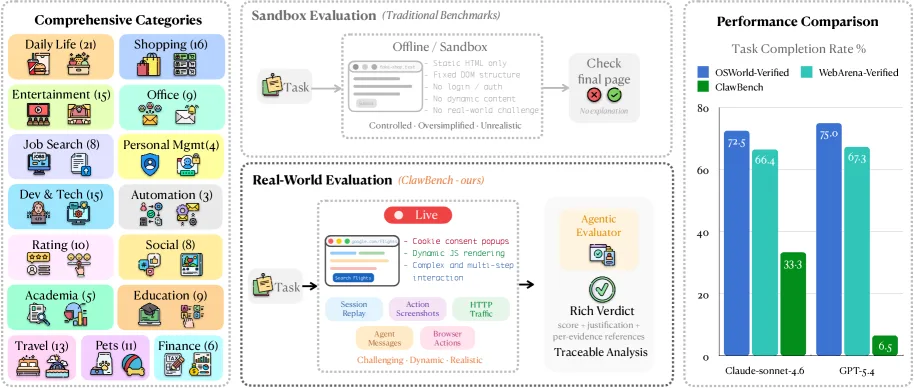
| ClawBench V2 及后续网页环境 | ClawBench 的公开预印本写的是 V1;当前仓库公开 V2 的两阶段评分与轨迹协议,但这本身不是已完成的 RL 环境实证 | 把可自托管、逐步可观测的网页任务做成安全的训练与评测边界,并保留浏览器、网络和 agent 轨迹 | “到达正确端点”与”提交正确载荷”必须分别报告;训练后只在按网站和流程隔离的任务上验收 |
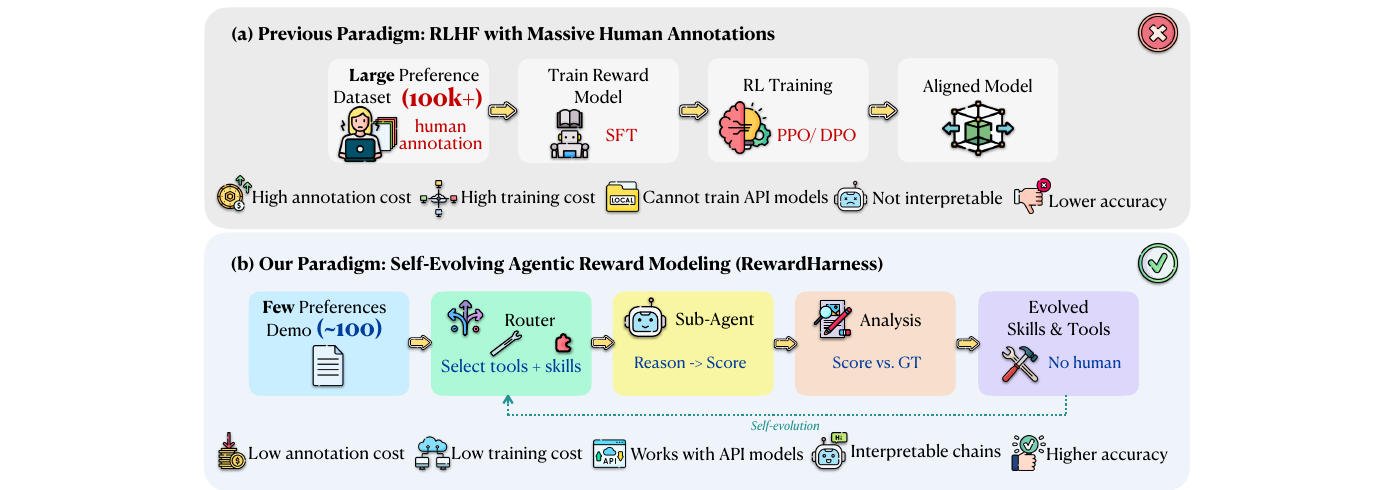
| RewardHarness → RSIBench → OpenRSI | 公开预印本 RewardHarness 在图像编辑偏好上探索 context evolution,而不是更新 reward-model 权重 | 将可审计 reward harness 的思想扩展到数学、代码与 agent 自我改进;RSIBench、OpenRSI 是工作名,不据此主张成熟公开发布 | 冻结 verifier 后,奖励机制本身的改动是否在保留任务上仍提高真实 outcome,而非仅提高 reward 或格式匹配 |
| WebsiteBench | 本文不把该名称当作已发布的 benchmark,也不主张其已有结果 | 在同一版本化网站状态下,公平比较 DOM/CDP 浏览器 agent 与截图、鼠标、键盘的 computer-use agent,并用可审计轨迹和终态验证定义任务 | 对同一任务,独立 evaluator 能否仅凭不可篡改工件复核成功;改变观察/动作接口、任务或站点时结论是否仍成立 |
IV-4. Frontier Auto Research 不只是跑得更久
“自动研究”很容易被误解成”让 agent 自己跑很久”。时长不够,也不是核心差别。autoresearch 展示受限文件面、固定实验时间和保留/回退的实验循环;AutoLab 测试固定时间内改善正确但次优的基线;MLS-Bench 测试 ML 方法机制能否跨设置成立;EdgeBench 观察长程环境反馈如何改变 best-so-far 工件。它们都重要,但测量对象不同。Frontier Auto Research 的拟议差别是任务的学术产物。
| 维度 | AutoLab / MLS-Bench / EdgeBench 分别强调什么 | Frontier Auto Research 的拟议要求 |
|---|---|---|
| 任务对象 | 已知基线的经验改进、方法级迁移或环境中的持续改善 | 一个明确的问题以及可被他人重跑和质疑的研究工件 |
| 改动面 | 任务定义的代码、方法组件或工作区 | 预先声明的代码、数据、实验与分析面;评测和保留集不可写 |
| 成功信号 | 分数、质量改进或时间曲线 | 效果量、对照、失败模式、复跑和解释是否共同支持一个窄结论 |
| 失败的价值 | 可能只是未得分 | 应留下可定位的失败谱系,避免下一个 agent 重复无信息的搜索 |
更诚实的要求是:若任务被称为研究任务,它至少应允许形成可审稿的贡献形态,包括清晰问题、可复现实验、合理对照、范围受限的结论与可检查的局限。发表仍是同行评审的决定,不是环境的奖励函数。
IV-5. 网页 Agentic RL:先保护 outcome,再讨论算法
网页 RL 有一个尖锐问题:agent 既能观察页面、生成文本、调用工具,也可能间接影响日志、缓存、表单载荷、评分提示或训练分布。一个高 reward 不足以说明用户意图被完成。ClawBench 的当前公开两阶段协议提供了直接例子:先确认最终请求被拦截,再由 judge 检查请求体是否满足指令,两个条件都为真才是成功。
| 风险面 | 可检验的防线 | 对网页环境的适用性 |
|---|---|---|
| 代理优化了 proxy,而非用户 outcome | 把 intercepted_rate 与最终 reward_rate 分开报告;配上 III-6 的四类反例 |
直接适用。拦截只是安全及意图提交证据,不是完成证明 |
| 代理或网页内容影响 evaluator | judge prompt、参考轨迹、私密规则和评分服务放在不可写且不可见边界;对 prompt injection 做对抗回归 | 直接适用。网页内容是非可信输入,浏览器 agent 已有专门的注入风险研究 BrowseSafe |
| 过程奖励被刷 | 任何中间奖励先做反例审计;未验证的过程信号作为诊断而非训练目标 | 原则直接适用;过程监督优于终局监督的实证主要来自数学推理 Let’s Verify Step by Step |
| 终局 reward 被平均归因给所有调用 | 记录决策、可见状态、工具结果和 reward 事件;比较 token / call / action 三种归因 | 网页需要新实证。Agent Lightning 的 transition 与 Polar 的 token-faithful reconstruction 是相邻起点,不是浏览器中的既有结论 |
| 训练集泄漏到 benchmark | 训练和测试按站点、工作流、帐号模板及任务语义隔离;测试任务和 judge 规则不进入合成数据或 prompt 库 | 直接适用。合成网页轨迹可用于训练,但 benchmark 须留在冻结保留集之外 |
奖励篡改的更一般形式,来自 agent 对奖励函数或奖励输入本身产生工具性影响的激励。Everitt 等人 的因果分析并非网页论文,但给出一个可移植的设计问题:策略能否通过改变”被评估的证据”而提高 reward,而不改变真实 outcome?如果答案可能是”能”,就必须让该证据通道离开 agent 的控制域。相关的失败图景亦见 Google DeepMind 关于 specification gaming 的整理。
IV-6. PPO、GRPO 与 2K 合成任务:它们是实验设计,不是结论
Polar 的公开贡献是通过 API proxy 记录 token 级模型交互,并重建与真实 harness 对齐的轨迹;其论文在软件工程 harness 中报告的是 GRPO 训练。它不等于”任何 browser harness 已可直接 RL”,也不等于 PPO 或 GRPO 在网页上已胜出。因此,ClawBench 后续 RL 的最小可信实验应从一个可证伪的矩阵开始:
| 假设 | 最小对照 | 必须同时报告 |
|---|---|---|
| GRPO 是稀疏网页 reward 的可行起点 | 同一可训练模型、harness、任务分布、rollout 预算下的冻结基线 | 每题 rollout 的 reward spread、全 0 / 全 1 group 比率、最终成功率与安全失败类别 |
| PPO 在有可信过程状态时更有帮助 | 只在过程状态与过程奖励经反例验证后,与 GRPO 比较相同预算 | critic 误差、过程 reward 与独立终局 outcome 的相关性、GPU / rollout 成本、保留任务收益 |
| 约 2K 合成实例能带来迁移 | 合成训练任务与最终评测按网站和流程隔离;加入仅 SFT、仅 RL、SFT+RL 对照 | 生成来源、过滤规则、去重、泄漏审计、对未见任务的收益与置信区间 |
PPO 的优势不能由”长轨迹”自动推出:它还需要可信 critic 和可用的中间信息。GRPO 的优势也不能由”不需要 critic”自动推出:若同一题的多个 rollout 全部失败或全部成功,组内相对信号接近零。这里的正确句子不是”PPO 可能比 GRPO 好”,而是:先度量 reward 的分辨率和 credit assignment,再让算法比较回答问题。
IV-7. 成本也是结果的一部分
长程 agent 的成本不是一个 API 单价;账本结构见 I-9。选择模型或训练方案时应报告 Pareto 曲线,而不是只给最佳分数。本文不报价具体供应商或型号;价格、可用性和限额会变化,应在每次实验的时间戳成本账本中独立固定。
IV-8. 两个值得严肃讨论的 workshop 题目
这两条是研究议程,不是活动或赞助公告。第一,Auto Research:什么 benchmark、方法和环境可以支持小时级、天级的研究循环?如何把 evaluator 冻结、保留集、证据谱系和 anti-reward-hacking 变成默认协议?”AI Research Scientist”应被分解成哪些可反驳的能力主张?第二,Agent Harness Engineering:agent 的能力不只在 prompt 中,也在 context、文件状态、工具权限、loop、并发、恢复、评测和训练接口中;我们怎样系统地设计、实现和评估通用与 coding agent 的 harness?Lilian Weng 的 Harness Engineering for Self-Improvement 把 workflow、持久状态、子任务、评测、权限和自我改进放进同一套系统视角;这里采用同样的写作原则,但把重点放在每一个循环如何留下可外部审计的证据。
IV-9. 接下来该如何证明,而不是宣告
- 先为每条研究线写一页 pre-registered task card:目标、工件、可改动面、风险动作、可见反馈、隐藏反馈、预算、保留集和终止条件。
- 建立 append-only 的实验谱系:每个 hypothesis、diff、运行环境、结果、选择或回退都具有可核验 fingerprint。
- 让 evaluator 与训练 policy 隔离:任务规则、参考轨迹、judge prompt 和最终测试位于独立访问域,并对每次版本变更做回归测试。
- 用"真实 outcome + 安全 + 成本 + 迁移"四张表报告结果;单一 reward 只能是一项诊断,不能是故事结尾。
- 把 RSI 保留为条件性的结论:只有系统改进了未来改进机制,并且这种收益在冻结、分布偏移的评测上保持,才有资格讨论经验性 RSI 证据。
第五部分 · 相邻热门方向:九条路径回到五个核心问题
V-1. 总览
路线图收束了五条主线,但 agent 研究仍很容易被热点词带着扩张:memory、multi-agent、MCP、world model、browser / computer use、self-evolving skills。它们确实重要,但不应各自变成一个没有验收边界的新项目。本部分把 36 篇论文/预印本与两份官方运行时文档压缩为九个相邻方向,并只问一个问题:它们怎样使五条核心研究线更可测、更安全,或更容易被推翻?(源计数 36 只计互不重复的 arXiv 论文/预印本;OpenAI Computer Use 与 Browser Use Terminal 是额外两份运行时文档;技能章节的 SkillRouter 与 Skill Retrieval Augmentation 是补充 routing 证据。)
| 相邻方向 | 四条锚点来源 | 可回写的核心变量 | 不能误推 |
|---|---|---|---|
| 状态与 memory | Agent Memory, MemGym, AgeMem, MAGE | 状态构造、检索、压缩、修订与恢复成本 | 有 memory 不等于具备长程能力 |
| 多 agent 协作 | SABER, NRT-Bench, MAFBench, MAESTRO | delegation、最小权限、消息/轨迹和总预算 | 更多 worker 不等于更好 |
| MCP 与工具治理 | protocol governance, execution control, threat modeling, MCP-Persona | tool contract、身份、授权、可撤销执行 | 接入协议不等于安全执行 |
| Agent 安全 | BrowseSafe, Security Considerations, AgentDyn, WASP | 非可信输入、注入、sandbox、policy interception | guard 得分不等于真实安全 |
| Browser / Computer Use | BrowserGym, OSWorld, OpenAI Computer Use, Browser Use Terminal | 观测/动作面、reset/replay、账号权限、后端验收 | 截图、点击或 URL 改变等于任务完成 |
| World model / embodied | WorldArena, WorldArena 2.0, WorldLines, LongAct | world state、交互效用、长期计划和空间/情节记忆 | 逼真画面不等于可用环境 |
| Harness 与计划 | AHE, APB, TRACE, ClawArena-Team | editable surface、过程证据、计划失败与管理权限 | outcome 分数不能归因给模型本身 |
| 大工具空间与调度 | PlanBench-XL, SAGA, Uno-Orchestra, AutomationBench | tool discovery、failure recovery、workflow cost、跨应用终态 | 更便宜的并行不等于可靠结果 |
| 持续学习与技能 | ACuRL, MUSE-Autoskill, skill-evolution survey, SkillOpt | curriculum、skill lifecycle、held-out acceptance、回归 | 自我编辑不等于 RSI |
V-2. 状态与 Memory
Agent Memory 将长程、带工具的 stateful workload 分解为构造、检索与生成阶段;MemGym 试图在深度研究、coding 与 computer use 中独立测量 memory;AgeMem 把长短期记忆操作作为可训练动作;MAGE 把执行状态组织成可增长、压缩、维护和修订的层级。回写:long-horizon harness 要把 task manifest、外部事实、候选工件、未决假设、checkpoint 与状态变更原因做成版本化对象,对每次检索、压缩或恢复报告成本;RSIBench 可把”候选改动破坏 state reconstruction”作为 regression。边界:在一个任务上检索到正确片段,不证明长期因果状态被正确维护。
V-3. 多 Agent
SABER 关注 stateful coding workspace 的 operational safety;NRT-Bench 用可回放多轮 red-teaming 考察团队风险;MAFBench 指出 orchestrator 选择会改变准确率、时延与协调;MAESTRO 导出 framework-agnostic trace 与系统信号。回写:ART 和 ClawBench V2 的 baseline 必须含单 agent、顺序多步、固定并行与 selector-driven delegation,固定总 token、wall-clock、worker-hours 和权限;每次子任务授予的读写能力、输入摘要、输出工件与 merge decision 进入 trace。边界:并行化可能只是把成本搬到更多 API 调用或更宽权限。
V-4. MCP 与 Tool Governance
Governance Gaps 讨论协议层缺失的治理原语;From Tool Connection to Execution Control 提出运行时执行控制不应被连接协议替代;Security Threat Modeling 提供协议威胁建模视角;MCP-Persona 说明工具组合可按用户/任务偏好评估。回写:environment contract 要在工具名之外声明 schema、身份、授权、幂等性、外部副作用、审计事件、撤销与错误语义;RSIBench 的候选不应拥有修改 verifier、policy 或 credential routing 的权限。边界:MCP/A2A 是互操作接口,不是 sandbox、least privilege、approval workflow 或完整审计系统。
V-5. Agent Security
BrowseSafe 研究网页内容中的 prompt injection;Security Considerations for AI Agents 将输入、模型和 sandbox 表面列为不同攻击面;AgentDyn 提供动态真实世界注入测试;WASP 在隔离环境研究 web-agent 注入攻击。回写:ClawBench V2 / WebsiteBench 应把 untrusted page、tool response、文件和任务文本分开标记,每个 task family 至少加入 III-6 的四类反例与误导性工具说明。边界:一个 guard 的检出率不等于安全,还需报告误拦截、漏拦截、性能开销、攻击分布变化与权限升级。
V-6. Browser / Computer Use
BrowserGym 将多种浏览器任务放进统一 Gym-facing interface;OSWorld 将开放式桌面任务绑定到配置过的计算机环境与可执行评测;OpenAI Computer Use 指南 将截图—动作—更新截图循环、隔离 browser/VM、高影响操作的人类确认与不可信页面输入明确为 harness 责任;Browser Use Terminal 把 profile、secrets、domain policy、可恢复 session 与 event log 暴露为浏览器 runtime。回写:task manifest 至少版本化 observation_surface、action_surface、账号与 credential scope、reset/replay tier、domain/egress policy、action receipt、sidecar evidence 与非 agent 可写的 backend postcondition。边界:截图或点击不代表后端提交,真实账号上的副作用不必然可重放。完整 substrate comparison 见 Web-Agent Environments 与 Agent Research Environments。
V-7. World Models 与 Embodied
WorldArena 提醒视觉/感知质量与实际交互效用之间可能有缺口;WorldArena 2.0 扩展到 visuotactile 与 interactive RL;WorldLines 把长期具身任务绑定到可追溯的 state、memory 与规划;LongAct 聚焦自由文本家庭任务的依赖、记忆与适应性计划。回写:合成实例不只生成任务文本,还应生成初态、可执行转移、失败分支与后验检查。边界:渲染逼真不证明环境语义、因果转移或跨分布控制有效。
V-8. Harness 与 Planning
Agentic Harness Engineering 将可编辑组件、经验摘要与决策预测组织为可证伪的 harness 演化闭环;Agent Planning Benchmark 分开测量计划、反馈条件下的重规划、噪声工具与不可解任务;TRACE 强调过程效用、evidence grounding 与所需支架强度;ClawArena-Team 将 subagent management 与 least-privilege、模态路由一起评分。回写:所有公开结果应写作 model + harness + environment + tool policy + evaluator + budget。边界:更长 prompt、更复杂 loop 或更高 outcome 都不能自动归因于”模型能力”或”真正的规划”。
V-9. 大工具空间与 Orchestration
PlanBench-XL 用大规模工具生态和故障工具测试检索、适应与恢复;SAGA 把完整 agent workflow 作为调度单位;Uno-Orchestra 研究选择性 delegation;AutomationBench 将跨应用 API 发现、政策遵循与终态写入结合为任务。回写:动作空间应包括发现、调用、验证、恢复与停止,报告 cost_per_verified_success、最坏延迟、失败后恢复、无效调用与权限升级。边界:更低延迟或更多吞吐不等于正确完成。
V-10. 持续学习与 Skill Evolution
ACuRL 将目标环境探索、curriculum task synthesis 与持续适应相连;MUSE-Autoskill 把技能创建、存储、管理、测试与修订作为生命周期;Agent Skill Evaluation and Evolution 综述执行反馈、轨迹蒸馏、压缩与 RL 等演化范式;SkillOpt 将技能文档编辑限制为由 held-out 分数接纳的变更;SkillRouter 与 SRA-Bench 将候选检索、是否需要加载与后续使用拆成不同 routing 问题。回写:”skill”要像代码一样版本化,声明输入/输出、权限、测试、适用分布、成本与过期条件;RSIBench 可把外部 skill 的 accepted/rejected edit 当作受控自改对象。边界:依赖同一 generator、task template 或 reward 的 self-edit loop 很可能只是局部拟合。
V-11. 收束为五条项目设计决策
| 研究线 | 现在应新增的设计 | 最小可推翻实验 |
|---|---|---|
| RSI / OpenRSI | 版本化 skills/harness/state,候选不能写 acceptance 或 credentials | 与无 held-out gate 的 self-edit 比较跨代收益、回归与完整性违规 |
| ART / Auto Research | 研究工件须带状态谱系、计划/证据轨、单/多 agent 同预算对照 | 同一问题比较单 agent、顺序与并行,检查可复跑结论而非文案质量 |
| Long horizon | 把状态事件、checkpoint、恢复、停止与成本当一等输出 | 故障注入后测 state reconstruction、recovery、unsafe action 与 verified success |
| ClawBench V2 / WebsiteBench | 观测与动作面、账号权限、reset/replay、工具协议、注入隔离和后端 verifier 进入环境 contract | 在 hidden injection、错误 payload、UI/后端不一致与跨接口动作上测安全和终态 |
| Synthetic training | 可执行实例+初态+转移+verifier;对 skills 做生命周期与 OOD 接纳 | 同预算 SFT、RL、SFT+RL,在按环境/规则隔离的 held-out task 上比较 |
热门方向值得做成对五条核心问题的约束和诊断,而不是同时开启九个新产品。下一轮工作应优先实现能验证上述设计决策的最小任务与反例,再决定哪一条线值得扩大为论文或训练计划。
接下来怎么看这组文章
- 环境文章:先看各类科研任务到底对什么工件、何种反馈和何种 verifier 负责。
- Agent Planning (in Long-Horizon Agents):把研究目标、假设、证据缺口、控制、预算、重规划和停止条件写成可检查的计划谱系。
- Agentic RL (in Agent Harness Engineering):再看训练时为什么必须保留真实 harness 的行为。
- 长程 Agent:把研究运行中的 checkpoint、恢复、失败和成本纳入同一条证据轨。
- RSI:最后看何时可以从"目标优化"升级到"改进改进者"的主张。
References
AutoResearch、自动实验循环与科研任务边界
- Karpathy, autoresearch;AutoLab;MLS-Bench;EdgeBench / 项目页;FML-Bench;MLAgentBench;MLGym。
- PaperBench、CORE-Bench、RExBench、ScienceAgentBench、AIRS-Bench。
- ResearchClawBench、The AI Scientist、Auto Research with Specialist Agents、AlphaEvolve。
- SciAgentArena、AutoResearchBench、ARA、SocSci-Repro-Bench、EurekAgent、Meta-Agent Challenge。
Deep Research / 文献发现 / 证据完整性
RSI 与 evaluator integrity
- Gödel Machines、Darwin Gödel Machine、Red Queen Gödel Machine、RSEA、Good, Speculations Concerning the First Ultraintelligent Machine。
- Reusable Holdout / Generalization in Adaptive Data Analysis、The Generic Holdout。
- Reward Tampering、Everitt et al., Reward Tampering Problems and Solutions、Let’s Verify Step by Step、Google DeepMind on specification gaming。
- Reward Hacking as Equilibrium、RewardHackingAgents、RSI survey、Hack-Verifiable Environments、MetaSkill-Evolve、GRASP、Reward Hacking Benchmark。
Long horizon、terminal / harness 与 planning
- Terminal-Bench 2.0 / 基准页 / 主页、TB3 contribution call、Terminal-Bench Science / 状态页、Terminal-Bench Challenges 与运行文档。
- Long-running harnesses、Task Alignment Benchmark、Polar。
- WildClawBench、AgentLAB、DeepPlanning、AMA-Bench、VLAs-as-Tools、BCER Agent、LongCLI-Bench、MAGE、Continual Learning Bench。
环境、verifier 与 web / computer 控制
- Harbor core concepts / tasks / docs、SForge / EdgeBench harness / SForge 仓库、ClawBench 仓库。
- BrowserGym(GitHub) / BrowserGym(arXiv)、WebArena、OSWorld、Browser Use Terminal、OpenAI Computer Use。
- VeriEnv、WebAgentGuard、EvoEnv、BrowseSafe、Autonomous Evaluation for CUAs、MacArena。
Agentic RL 与合成实例训练
- DeepSeekMath / GRPO、SAO、Agent Lightning、AgentTrek。
- SWE-Gym、R2E-Gym / AgentGym、SWE-smith、EnvFactory、ASTRA。
- Trajectory Diversity Scaling、RL Foundation Models、SFT Memorizes, RL Generalizes、ACuRL、Foundation World Models。
- Data Portraits、Inference-Time Decontamination、OpenAI Usage API。
研究路线图基础与披露标准
- ClawBench(V1 预印本)、V1/V2 说明、评分规范;RewardHarness、官方仓库;RSIBench 页面、openrsi 0.0.1。
- Harness Engineering for Self-Improvement、COPE 预印本指南、ACM 工件评审与徽章、ICMJE 角色与利益冲突。
相邻方向(memory、multi-agent、MCP、security、world models、harness/planning、orchestration、skills)
- Memory:Agent Memory、MemGym、AgeMem、MAGE。
- Multi-agent:SABER、NRT-Bench、MAFBench、MAESTRO。
- MCP / tools:Governance Gaps、Execution Control、Protocol Threat Modeling、MCP-Persona。
- Security:BrowseSafe、Security Considerations for AI Agents、AgentDyn、WASP。
- World models / embodied:WorldArena、WorldArena 2.0、WorldLines、LongAct。
- Harness / planning:Agentic Harness Engineering、Agent Planning Benchmark、TRACE、ClawArena-Team。
- Tools / orchestration:PlanBench-XL、SAGA、Uno-Orchestra、AutomationBench。
- Continual learning / skills:ACuRL、MUSE-Autoskill、Agent Skill Evaluation and Evolution、SkillOpt、SkillRouter、Skill Retrieval Augmentation / SRA-Bench。
AutoResearch: From a Falsifiable Research Loop to the Evidence Map
The interesting part of AutoResearch is not a claim that an agent has suddenly become a scientist. It is the discipline of turning research into an auditable loop: propose a change, run an experiment, read evaluator-owned evidence, retain or reject an artifact, and choose the next experiment. That loop is useful. By itself, however, it is neither a benchmark nor evidence of recursive self-improvement (RSI). This long note makes one continuous argument in five parts: Part I is the methodological backbone of AutoResearch; Part II is a Deep Research Agent's discovery–qualification–evidence–citation protocol; Part III converges RSI, Auto Research, long horizon, RL environments, and synthetic-instance training into one evidence map; Part IV is a research roadmap that turns project progress into auditable evidence; Part V constrains nine adjacent hot directions back to the five core questions.
Part I · AutoResearch: Turning a Research Loop into a Falsifiable System
I-1. Four Things That Must Stay Separate
| Term | What it is | What it does not establish by itself |
|---|---|---|
| Research loop | A continuing propose, implement, run, measure, and revise process | Novelty, transfer, or autonomy |
| Benchmark | A task distribution, protocol, scoring rule, and baselines | A particular agent or harness works |
| Agent harness | The execution system around the model: tools, state, permissions, budget, sandbox, logs, and evaluation hooks | Scores are caused only by model capability |
| RSI | The system improves the agent, policy, or tools that will perform later improvement | Merely improving an external target or training script |
Karpathy’s autoresearch is a clean prototype. The agent edits a constrained training script while preparation and evaluation stay frozen; short runs return a metric and the loop keeps better candidates. It demonstrates bounded empirical optimization. It does not claim cross-hardware comparability, general scientific competence, or RSI.
I-2. What Sits Between Code Editing and Research
A research loop needs answers to four questions:
- What is the intervention? Which files, hyperparameters, tool calls, or experimental designs may change?
- Where does evidence come from? Visible development metrics, a sealed verifier, physical constraints, or human feedback?
- What is retained? Only the final best artifact, or hypotheses, failed trials, and a decision lineage?
- How is local optimization ruled out? Is the evaluator frozen, and are selected results rerun on held-out seeds, settings, or an independent runtime?
Without the fourth answer, the honest label is usually “optimization of a local harness,” not research. A stronger claim puts evaluator code, data preparation, and hidden tests behind a write boundary, then reruns winners on preregistered held-out settings.
I-3. Scientific Tasks Can Measure Different Objects
| Measurement family | Representative systems | Main artifact and acceptance signal | Narrowest supported conclusion |
|---|---|---|---|
| ML-method generalization | MLS-Bench | A constrained ML-mechanism change and cross-setting results | Whether a method holds in the stated settings |
| Local experimentation loop | AutoLab, MLAgentBench, MLGym | A code/model artifact improved within budget; local or environmental feedback | Whether an agent can diagnose, edit, run, and use feedback persistently |
| Long-horizon search dynamics | EdgeBench, FML-Bench | Best-so-far artifacts, process metrics, and a fixed execution interface | How a search strategy uses feedback in a specified environment |
| Reproduction of existing work | PaperBench, CORE-Bench | Executable repository, results, and hierarchical rubric/reproduction checks | Whether an agent can reconstruct a specified part of published work |
| Hidden-target re-discovery | ResearchClawBench | Related literature, raw data, a hidden target paper, and expert weighted rubrics form a bounded research-artifact re-discovery task | A high score independently validates the target paper, is an open-ended discovery, or earns peer-review acceptance |
| Unimplemented research extension | RExBench | An extension implemented on an existing paper and codebase, accepted by execution | Whether an agent can implement a defined but previously unimplemented experiment extension |
| Data-driven discovery / full lifecycle | ScienceAgentBench, AIRS-Bench | Task-specific evaluators for data analysis, ideas, experiments, and iteration | Completion of specified research workflows on a bounded task distribution |
| Scientific-computing execution | Terminal-Bench Science | A completed scientific-computing workflow; planned deterministic pytest | Reliable completion of programmatically verifiable science tasks |
This is not a ranking of which system is “more scientific.” It first says that paths to a high score cannot borrow one another’s conclusion: reproducing a paper is not proposing a new mechanism; implementing an expert-written extension is not choosing a valuable hypothesis; and searching better in one environment is not surviving a new environment or laboratory. ResearchClawBench builds tasks from real papers, related literature, and raw data, but keeps the target paper on the evaluation side and scores research artifacts with expert rubrics. That makes re-discovery of a known target more inspectable than freely writing a report, but it is still neither an independent reproduction of the original claim nor an open-ended discovery. PaperBench notably executes the submitted codebase in a fresh GPU container, while CORE-Bench focuses on computational reproduction from supplied code and data. They make “it runs” more checkable, but they do not make the original paper automatically true or a reproduction task a scientific discovery. FML-Bench separates strategy from execution infrastructure and records process metrics, which warns against attributing a stronger harness, more parallelism, or cheaper API calls to a “better research strategy.” Terminal-Bench Science is still under construction and should not be cited as a released, complete benchmark.
I-4. Candidate Search Cannot Also Accept the Conclusion
The development phase of AutoResearch is inherently adaptive: the next hypothesis follows a previous metric, log, or failure. That is not a flaw, but it means the best candidate selected from many trials cannot be certified by the same feedback channel. Exploration and acceptance need two loops with different boundaries.
| Stage | What the agent may see or do | Objects that must stay write-protected or isolated | Evidence that must remain |
|---|---|---|---|
| Explore | Development tasks, editable surface, development data/seeds, failure logs, and bounded process feedback | Final holdout, acceptance code, private rules, and production credentials | Every hypothesis, edit, development query, outcome, and rejection reason |
| Freeze candidate | Select one candidate and submit the complete artifact | The candidate cannot change after seeing a final result | Git/artifact hash, environment and data digest, dependency lock, budget, and selection time |
| Accept | Submit the frozen candidate and receive only pre-agreed limited results | A holdout unavailable during selection, an independent verifier, and review policy | Terminal outcome, verifier version, query count, indeterminate cases, and safety failures |
| Replicate / challenge | Independent rerun, reconstruction, or counterexample | The original agent has no write access to the new run | New runtime, differences, negative results, scope revision, and whether the claim is withdrawn |
Generalization in Adaptive Data Analysis and Holdout Reuse shows that repeatedly viewing the same holdout adaptively can overfit the holdout itself; The Generic Holdout further considers separating unrestricted exploration from limited-exposure acceptance. These are conditional statistical mechanisms, not an automatic guarantee supplied by the engineering habit of hiding one test set. The acceptance protocol proposed here is therefore an auditable engineering minimum only: record development/acceptance query counts, freeze a candidate before submission, limit final feedback, and rerun it in a clean runtime. A formal generalization guarantee requires a method or fresh holdout appropriate to the task and query regime.
This gives a more honest result sentence: “A candidate selected after q development queries on D_dev was frozen as hash h; it met preregistered postconditions on selection-independent H_accept and an independent run R.” That still does not establish novelty, causal explanation, or publication, but it creates objects another reader can inspect and refute rather than merely trust as the “best run.”
I-5. Frontier Auto Research: The Deliverable Is a Reviewable Evidence Package
Frontier Auto Research (hereafter ART) is a working name here for a proposed research program, not a released team, paper, or leaderboard. It should not compete with EdgeBench, AutoLab, or MLS-Bench for the label “more research-like.” It changes a more concrete unit: a task’s deliverable is not only a score or final code, but a narrow claim and evidence package that an external reader can try to refute.
| System | Its primary deliverable | Conclusion it is best suited to support | What it does not replace |
|---|---|---|---|
| MLS-Bench | A controlled ML-mechanism change and cross-setting results | Whether a method generalizes and scales | A complete argument about an open research question |
| AutoLab | A correct baseline improved persistently under a fixed wall-clock budget | Whether an agent can diagnose, edit, and optimize empirically | Novel scientific conclusion or paper quality |
| EdgeBench | Best-so-far artifacts and curves from long-horizon environment interaction | How an agent learns from multilevel feedback | Foundation-model weight updates or RSI |
| ResearchClawBench | Hidden targets and weighted research-artifact rubrics in real-paper task packages | Whether an agent can re-discover part of a target result under declared materials and protocol | The target paper’s truth, a new discovery, or peer-review acceptance |
| Frontier Auto Research (proposed) | Problem, allowed intervention, code/data, controls, failure record, held-out replication, and bounded conclusion | Whether a research claim can be rerun, challenged, and revised | Publication guarantee, domain-value judgment, or peer review |
The question “can solving one task lead to a top-tier conference paper?” should therefore become a more honest criterion: can the task produce a minimal but complete research evidence package? It needs a clear problem, preregistered edit surface, executable artifacts, reasonable controls, negative results or failure analysis, held-out replication, and a scope-limited explanation. Publication is an external peer-review decision, not an environment reward.
This definition also avoids a false conflict with EdgeBench. EdgeBench asks how sustained interaction in real environments becomes a better artifact and learning curve. ResearchClawBench asks whether a preconstructed hidden-target task can re-discover parts of a research artifact. The proposed Frontier Auto Research question is whether one improvement supports a conclusion an independent reader would examine. They can use related harnesses while answering different questions. MLS-Bench, AutoLab, EdgeBench, and ResearchClawBench respectively provide reference points for method generalization, long-horizon closed-loop optimization, within-environment learning, and hidden-target re-discovery, not baselines that need replacing. MLS-Bench · AutoLab · EdgeBench · ResearchClawBench
I-6. A Research Card Worth Publishing
I would report a serious AutoResearch experiment with this card, not a single attractive trajectory:
| Field | What must be fixed or published |
|---|---|
| Task and artifact | Problem, editable surface, submission artifact, and write-protected components |
| Budget | Wall-clock time, GPU-hours, tokens, concurrency, and retry rules |
| Development and selection | D_dev, development-query/trial cap, visible feedback, selection rule, and rejected candidates |
| Candidate freeze | Pre-submission Git/artifact hash, environment/data digest, dependency lock, and selection time |
| Acceptance and replication | H_accept, verifier version, final-feedback policy, independent runtime, and indeterminate-case handling |
| Controls | One-shot, random-search, no-lineage, human, or established baselines |
| Lineage | Each hypothesis, change, observation, retain/reject decision, and artifact fingerprint |
| Resource ledger | Per-attempt tokens, model/tool calls, GPU or worker-hours, environment time, retries, human intervention, and cancellation reason |
The pivotal ablation removes experimental lineage while keeping model, tools, and budget fixed. Only when the advantage disappears is there evidence that the loop learned from its history rather than merely sampled a lucky candidate.
I-7. A Research Evidence Package Is Not One Log: Five Non-Interchangeable Kinds of Evidence
Generated code, a completed notebook, or a written report do not by themselves make an agent result reviewable research. Recent work sharpens the decomposition. ResearchClawBench uses hidden target papers and expert rubrics to make re-discovery of target work a scoreable research-artifact task, but its task package and rubric are a measurement protocol, not a decision about the target paper’s truth or a new discovery. SciAgentArena uses interactive, stepwise-verifiable tasks to measure well-specified scientific workflows, while reporting that current agents remain uneven on open questions and novel insight. AutoResearchBench separates literature discovery into deep target finding and broad collection. ARA extracts a workflow graph of sources, methods, experiments, and outputs from papers. SocSci-Repro-Bench explicitly separates agent failure from source materials that are themselves not reproducible.
| Evidence type | What the research agent must deliver | Narrow conclusion it supports | What it cannot replace |
|---|---|---|---|
| Literature evidence | Queries, retrieval sources, inclusion/exclusion rule, source link for each claim | Qualifying material was found and its scope can be audited | A causal conclusion or exhaustive coverage of all literature |
| Workflow evidence | Source -> method -> experiment -> output dependency graph with versions | The result-generating path can be understood or reconstructed | Materials will necessarily run in a new environment |
| Material evidence | Data, code, environment, dependencies, launch command, and executability status | Execution failure can be separated from missing or broken materials | The original paper’s conclusion is necessarily correct |
| Intervention evidence | Declared change, controls, ablations, negative results, and effect scope | A bounded change affected an outcome in declared conditions | The same effect survives unseen conditions |
| Governance evidence | Permissions, Git/artifact record, budget, human handoff, and acceptance trace | Who could change and accept what can be held accountable | The design eliminates reward hacking or human responsibility |
EurekAgent treats permissions, artifacts, budget, and human oversight as separate environment-engineering planes for research agents. Meta-Agent Challenge gives a meta-agent a sandbox, time limit, and held-out evaluation API to develop an agent artifact, with reward-hacking defenses in the framework. They support treating a research harness as an evaluable object; they do not permit a sandbox or generated agent artifact to be called verified strong RSI.
I-8. ART’s Minimum Acceptance Protocol: From Task Completion to a Reviewable Claim
Frontier Auto Research should split task completion into the following five gates. They are proposed design, not reported results from a released system.
| Gate | Minimum artifact | External acceptance question |
|---|---|---|
| Scope | Question, editable surface, literature scope, initial hypothesis, and prohibited claims | Is the question narrow enough, and can its conclusion be falsified by evidence? |
| Reconstruct | Workflow graph, data/code/environment manifest, executability label | Why can or cannot the result be reconstructed, and to whom is failure attributed? |
| Intervene | Preregistered change, baseline, controls, and ablations | Did only the target variable change, without silently changing evaluator or resources? |
| Verify | Independent or held-out rerun, negative results, resource ledger, and scope-limited explanation | Does the result survive conditions that did not select it? |
| Release | Append-only trace, artifact hashes, permission/approval record, and rollback point | Can an outside reader inspect the narrow claim rather than only trust a report? |
These gates also give safer wording. Completing a computational workflow is workflow execution. Finding qualifying papers is literature discovery. Rerunning an existing result is reproduction. Only when controls, held-out verification, and a scope explanation all hold may a report say evidence-supported empirical claim. A paper, simulated review, or one scalar score is not a substitute for those gates.
I-9. Cost Is Not a Model Price List
When a research loop uses expensive closed models, multiple workers, or a GPU cluster, cost is an experimental condition. Do not report only the selected best run, and do not treat a public price on one day as a fixed property of a model. A reliable ledger separates immutable measured usage (tokens, requests, GPU/environment time, retries, concurrency, and human minutes), period-level invoiced cost, and a dated, currency-specific price-snapshot estimate with its allocation rule and source. The official Usage API describes project-level usage primitives, but experimental reporting still has to include environments, failures, and concurrency. OpenAI Usage API
For the question whether an Opus- or GPT-class model is too expensive, the right answer is not a guessed total first. Freeze a budget and report attempts, completions and cancellations, cached and uncached tokens, model requests, browser or sandbox minutes, GPU active/reserved time, queue time, external tools, human confirmations, and total development cost for the same research conclusion. Readers can then distinguish an algorithmic gain from more parallelism, retries, or money.
I-10. When RSI Is an Appropriate Claim
RSI concerns the system that performs the next round of research, not merely the current target. A system that changes its own tool selection, context policy, search program, or agent policy, then performs better on sealed tasks it did not select against, approaches empirical evidence for RSI. Darwin Gödel Machine and AlphaEvolve are serious directions to study; their experimental results are still not a proof of unbounded recursive improvement.
I therefore use deliberately conservative labels:
- Improving an external artifact: automated target optimization.
- Reusing experimental history to improve continuously: AutoResearch / autonomous research loop.
- Improving the agent or harness that runs future loops, with gains preserved on sealed, shifted evaluations: empirical evidence for RSI.
In addition, Auto Research with Specialist Agents is a reminder to report gains from “specialist-agent division of labor” separately from simply spending more compute, which is the same discipline as the lineage ablation above.
Part II · Deep Research Agents: From Retrieval to Reviewable Claims
Part I separated exploration from acceptance; the loop’s input side—literature and web evidence—needs the same discipline. Deep Research is not “search more pages, then write a longer summary.” A reliable research agent must separately find candidate sources, verify that a source applies, extract evidence from a specific version, bind each claim to an appropriate citation, and preserve a contamination boundary between web retrieval and evaluation. The real deliverable is not a bibliography, but a set of narrow claims that can be traced, challenged, and updated. The central claim is: retrieval != qualification != evidence extraction != citation != accepted claim—doing any one well does not replace the next.
II-1. Separate Five Objects First
| Object | Question it actually answers | Minimum inspectable record | What it cannot establish automatically |
|---|---|---|---|
| Discovery | Which candidate sources may be relevant? | Query, retrieval interface, time, candidate set, and unsearched scope | A candidate qualifies or supports any later claim |
| Qualification | Does a source’s version, type, status, and setting match the question? | Authors/date/version, source location, task/data/setting, and source status | The conclusion transfers to a different setting or newer version |
| Evidence extraction | What does this part of the source actually support? | Locatable excerpt or structured fact, conditions, source hash/URL | One fact supports a stronger causal or universal conclusion |
| Citation binding | Which evidence supports this sentence? | Claim ID, source ID, support type, qualifier, and conflicting source | A bibliography covers every claim in the prose |
| Acceptance | Is the claim ready for public conclusion or a research decision? | Cross-check, counterexample/uncertainty, independent review, or frozen acceptance | A cited claim is correct, complete, or peer reviewed |
AutoResearchBench divides scientific literature discovery into two tasks: Deep Research, which traces a specific target paper through progressive probing, and Wide Research, which collects a set of papers meeting stated conditions. SAGE makes scientific retrieval a reasoning-intensive benchmark and finds that evaluated deep-research systems still struggle. Writing multiple queries therefore does not show that the retrieval process found evidence meeting a research condition; query formulation, corpus, retriever, and reranking policy are all part of the result.
II-2. A Reference List Is Not Ground Truth by Default
Literature search is often scored against a human reference list, but that does not make the list complete, unbiased, or strictly relevant to the current question. Rethinking Literature Search Evaluation argues for reporting recall, topical relevance, ranked-list diversity, and diagnostics such as co-authorship distance separately rather than treating one human list as the only truth. This does not license an agent to dismiss expert citations. It requires the system to state what it optimizes, what it misses, and which protocol decides relevance. A personal knowledge base should therefore not write “cited by a paper” as “verified.” A stronger entry separates:
- Bibliographic facts: title, authors, version, publication date, persistent URL;
- Scope facts: object of study, tasks, data, models, environment, and evaluator;
- Empirical claims: what was observed under which conditions;
- Interpretation or inference: the design implications we draw, explicitly labeled as inference;
- Conflict and unknowns: opposing evidence, missing experiments, preprint status, and items to recheck.
II-3. Build the Personal Knowledge Base from Source Cards and Claim Ledgers
A lightweight but rigorous local knowledge base does not require a complicated database. It needs traceable objects, rather than isolated summaries:
SourceCard(
  source_id, canonical_url, title, authors, source_type, status,
  version_or_date, accessed_at, scope, methods_or_interface,
  findings, limitations, quoted_or_locatable_evidence, content_digest)

ClaimRecord(
  claim_id, text, claim_type, scope, source_ids, support_type,
  uncertainty, conflicts, author_inference, last_checked_at)

ResearchDecision(
  question, alternatives, evidence_claim_ids, rejected_evidence,
  decision, rationale, owner, review_or_recheck_trigger)
support_type should at least distinguish direct finding, source metadata, implementation/documentation fact, and our inference. The last kind is valid, but must not masquerade as a paper result. For dynamic projects, version_or_date and last_checked_at are not decoration: task counts, leaderboards, APIs, and repository interfaces change.
II-4. On the Web, Content Is an Evidence Candidate, Not an Instruction
Web research creates two distinct risks. First, webpages, PDFs, search snippets, and tool output may contain untrusted or malicious instructions. They can enter the evidence-candidate channel, but cannot alter the agent’s authority, hidden rules, or evaluator. Second, a public benchmark’s questions, metadata, or answers can be retrieved at test time. Search-Time Contamination in Deep Research Agents separates benchmark-metadata, question-context, and explicit-answer leakage, and recommends isolated search, transparent trajectories, and controlled benchmark access.
| Context | What the agent may access | What must remain isolated | Evidence to retain |
|---|---|---|---|
| Open research / knowledge-base construction | Declared search sources, papers, project pages, and readable web pages | Authority escalation, private credentials, undeclared automatic submission | Query, URL, version/time, excerpt, rejected sources, and source card |
| Public benchmark evaluation | A pre-approved closed corpus or controlled search proxy | Benchmark name, question, answers, metadata, and evaluator implementation | Allow/block policy, complete access trace, contamination hit type, and rerun configuration |
| Final research acceptance | Frozen candidate and preregistered verification sources | Development-selected hidden holdout and authority to approve conclusions | Claim ledger, independent review, counterexamples, resource ledger, and accept/reject decision |
Web retrieval also does not make one-agent systems automatically preferable. AgentWebBench treats coordination between a user agent and website content agents as its own problem and separately observes retrieval, synthesis, and interaction reliability. The direct lesson for multi-agent research is that workers can widen query coverage, but each worker’s sources, authority, deduplication, conflicts, and merge rule still belong in the evidence ledger.
II-5. A Deep Research Protocol That Can Fail
The table below is a minimum protocol for personal research, ART’s literature phase, or a future benchmark. It is a design proposed here, not a result claim about an existing system.
| Stage | Object to freeze or disclose | Baselines to compare | Failure or rejection signal |
|---|---|---|---|
| Question | Inclusion/exclusion conditions, time window, source types, and required claim type | One query, manual keywords, or fixed retriever | The question has no decidable scope, or conditions change after results appear |
| Discover | Corpus/search policy, query budget, retrieval trace, and deduplication rule | Keyword-only, citation expansion, agentic search | Known high-quality sources are missed, or only one community/template is retrieved |
| Qualify | Version, experimental setting, evidence location, and source status | Title/abstract screen versus full-text verification | The paper does not support the object, condition, or version, or status is unknown |
| Bind | Claim-to-source mapping, support type, counterexamples, and uncertainty | Bibliography-only versus claim ledger | One source supports a claim beyond its scope |
| Accept | Independent sampling review, citation coverage, contamination audit, and recheck trigger | Agent self-review versus external review/frozen rule | Evidence is not locatable, conflict is hidden, evaluation search leaks, or work cannot be replayed |
Metrics should remain separate as well: discovery recall/coverage, qualification precision, claim-level citation entailment, citation diversity, duplication/conflict rate, contamination-hit rate, and time/cost per acceptable claim. No single score establishes that a system “researches well.”
II-6. Toward the Five Core Threads
| Research line | What Deep Research should contribute | What it cannot replace |
|---|---|---|
| Auto Research / ART | Question, evidence graph, reviewable premises, claim ledger, and recheck trigger | Controlled experiments, reruns, causal explanation, or peer review |
| RSI / OpenRSI | Which external evidence a candidate edit used, and source/evaluation boundaries the candidate cannot write | Cross-generation improvement, independent held-out gain, and safe rollback |
| Long horizon | Recoverable reading/retrieval state, read versions, unresolved conflicts, and budget ledger | Terminal correctness and recovery of an hours-long service |
| Environment / WebsiteBench | Controlled search corpus, webpage trust labels, injection/contamination counterexamples, and access traces | Backend postconditions, action safety, or general Browser Use ability |
| Synthetic training | Training-source lineage, blocked domains, answer/question similarity audits, and split provenance | SFT/RL transfer evidence on unseen environments |
The smallest practical conclusion is simple: turn every important sentence into a ClaimRecord with a source, scope, status, and recheck time before deciding it belongs in a post, research design, or training data. Then the knowledge base is not a warehouse of links. It is an evidence system that can support the next retrieval, refutation, and experimental decision.
Part III · Research Agenda: Five Threads and the Evidence Map
Parts I and II fixed the discipline of the experiment loop and of retrieval; this part converges the program into five distinct, rejectable artifacts: controlled self-improvement (RSI), reproducible research artifacts (Auto Research), recoverable long-horizon execution, auditable environments and evaluators, and synthetic training experience that transfers to unseen work. A credible research-agent program must state what each layer owns; a positive result in one layer cannot vouch for another. The tables below bind each primary source to the narrowest conclusion and boundary it directly supports.
III-1. One Program, Five Non-Interchangeable Layers
| Layer | Question it answers | Its actual output | Constraint it places on the next layer |
|---|---|---|---|
| RSI | Does the improvement process itself improve across generations? | Versioned candidates, independent acceptance, rollback, and a cross-generation curve | The candidate cannot write the acceptance gate or its evidence channel |
| Auto Research | Does the system form a reviewable empirical conclusion? | Research question, artifact, controls, reruns, limits, and cost ledger | Generated prose or a local metric is not a scientific conclusion |
| Long horizon | Can hours of work persist, recover, and retain the right state? | Durable state, checkpoints, recovery records, time and failure traces | More tokens or one demo is not long-horizon capability |
| Environment | Are reward, action, initial state, and verification actually controlled? | Reset, authority, independent judging, evidence trails, adversarial regressions | A container, an LLM judge, or a screenshot alone is not an outcome |
| Synthetic training | Does learned experience transfer to unseen work? | Provenanced instances/trajectories, filtering, recipe, held-out gains | Training data, teacher, and evaluator cannot share an answer key |
This also answers the division of work. Frontier Auto Research / ART belongs to the research-artifact layer. ClawBench V2 and WebsiteBench belong to the environment layer. RewardHarness -> RSIBench -> OpenRSI belongs to the candidate-change and acceptance layer. Synthetic instances and agentic RL form a cross-cutting training layer. A long-horizon harness runs through every system that needs multi-stage work. The threads are dependencies, not a ranking: the environment fixes observation, action, and a credible reward; a long-horizon harness determines whether an agent can actually use that feedback; synthetic data and RL determine which experience reaches a model; Auto Research determines whether the improved external object can support a research conclusion; RSI then asks whether the improver itself became better under strict conditions.
III-2. Enter from the Matching Guide: Five Threads and Adjacent Directions
| The question you actually want to study | Companion guide | Boundary to carry forward |
|---|---|---|
| Who improves whom, and who controls acceptance? | RSI | A candidate may modify; it cannot control acceptance. Measure improvement operator, selection, transfer, and integrity separately. |
| How can a research conclusion be reproducible, falsifiable, and auditable? | Part I of this post · AutoResearch | Development search, candidate freezing, independent acceptance, and reruns; an improved artifact is neither automatic publication nor RSI. |
| How can web and literature retrieval become a reviewable research premise? | Part II of this post · Deep Research Agents | Keep discovery, qualification, evidence extraction, claim-citation binding, and acceptance as traceable objects; keep open-research and evaluation retrieval separate. |
| How can work lasting hours or days persist, reconstruct state, and recover? | Long-horizon agents | Name the task envelope and active/wait/recovery/human time first; more context does not replace a native harness and recoverable state. |
| How can plan, execution, replanning, refusal, and terminal acceptance be distinguished? | Agent Planning (in Long-Horizon Agents) | Plan text, a successful tool call, or a process score is not a correct global terminal state. |
| How can agent memory be recoverable, split-isolated, and kept within safety boundaries? | Agent Memory (in Long-Horizon Agents) | A longer context, similarity retrieval, or successful summary is not correct execution state. |
| How should an environment define authority, reset, verifier, and reward boundaries? | Agent Research Environments | Separate observe/propose/intercept/commit/evidence/verify; a container or verifier does not make reward unhackable. |
| How can reward, evidence, verifier, judge, and acceptance avoid impersonating one another? | Evaluation Integrity (in Web-Agent Environments) | High reward, a successful endpoint, a complete trace, or judge preference is not completion of the user goal. |
| How should MCP and browser/computer tool side effects be controlled? | Tool Governance (in Web-Agent Environments) | Connection, a token, a screenshot, and tool success are not independent acceptance. |
| How can we show that multi-agent delegation and parallelism have net benefit? | Multi-Agent Systems (in Web-Agent Environments) | More workers, roles, or messages are not automatically faster, more reliable, or safer. |
| How can skills evolve without contaminating acceptance or safety boundaries? | Agent Skills (in RSI) | SKILL.md, one edit, or a larger library is not RSI. |
| How can a world model become a trainable, acceptable environment? | World Models (in Agent Research Environments) | Plausible frames, smooth video, or an action success do not make a state transition or terminal outcome correct. |
| How can synthetic instances train a foundation model without contaminating evaluation? | Synthetic Agent Training (in Agent Research Environments) | Instance admission and training-result acceptance must be separate; count is not effective coverage or held-out transfer. |
| Which companion post covers training through a real harness? | Agentic RL (in Agent Harness Engineering) | The training interface should preserve token trajectories and attribution design; coding-harness gains cannot be carried over to GUI/browser. |
| Which adjacent directions deserve attention without borrowing claims from the core five? | Part V of this post · Adjacent directions | Memory, multi-agent systems, MCP, Browser/Computer Use, security, world models, harness/planning, orchestration, and skill evolution all need their own evaluation objects. |
III-3. RSI: A Candidate May Modify; the Acceptance Gate May Not Be Candidate-Controlled
| Primary source | Narrowest usable conclusion | Boundary / project implication |
|---|---|---|
| Gödel Machines | A formal model binds self-modification to proofs of utility under explicit axioms | A deployed agent does not have that global guarantee |
| Darwin Gödel Machine | Iterated scaffold/code changes can be validated on external coding benchmarks | Finite benchmark gains are not unbounded RSI |
| Red Queen Gödel Machine | Evaluators/utilities can evolve by epochs and must be versioned | Co-evolution does not automatically remove evaluator overfitting |
| RSEA | Improvement operator, selection, transfer, and integrity can be formalized and falsified separately | One best-score lineage is not recursive self-improvement |
| Reusable Holdout | Repeated adaptive access to a holdout can distort inference; reuse needs controls | One hidden test set is not safe to use indefinitely |
| Generic Holdout | Limiting what a searcher learns from a holdout is another route against false discovery | Pass/fail disclosure does not solve every adaptive problem |
| Reward Tampering | If a system can influence its reward channel, the score becomes an attack surface | Isolation does not automatically fully solve tampering risk |
| Reward Hacking as Equilibrium | Finite evaluator coverage structurally leaves quality dimensions unoptimized (theoretical modeling) | Do not add only one aggregate score; enumerate unmeasured dimensions and counterexamples |
| RewardHackingAgents | Evaluator tampering and train/test leakage can be engineered as observable outcomes | RSIBench should report integrity failures separately from task success |
| RSI survey | What changes and how closed the loop is separates self-refine/-train/-evaluate and research loops | State the editable object and human/external acceptance boundary |
| Hack-Verifiable Environments | Environments can contain deterministically detectable hacking opportunities | Every new task family needs anti-gaming regression cases |
| MetaSkill-Evolve | A frozen-backbone experiment can evolve task skills and an improvement meta-skill together | Bounded empirical evidence, not proof of general strong RSI |
| GRASP | Skill-library candidates can be admitted with a balanced holdout and hard regression budget | The acceptance gate, regression budget, and rejected candidates must be first-class artifacts |
| Good, Speculations | The ultraintelligence argument is a conditional inference | A conditional argument is not an empirical guarantee for a deployed system |
Convergence for RSIBench / OpenRSI. A candidate may write only to a declared editable surface; development metrics, the hidden acceptance evaluator, permission policy, logs, and the release decision live in another write-authority domain. A multi-generation curve fixes a resource policy and reports rejected changes and rollbacks. Report candidate_gain, acceptance_gain, heldout_gain, regression_rate, and integrity_violations separately, plus four independent curves: improvement operator, selection/acceptance, transfer/persistence, and integrity/reversibility. Only the final two together justify discussing an “improver that improves.” Without them, “self-optimization experiment” or “harness search” is more accurate than RSI.
III-4. Auto Research: Improving a Research Artifact Is Not Automatic Science
| Primary source | Narrowest usable conclusion | Boundary / project implication |
|---|---|---|
| autoresearch | A bounded experiment loop can bind edits, runs, metrics, and a best-so-far artifact | A local gain is not a new method or scientific discovery |
| AutoLab | Correct but suboptimal artifacts can be persistently optimized under a fixed wall-clock budget | A better external artifact is not agent or model RSI |
| MLS-Bench | ML-method candidates can be required to validate across controlled settings and scales | Engineering tuning is not a generalizable new method |
| EdgeBench | Best-so-far artifacts and learning curves can be studied under long-horizon interaction | A within-run curve does not mean foundation-model weights changed |
| The AI Scientist | Ideas, experiments, writing, and automated review can be connected in one workflow | Passing an automated reviewer is not peer-review acceptance |
| ResearchClawBench | Related literature and raw data can be packaged into bounded hidden-target re-discovery tasks | A high rubric score is not an open-ended discovery or independent validation |
| SciAgentArena | Real scientific settings can become interactive, stepwise-verifiable tasks | Open insight remains difficult; ART must separate workflow execution from a novelty claim |
| AutoResearchBench | Deep target-paper retrieval and broad collection are measurable capabilities | Literature evidence needs recall/precision and a source chain |
| ARA | Sources/methods/experiments/outputs can be extracted into a reconstructable workflow graph | ART artifacts should expose dependencies and result-generation paths |
| SocSci-Repro-Bench | Reproduction tasks should distinguish agent failure from non-reproducible materials | Each ART task needs a material-runnability label and failure attribution |
| EurekAgent | Permissions/artifacts/budget/human oversight are independent engineering planes | ART must declare authority, Git artifacts, budget, and human intervention points |
| Meta-Agent Challenge | An agent developing another agent can be evaluated with a held-out API and anti-hacking controls | “An agent improves an agent” must evaluate the final artifact, not the narrative |
Convergence for ART. Frontier Auto Research should not compete with AutoLab by “optimizing longer,” with MLS-Bench by “having more method tasks,” or with EdgeBench by “having a longer environment.” Its unit of contribution is a minimum research package: problem and assumptions; runnable baseline; declared editable surface; experiment graph; strong controls; negative results; rerun script; data/code versions; cost ledger; and one narrow conclusion supported by held-out or fresh settings. It may produce a paper candidate; novelty and field value remain decisions of peer review.
III-5. Long Horizon: State, Recovery, Planning, and Safe Degradation
| Primary source | Narrowest usable conclusion | Boundary / project implication |
|---|---|---|
| Terminal-Bench 2.0 | End states of realistic terminal workflows can be verified with human-written tests | A passing end state is not open-ended research ability |
| TB3 contribution call | TB3 is an in-development plan for a harder terminal benchmark | A target task count or solve rate is not a released result |
| Terminal-Bench Science | Real computational-science workflows can become containerized, programmatically verified tasks | Deterministic completion is not proposing a hypothesis |
| Long-running harnesses | A feature list, progress file, tests, bootstrap script, and version control help a fresh session reconstruct work | Context compaction alone is not reliable long-running work |
| Task Alignment Benchmark | Long-running terminal agents must selectively use environmental cues | High completion is not safe treatment of environmental instructions |
| Polar | Native-harness API traffic can be recorded as token-faithful traces, with async rollouts | Not every harness integrates without changes, nor is session reward already attributed |
| WildClawBench | Native CLI harnesses, real tools, and hybrid grading substantially change long-run evaluation | Report the model-harness-evaluator configuration, not a model name alone |
| AgentLAB | Memory poisoning and objective drift can be measured separately in long-horizon environments | Long-horizon success needs a safety-failure rate beside it |
| DeepPlanning | Active information gathering plus global time/budget constraints differs from local step reasoning | Tasks should include global constraints, not only decomposed steps |
| AMA-Bench | Agent memory is a machine-generated interaction stream, not just dialogue QA | State stores need causality, goals, and external facts |
| VLAs-as-Tools | Long-horizon control can combine high-level planning, bounded tools, progress feedback, and replanning | The harness should expose verifiable subtask state and recovery events |
| BCER Agent | Artifact binding and bounded local recovery can make long chains traceable | Every recovery should bind inputs, tool version, outputs, and blast radius |
| LongCLI-Bench | Long CLI tasks should separate requirement fulfilment from regression avoidance | A single pass rate hides regression risk |
| MAGE | Execution state can be organized as a growing, compressing, maintaining, and revising hierarchy | Similarity retrieval is not correctly maintained causal long-term state |
| Continual Learning Bench | Task sequences can share discoverable structure; sequential_gain separates experience gain from initial capability |
State recovery or a later gain does not prove a weight update or general continual learning |
Long-horizon harness acceptance. Preserve a task manifest, initial-state hash, progress ledger, checkpoints, tool/model/environment versions, recovery causes, retries, human takeovers, and final evaluator record. The core metrics are not one pass rate but outcome, recovery_success, state_reconstruction, unsafe_action_rate, cost_per_success, and time_to_stable_artifact. Terminal-Bench’s home, TB2 benchmark page, TB3 status, TB Science status, plus Terminal-Bench Challenges and its run guidance should be read by their released status: beyond final-state verification, the process remains diagnostic and reproducibility evidence, not disposable noise.
III-6. Environment: Before Training, Give Reward an Auditable Origin
| Primary source | Narrowest usable conclusion | Boundary / project implication |
|---|---|---|
| Harbor core concepts | Tasks, datasets, agents, and container environments can have separate versioned contracts | One task format does not guarantee every implementation is comparable |
| Harbor task structure | An agent workspace and a separate verifier can be split, with logs as analysis artifacts | A separate verifier does not automatically cover every side channel |
| SForge / EdgeBench harness | Work/judge containers, a host-side judge, async submission, and recovery can support day-scale runs | A hidden judge does not remove reward hacking or overfitting |
| BrowserGym | A Gym-like browser interface can unify multiple web-agent benchmarks | Browser reset does not automatically reset remote services, accounts, or business state |
| WebArena | Self-hosted functional web applications can define realistic web tasks and postconditions | Not any live website can be evaluated with the same reproducibility |
| Browser Use Terminal | Browser runtimes have their own session, action, and tool semantics | A browser action or screenshot does not prove a server-side transaction completed |
| OpenAI Computer Use | General computer use must run through a continuous app/API loop with safety boundaries | A visual end state is not itself a business outcome |
| VeriEnv | Recreated websites plus an internal SDK can yield executable, verifiable synthetic environments | A self-hosted site still needs cloned-semantics checks and transfer to unseen sites |
| WebAgentGuard | Prompt-injection detection can be decoupled into a guard separate from the acting agent | Evaluate false blocks, latency, and unseen attack styles too |
| EvoEnv | Environments need solve–verify asymmetry to keep rewards informative | A generator must not let the policy simulate or tamper with its oracle in language |
| BrowseSafe | Realistic HTML injections can change browser-agent actions, not just text output | Page content is untrusted input; it cannot see privileged or judge context |
| Autonomous Evaluation for CUAs | A GUI visual evaluator can be a noisy reward if that noise is explicitly corrected | A raw LLM/VLM judge is not ground truth |
| MacArena | Cross-platform distributions can invert agent rankings; macOS-native and ported tasks differ | WebsiteBench should report platform, UI interface, and distribution separately |
| OSWorld | VM snapshots, execution-based evaluation, and multiple interfaces can define computer-use environments | Screenshot success does not replace file, cookie, server, or business postconditions |
| Reward Hacking Benchmark | Known shortcuts can be measured separately inside an environment | A lower exploit rate does not prove safety |
Convergence for ClawBench V2 / WebsiteBench. Write five planes as versioned contracts: reset (backend, identity, browser/VM state); observe (DOM/CDP, a11y, screenshot, or terminal); act (authority, egress, intercepted commit surface); verify (independent judge and hidden rules); and evidence (append-only traces, artifact hashes, network/request records). For every reward, include at least four counterexamples: right endpoint/wrong payload; injected page text; plausible screenshot/no server submission; and missing or reordered trace evidence. SForge’s work/judge separation (SForge repo, Harbor docs, ClawBench repo) is an isolation pattern worth studying, not proof that isolation has been solved. Interception controls only its declared browser/CDP/proxy plane and cannot claim every OS or network side channel.
III-7. Synthetic Instances and Foundation-Model Training: Scale Is Not Evidence, Extrapolation Is
| Primary source | Narrowest usable conclusion | Boundary / project implication |
|---|---|---|
| AgentTrek | Tutorial-guided replay plus execution verification can synthesize GUI-agent trajectories | Synthetic trajectories are not online RL, nor may they train final benchmark tasks |
| Agent Lightning | A common data interface can connect complex agent execution to RL credit assignment | A transition schema does not automatically assign correct long-horizon credit |
| SWE-Gym | Real SWE environments, agents/verifiers, and trajectories can be used together for training | Gains in one coding environment do not transfer to browser/computer environments |
| R2E-Gym / AgentGym | Commits, test generation, and back-translation can scale executable training instances | More scale does not necessarily mean more realism, diversity, or no leakage |
| SWE-smith | Synthesizing instances that break existing tests is a scalable data route | Passing original tests does not remove source or benchmark-overlap risk |
| Data Portraits | Training-data membership records can support later leakage and overlap audits | Metadata alone does not make a training set fair or lawful |
| Inference-Time Decontamination | A leaked benchmark can sometimes be re-evaluated through detection and rewriting | Post-hoc rewriting does not replace pre-training lineage or a sealed holdout |
| Trajectory Diversity Scaling | Under a fixed budget, trajectory diversity can be more useful than raw quantity | A 2K target must report diversity, duplication, and long-tail coverage |
| RL Foundation Models | A synthetic MDP prior can train in-context adaptation on held-out tabular tasks | Publish the prior; do not infer transfer to web/GUI agents |
| EnvFactory | Executable tool environments and natural multi-turn trajectories can be synthesized together | Retain source, verifier, and split for every generation claim |
| ASTRA | Tool-call topology can support structured trajectory synthesis and rule-verifiable multi-turn RL | Trajectory-level reward still needs independent outcome audits of credit |
| SFT Memorizes, RL Generalizes | In controlled text/vision studies, SFT and outcome RL differ in extrapolation; SFT can stabilize RL | Not a browser-RL result or an algorithm verdict for all distributions |
| ACuRL | Target-environment experience can drive curriculum-task synthesis and continual adaptation | Target-environment data must stay isolated from final evaluation |
| Foundation World Models | A foundation-world-model agenda joins specifications, verification, calibration, and test-time synthesis | An architectural vision, not a released training result or safety guarantee |
Convergence for training. “2K synthetic instances” is only a falsifiable scale hypothesis. Before training, record provenance: source, license, PII review, generator/checkpoint, templates, and environment image. During training, compare SFT-only, RL-only, SFT+RL, and frozen-base baselines. After training, accept only on tasks split away by website, workflow, account template, semantics, and evaluator rules. Report accepted/rejected trajectories, deduplication, difficulty/diversity, reward distribution, tokens, GPUs, sandboxes, APIs, wall clock, and human review. Without that, “synthetic instances improved a foundation model” has no auditable object.
III-8. Choose the Question Before the Evidence
This map does not rank “who is best.” It routes by question first, then binds each link to the one cell it directly supports.
| The real question | Read first | What it most directly supports | What it should not be used to infer |
|---|---|---|---|
| Can an agent propose ML methods that generalize and scale? | MLS-Bench | Candidate methods can be required to validate across controlled settings and scales | Solving some tasks is open-ended scientific discovery |
| Can a system persistently improve a correct but suboptimal artifact under a fixed budget? | AutoLab, the autoresearch repo | Diagnose, edit, run, and retain a best-so-far artifact as a measurable loop | A better external artifact means the agent or model underwent RSI |
| How can literature and web search become an auditable research premise? | AutoResearchBench, SAGE, Search-Time Contamination, Rethinking Literature Search Evaluation | Discovery, source qualification, locatable evidence, and citation binding can be separate records | A bibliography, fluent report, or high retrieval score proves source coverage or a correct conclusion |
| Can an agent exhibit a learning curve under long-horizon environment feedback? | EdgeBench | Within-run environment-learning trajectories can be defined and measured | The base-model weights changed |
| Can an agent complete verifiable terminal or scientific workflows? | Terminal-Bench 2.0, TB3 status, Terminal-Bench Science | End-to-end final states can be programmatically tested | Passing an endpoint test means proposing a hypothesis or doing open-ended science |
| How can tasks, containers, verifiers, and rollouts have a clear contract? | Harbor task docs, SForge, Reward Hacking Benchmark | Workspaces and judges can be separated, task interfaces versioned, and known shortcuts measured | A container or verifier automatically eliminates reward hacking |
| How should a web or computer agent’s actions and evidence be controlled? | BrowserGym, OSWorld, Browser Use, OpenAI Computer Use | Browser and general-computer agents have distinct observation, action, and isolation interfaces | A click, screenshot, or DOM match necessarily means a server-side task completed |
| How can an agent be trained through its real harness? | Polar, Agent Lightning, DeepSeekMath / GRPO, SAO | Token trajectories, attribution interfaces, and objectives can be designed explicitly | Coding-harness results auto-transfer to GUI/browser RL, or one async preprint settles a universal PPO/GRPO ranking |
| How can a long-horizon agent persist and recover after interruption? | WildClawBench, AMA-Bench, DeepPlanning | Native harnesses, state reconstruction, planning, and recovery should be evaluated separately | More context, more calls, or one final score explains long-horizon ability |
| How can we show an agent learns from sequential experience rather than only recovering state? | Continual Learning Bench | Task sequences can share discoverable structure; a gain metric separates experience gain from initial capability | Memory or a later gain alone proves a weight update, general continual learning, or RSI |
| How can synthetic instances enter training without contaminating evaluation? | SWE-Gym, R2E-Gym, EnvFactory, TDScaling, SFT vs. RL | Executable instances, admission, result acceptance, trajectory diversity, and SFT/RL config are independent variables | More data, teacher success, or training reward alone proves held-out transfer |
| When may we discuss RSI? | Gödel Machine, Darwin Gödel Machine, RSEA, Reusable Holdout | Cross-generation, independent, equal-resource claims plus improvement-operator, selection, transfer, and integrity can be formalized and falsified | One self-edit, local gain, or best-score lineage is recursive self-improvement |
III-9. Turn Project Differences into Testable Designs
Per-project core objects and decisive tests are given in the project map of IV-3. That table deliberately has no “best model” column. Compare task distribution, execution interface, hidden information, reward, resource budget, training status, and evaluation split before comparing scores; without those conditions, environment differences become falsely reported as model differences.
III-10. A Reusable Citation and Reporting Protocol
Every research note or blog conclusion should carry these labels:
- Source type: classic theory, peer-reviewed / preprint, official documentation, implementation, or future-work proposal.
- Object: external artifact, policy, harness, environment, verifier, evaluator, or the mechanism that improves them.
- Evidence form: theorem, controlled experiment, runtime interface, task specification, or design recommendation.
- Boundary: model, task, harness, budget, data/split, version, and access authority.
- Falsifier: what observation weakens the claim, such as changing the verifier or task distribution, a gain vanishing at equal budget, or the evaluator being contaminated.
For literature and web research, also retain a SourceCard and a ClaimRecord (schema in Part II). For entry points into the companion posts, see the table in III-2.
Part IV · Research Roadmap: Making Agent Progress Auditable
The evidence map settles what to believe; the remaining question is what to build. A worthwhile agent-research program is not a collection of benchmark names or one attractive demo. It must answer a harder question: what did a system actually change, why should we believe the change helped, and how do we know it did not merely learn to influence the evaluator? This part places Frontier Auto Research, ClawBench, RewardHarness, RSIBench / OpenRSI, and WebsiteBench on one map. The unifying aim is research-agent systems that preserve evidence, admit refutation, and learn safely.
IV-1. Separate Nine Kinds of Claims First
Research blogs become unreliable when preprints, code, internal plans, and intuitions are written in the same voice. I use nine labels rather than collapsing them into “progress.” This taxonomy adapts COPE’s guidance on preprint transparency, ACM’s distinction between available artifacts and validated results, and ICMJE’s principle of disclosing direct support and a sponsor’s role.
| Label | What it can say here | What it cannot say here |
|---|---|---|
| Peer-reviewed paper | Its paper version, publication venue, and conclusions within the documented scope | That an unreported experiment, code revision, or later plan inherits the paper’s authority |
| Public preprint | The archived version and the authors’ reported method and experiments | That it is “published” or has passed peer review |
| Public code / data | Its access point, version, license, and runnable scope | That downloadability establishes an independently validated result |
| Work-in-progress design | An intended environment boundary, interface, or acceptance criterion | A metric, scale, compatibility guarantee, or research finding not yet obtained |
| Research hypothesis | A causal conjecture that requires an ablation, such as when PPO or GRPO may fit | That “might help” has already become “works better” |
| Internal working name | A label the team currently uses to organize a research line | That the name is a released team, product, paper, or leaderboard |
| Research position | Why a problem and its evidence standard are worth choosing | Claims about another project’s performance, motivation, or limitation without a common experiment |
| Workshop concept | A topic, scientific question, and discussion the organizers would like to convene | That an event is accepted, has a public CFP, or has a fixed schedule |
| Sponsorship / collaboration | Direct support, collaborators, and roles that are both confirmed and cleared for public disclosure | Announcing an intention, treating institutional proximity as funding, or implying endorsement of results |
Pre-publication check: attach an accessible primary-source link to every statement that already happened, recording version, date, and scope; every result sentence should point to a table, run, or public artifact, otherwise write an observation or pending validation; mark internal names as working labels at first use and invent no team, leaderboard, user count, compatibility guarantee, or submission status; an algorithm comparison must state the fixed model, harness, data split, budget, seeds, and metrics; describe a workshop only as a theme or proposal unless a public CFP exists; name a collaborator or sponsor only when confirmed, disclosing the funder’s role and restrictions; check permissions, de-identification, and provenance for every external figure, screenshot, trajectory, and live-web datum; and fact-read the Chinese and English versions separately so numbers, status words, qualifications, and negations are semantically equivalent.
IV-2. One Spine: Action, Learning, and Evidence
I divide a research agent into three mutually constraining layers: action environment (an agent produces a deliverable artifact in a terminal, browser, or computer interface; irreversible actions need explicit safety boundaries); learning and harness (the model, context, tools, memory, and control loop jointly determine actual behavior, and training should not reduce the deployed harness to a different one-turn prompt); and evidence and evaluator (evaluation, logs, held-out data, reruns, and a cost ledger must sit outside the agent’s write boundary). The unit of work is therefore not “an agent completed a task,” but an evidence package: problem, permitted interventions, artifact, evaluator version, complete lineage, held-out evaluation, and resource ledger. Without these seven pieces, a result can guide debugging, but not sustain a research conclusion.
IV-3. Project Map: Public Foundations, Working Goals, Decisive Tests
| Research line | Public foundation | Goal described here | The test that would decide it |
|---|---|---|---|
| Frontier Auto Research / ART | autoresearch, AutoLab, MLS-Bench, and EdgeBench provide concrete paradigms for automated experiments, method transfer, and long-horizon feedback | Define a task by a publishable research artifact rather than one score: runnable code, clear comparison, failed attempts, and a testable explanation | With evaluator and budget fixed, does improvement survive on settings, seeds, or tasks that did not select it; can an independent run reconstruct the conclusion? |
| ClawBench V2 and successor web environments | The public ClawBench preprint covers V1; the current repository publishes V2’s two-stage scoring and trace protocol, which is not by itself evidence of a completed RL environment | Make self-hostable, step-observable web tasks a safe boundary for training and evaluation while preserving browser, network, and agent traces | “Reached the right endpoint” and “submitted the right payload” must be reported separately; post-training acceptance uses tasks isolated by website and workflow |
| RewardHarness → RSIBench → OpenRSI | The public preprint RewardHarness studies context evolution rather than reward-model weight updates for image-editing preferences | Extend the idea of an auditable reward harness to math, code, and agent self-improvement; RSIBench and OpenRSI are working names and do not by themselves claim a mature public release | With a frozen verifier, do changes to the reward mechanism still improve true outcomes on held-out tasks rather than only reward or format match? |
| WebsiteBench | This post does not treat this name as a released benchmark or claim existing results for it | Under one versioned website state, compare DOM/CDP browser agents fairly with screenshot, mouse, and keyboard computer-use agents, using auditable traces and end-state verification | Can an independent evaluator reproduce success from tamper-resistant artifacts alone, and does the conclusion survive a changed observation/action interface, task, or site? |
IV-4. Frontier Auto Research Is Not a Longer Run
“Automated research” is easily mistaken for “letting an agent run for a long time.” Duration is not enough, nor is it the key distinction. autoresearch demonstrates a constrained editable surface, fixed experiment duration, and keep-or-revert loop. AutoLab measures improvement of a correct but suboptimal baseline within a time budget. MLS-Bench measures whether an ML-method mechanism transfers across settings. EdgeBench studies how long-horizon environmental feedback changes a best-so-far artifact. All matter, but they measure different objects. The proposed distinction for Frontier Auto Research is the scholarly product of a task.
| Dimension | What AutoLab / MLS-Bench / EdgeBench respectively emphasize | Proposed Frontier Auto Research requirement |
|---|---|---|
| Task object | Empirical improvement of a known baseline, method-level transfer, or persistent improvement in an environment | A clear question and a research artifact that another person can rerun and challenge |
| Editable surface | Task-defined code, method component, or workspace | Predeclared code, data, experiment, and analysis surfaces; evaluator and held-out split are not writable |
| Success signal | A score, quality change, or time curve | Whether effect size, controls, failure modes, reruns, and explanation jointly support a narrow claim |
| Value of a failure | Potentially just a non-score | A localizable failure lineage that prevents a future agent from repeating uninformative search |
The honest requirement is narrower: if a task is called a research task, it should at least permit a reviewable contribution form, including a clear question, reproducible experiment, reasonable controls, scoped conclusion, and inspectable limitations. Publication remains a peer-review judgment, not an environment reward.
IV-5. Web Agentic RL: Protect the Outcome Before Choosing an Algorithm
Web RL has a sharp difficulty: the agent can observe pages, generate text, and call tools, while potentially affecting logs, caches, form payloads, judge prompts, or the training distribution. A high reward is not enough evidence that a user’s intent was completed. ClawBench’s current public two-stage protocol is a useful direct example: first establish that the final request was intercepted, then ask a judge whether its body satisfies the instruction; only both conditions yield success.
| Risk surface | Testable defense | Applicability to web environments |
|---|---|---|
| The agent optimizes a proxy, not the user outcome | Report intercepted_rate and final reward_rate separately; pair them with the four counterexample classes of III-6 |
Direct. Interception is safety and evidence of commit intent, not proof of completion |
| The agent or webpage influences the evaluator | Place judge prompts, reference traces, private rules, and scoring service behind an invisible, unwritable boundary; run adversarial prompt-injection regressions | Direct. Web content is untrusted input, and browser agents have dedicated injection-risk research BrowseSafe |
| Process reward is gamed | Audit every intermediate reward with counterexamples; treat an unvalidated process signal as diagnosis rather than a training target | The principle applies directly; evidence that process supervision beats outcome supervision is chiefly from mathematical reasoning Let’s Verify Step by Step |
| Terminal reward is broadcast to every call | Record decisions, visible states, tool results, and reward events; compare token, call, and action-level attribution | New browser evidence is required. Agent Lightning’s transitions and Polar’s token-faithful reconstruction are useful adjacent starting points, not established browser results |
| Training data leaks into the benchmark | Separate train and test by site, workflow, account template, and task semantics; never place test tasks or judge rules in synthetic data or prompt libraries | Direct. Synthetic web trajectories can train an agent, but the benchmark must remain a frozen holdout |
The more general form of reward tampering is an agent’s instrumental incentive to influence the reward function or its inputs. The causal analysis by Everitt et al. is not a web paper, but it yields a portable design question: can the policy raise reward by changing the evidence being assessed, without changing the true outcome? If it can, that evidence channel must leave the agent’s control domain. A related failure picture is catalogued in Google DeepMind on specification gaming.
IV-6. PPO, GRPO, and 2K Synthetic Tasks Are an Experimental Design, Not a Conclusion
The public Polar preprint proposes proxying LLM API traffic, recording token-level interactions, and reconstructing trajectories aligned with the real harness; its reported agent-training experiments use GRPO on software-engineering harnesses. That does not mean any browser harness is already trainable by RL, nor that PPO or GRPO has won on the web. The smallest credible subsequent web-RL experiment should start with a falsifiable matrix, not a large narrative:
| Hypothesis | Minimum control | Must report alongside it |
|---|---|---|
| GRPO is a viable starting point for sparse web reward | Same trainable model, harness, task distribution, and rollout budget against a frozen baseline | Per-task rollout reward spread, all-zero / all-one group rate, final success rate, and safe-failure categories |
| PPO helps when process state is trustworthy | Compare with GRPO only after process state and reward pass counterexample audits, at equal budget | Critic error, correlation between process reward and independent terminal outcome, GPU / rollout cost, and held-out gain |
| About 2K synthetic instances transfer | Keep synthetic training tasks separate from final evaluation by sites and workflows; include SFT-only, RL-only, and SFT+RL controls | Generation source, filters, deduplication, leakage audit, unseen-task gain, and confidence interval |
PPO does not win merely because trajectories are long: it needs a credible critic and useful intermediate information. GRPO does not win merely because it avoids a critic: if every rollout in a task group succeeds or fails, its relative signal is near zero. The correct sentence is not “PPO may be better than GRPO”; it is: measure reward resolution and credit assignment first, then let the algorithm comparison answer the question.
IV-7. Cost Is Also a Result
The cost of a long-horizon agent is not an API sticker price; the ledger structure is as defined in I-9. Model and training choices should report a Pareto curve rather than only the top score. This post intentionally does not quote specific provider or model prices: availability, limits, and pricing change, and should be fixed independently in a timestamped cost ledger for each experiment.
IV-8. Two Workshop Themes Worth Taking Seriously
These are research themes, not event or sponsorship announcements. First, Auto Research: which benchmarks, methods, and environments can support hour- and day-scale research loops? How can frozen evaluators, held-out splits, evidence lineage, and anti-reward-hacking become a default protocol? Into which falsifiable capability claims should “AI Research Scientist” be decomposed? Second, Agent Harness Engineering: agent capability is not only in a prompt; it also lives in context, file state, tool permissions, loops, concurrency, recovery, evaluation, and training interfaces. Lilian Weng’s Harness Engineering for Self-Improvement places workflows, persistent state, subagents, evaluation, permissions, and self-improvement in one systems view; this post follows the same discipline while centering how each loop leaves evidence an external reader can audit.
IV-9. What to Prove Next, Rather Than Announce
- Write a pre-registered task card for each line: objective, artifact, editable surface, risky actions, visible feedback, hidden feedback, budget, held-out split, and stop condition.
- Keep append-only experimental lineage: every hypothesis, diff, runtime, result, selection, and revert receives a checkable fingerprint.
- Isolate evaluator from training policy: task rules, reference traces, judge prompts, and final tests live in separate access domains and every version change receives regression tests.
- Report four tables: true outcome, safety, cost, and transfer. A single reward is a diagnostic, not the end of the story.
- Keep RSI conditional: only a system that improves the mechanism of future improvement, with gains retained under frozen and distribution-shifted evaluation, earns a discussion of empirical RSI evidence.
Part V · Hot Adjacent Directions: Nine Paths Back to the Core Five
V-1. Overview
The roadmap converges on five threads, yet agent research still expands too easily around fashionable terms: memory, multi-agent systems, MCP, world models, browser and computer use, and self-evolving skills. Each matters, but none should automatically become an unbounded new project. This part compresses 36 paper/preprint sources plus two official runtime documents into nine adjacent directions and asks one question: how can they make one of the five core research threads more measurable, safer, or easier to falsify? (The count 36 covers distinct arXiv paper/preprint citations only; OpenAI Computer Use and Browser Use Terminal are two additional runtime documents; the skills section’s SkillRouter and Skill Retrieval Augmentation are supplementary routing evidence.)
| Adjacent direction | Four anchor sources | Core variable it adds | Invalid inference to avoid |
|---|---|---|---|
| State and memory | Agent Memory, MemGym, AgeMem, MAGE | State construction, retrieval, compression, revision, recovery cost | Memory does not imply long-horizon ability |
| Multi-agent coordination | SABER, NRT-Bench, MAFBench, MAESTRO | Delegation, least privilege, messages/traces, total budget | More workers are not automatically better |
| MCP and tool governance | protocol governance, execution control, threat modeling, MCP-Persona | Tool contract, identity, authorization, revocable execution | A connection protocol is not secure execution |
| Agent security | BrowseSafe, Security Considerations, AgentDyn, WASP | Untrusted inputs, injection, sandboxing, policy interception | A guard score is not real-world safety |
| Browser / computer use | BrowserGym, OSWorld, OpenAI Computer Use, Browser Use Terminal | Observation/action surface, reset/replay, account authority, backend acceptance | A screenshot, click, or changed URL is task completion |
| World models / embodied agents | WorldArena, WorldArena 2.0, WorldLines, LongAct | World state, interaction utility, long planning, spatial/episodic memory | Plausible imagery is not a usable environment |
| Harness and planning | AHE, APB, TRACE, ClawArena-Team | Editable surface, process evidence, planning failure, management authority | Outcome score cannot be assigned to the base model alone |
| Large tool spaces and orchestration | PlanBench-XL, SAGA, Uno-Orchestra, AutomationBench | Tool discovery, recovery, workflow cost, cross-app final state | Cheaper parallelism is not a reliable result |
| Continual learning and skills | ACuRL, MUSE-Autoskill, skill-evolution survey, SkillOpt | Curriculum, skill lifecycle, held-out acceptance, regression | Self-editing is not RSI |
V-2. State and Memory
Agent Memory separates construction, retrieval, and generation phases in stateful, tool-using long-horizon workloads; MemGym isolates memory measurement across deep research, coding, and computer use; AgeMem treats long- and short-term memory operations as trainable actions; MAGE organizes execution state as a hierarchy that can grow, compress, maintain, and revise. Write-back: a long-horizon harness should version task manifest, external facts, candidate artifacts, unresolved hypotheses, checkpoints, and reasons for state changes, reporting cost for each retrieval, compression, and recovery; RSIBench can treat a candidate change that breaks state reconstruction as a regression. Boundary: retrieving a correct snippet on one task does not show a system maintains causal long-term state.
V-3. Multi-Agent Systems
SABER examines operational safety in stateful coding workspaces; NRT-Bench uses replayable multi-turn red-teaming for team risk; MAFBench finds orchestration choices can change accuracy, latency, and coordination; MAESTRO exports framework-agnostic traces and system signals. Write-back: ART and ClawBench V2 baselines should include one agent, sequential multi-step work, fixed parallelism, and selector-driven delegation under fixed total tokens, wall-clock, worker-hours, and authority; each subtask’s read/write grant, input summary, artifact, and merge decision belongs in the trace. Boundary: parallelism may only move expenditure to more API calls or wider authority.
V-4. MCP and Tool Governance
Governance Gaps discusses missing governance primitives; From Tool Connection to Execution Control argues runtime execution control should not be replaced by a connection protocol; Security Threat Modeling provides a protocol threat-modeling lens; MCP-Persona shows tool portfolios can be evaluated against user or task preferences. Write-back: beyond a tool name, an environment contract should declare schema, identity, authority, idempotency, external effects, audit events, revocation, and error semantics; an RSIBench candidate must not modify the verifier, policy, or credential routing. Boundary: MCP or A2A are interoperability interfaces, not sandboxes, least privilege, approval workflows, or complete audit systems.
V-5. Agent Security
BrowseSafe studies prompt injection in web content; Security Considerations for AI Agents separates input, model, and sandbox attack surfaces; AgentDyn offers a dynamic real-world injection-testing direction; WASP studies web-agent injection attacks in isolated environments. Write-back: ClawBench V2 / WebsiteBench should label untrusted pages, tool responses, files, and task text separately, with the four counterexample classes of III-6 plus deceptive tool descriptions. Boundary: a guard’s detection rate is not safety; report false blocks, misses, overhead, attack-distribution shift, and authority escalation.
V-6. Browser / Computer Use
BrowserGym puts multiple browser-task settings behind a common Gym-facing interface; OSWorld binds open-ended desktop tasks to configured computer environments and executable evaluation; the OpenAI Computer Use guide makes the screenshot-action loop, isolated browser/VM, human confirmation for high-impact actions, and untrusted page input harness responsibilities; Browser Use Terminal exposes profiles, secrets, domain policy, resumable sessions, and event logs as parts of a browser runtime. Write-back: a task manifest should version at least observation_surface, action_surface, account and credential scope, reset/replay tier, domain/egress policy, action receipts, sidecar evidence, and a non-agent-writable backend postcondition. Boundary: a screenshot or click does not represent a backend commit, and real-account side effects are not necessarily replayable. Fuller substrate comparison in Web-Agent Environments and Agent Research Environments.
V-7. World Models and Embodied Agents
WorldArena highlights a gap between visual quality and interactive utility; WorldArena 2.0 extends evaluation toward visuotactile and interactive RL; WorldLines binds long-horizon embodied tasks to traceable state, memory, and planning; LongAct studies dependencies, memory, and adaptive planning in free-form household tasks. Write-back: synthetic instances should generate not only task text but initial state, executable transitions, failure branches, and postcondition checks. Boundary: realistic rendering does not establish environment semantics, causal transitions, or out-of-distribution control.
V-8. Harness and Planning
Agentic Harness Engineering organizes editable components, distilled experience, and decision predictions into a falsifiable harness-evolution loop; Agent Planning Benchmark separately measures planning, feedback-conditioned replanning, noisy tools, and unsolvable tasks; TRACE emphasizes trajectory utility, evidence grounding, and the minimum support needed for success; ClawArena-Team scores subagent management together with least privilege and modality routing. Write-back: every public result should be attributed to model + harness + environment + tool policy + evaluator + budget. Boundary: a longer prompt, more complex loop, or higher outcome cannot automatically be attributed to model capability or genuine planning.
V-9. Large Tool Spaces and Orchestration
PlanBench-XL tests retrieval, adaptation, and recovery in a large tool ecosystem with tool failures; SAGA treats the full agent workflow as the scheduling unit; Uno-Orchestra studies selective delegation; AutomationBench combines cross-application API discovery, policy adherence, and final writes. Write-back: a multi-tool environment should expose discovery, invocation, verification, recovery, and stopping, reporting cost_per_verified_success, tail latency, failure recovery, invalid calls, and authority escalation. Boundary: lower latency or greater throughput is not correct completion.
V-10. Continual Learning and Skill Evolution
ACuRL connects target-environment exploration, curriculum task synthesis, and continual adaptation; MUSE-Autoskill treats creation, storage, management, testing, and revision as a skill lifecycle; Agent Skill Evaluation and Evolution surveys evolution through execution feedback, trajectory distillation, compression, and RL; SkillOpt constrains skill-document edits to changes accepted by held-out score; SkillRouter and SRA-Bench separate candidate retrieval, whether loading is needed, and subsequent use as distinct routing problems. Write-back: a skill needs code-like versioning (inputs/outputs, authority, tests, applicable distribution, cost, expiry); RSIBench can use accepted and rejected external-skill edits as a controlled self-modification surface. Boundary: a self-edit loop sharing its generator, task template, or reward may merely fit locally.
V-11. Converge to Five Design Decisions
| Research line | Design to add now | Minimum falsification experiment |
|---|---|---|
| RSI / OpenRSI | Versioned skills, harnesses, and state; candidates cannot write acceptance or credentials | Compare cross-generation gain, regressions, and integrity violations against self-editing without a held-out gate |
| ART / Auto Research | Research artifacts include state lineage, planning/evidence traces, and same-budget single/multi-agent controls | Compare one agent, sequential, and parallel work on the same question; check replayable conclusions rather than prose quality |
| Long horizon | State events, checkpoints, recovery, stopping, and cost are first-class outputs | Inject failures and measure state reconstruction, recovery, unsafe actions, and verified success |
| ClawBench V2 / WebsiteBench | Observation and action surfaces, account authority, reset/replay, tool contracts, injection isolation, and backend verifiers enter the environment contract | Test safety and final state on hidden injections, wrong payloads, UI/backend mismatches, and cross-interface actions |
| Synthetic training | Executable instances with initial state, transitions, and verifier; lifecycle management for skills | Compare equal-budget SFT, RL, and SFT+RL on environment- and rule-separated held-out tasks |
Hot directions should become constraints and diagnostics for the five core questions, not nine simultaneous product tracks. The next iteration should implement the smallest tasks and counterexamples capable of testing these decisions, then decide which line merits expansion into a paper or training program.
Where to Go Next
- Environments: what artifacts, feedback, and verifiers different research tasks actually hold an agent accountable for.
- Agent Planning (in Long-Horizon Agents): make research goals, hypotheses, evidence gaps, controls, budget, replanning, and stopping conditions into an inspectable plan lineage.
- Agentic RL (in Agent Harness Engineering): why a training system must preserve the behavior of the real harness.
- Long-horizon agents: put checkpoint, recovery, failure, and cost from research runs on one evidence trail.
- RSI: when it is justified to move from optimizing a target to improving the improver.
References
AutoResearch, autonomous experiment loops, and scientific-task boundaries
- Karpathy, autoresearch; AutoLab; MLS-Bench; EdgeBench / project page; FML-Bench; MLAgentBench; MLGym.
- PaperBench, CORE-Bench, RExBench, ScienceAgentBench, AIRS-Bench.
- ResearchClawBench, The AI Scientist, Auto Research with Specialist Agents, AlphaEvolve.
- SciAgentArena, AutoResearchBench, ARA, SocSci-Repro-Bench, EurekAgent, Meta-Agent Challenge.
Deep research / literature discovery / evidence integrity
RSI and evaluator integrity
- Gödel Machines, Darwin Gödel Machine, Red Queen Gödel Machine, RSEA, Good, Speculations Concerning the First Ultraintelligent Machine.
- Reusable Holdout / Generalization in Adaptive Data Analysis, The Generic Holdout.
- Reward Tampering, Everitt et al., Reward Tampering Problems and Solutions, Let’s Verify Step by Step, Google DeepMind on specification gaming.
- Reward Hacking as Equilibrium, RewardHackingAgents, RSI survey, Hack-Verifiable Environments, MetaSkill-Evolve, GRASP, Reward Hacking Benchmark.
Long horizon, terminal / harness, and planning
- Terminal-Bench 2.0 / benchmark page / home, TB3 contribution call, Terminal-Bench Science / status, Terminal-Bench Challenges and run guidance.
- Long-running harnesses, Task Alignment Benchmark, Polar.
- WildClawBench, AgentLAB, DeepPlanning, AMA-Bench, VLAs-as-Tools, BCER Agent, LongCLI-Bench, MAGE, Continual Learning Bench.
Environments, verifiers, and web / computer control
- Harbor core concepts / tasks / docs, SForge / EdgeBench harness / SForge repo, ClawBench repo.
- BrowserGym (GitHub) / BrowserGym (arXiv), WebArena, OSWorld, Browser Use Terminal, OpenAI Computer Use.
- VeriEnv, WebAgentGuard, EvoEnv, BrowseSafe, Autonomous Evaluation for CUAs, MacArena.
Agentic RL and synthetic-instance training
- DeepSeekMath / GRPO, SAO, Agent Lightning, AgentTrek.
- SWE-Gym, R2E-Gym / AgentGym, SWE-smith, EnvFactory, ASTRA.
- Trajectory Diversity Scaling, RL Foundation Models, SFT Memorizes, RL Generalizes, ACuRL, Foundation World Models.
- Data Portraits, Inference-Time Decontamination, OpenAI Usage API.
Research-program foundations and disclosure standards
- ClawBench (V1 preprint), V1/V2 note, scoring specification; RewardHarness, official repository; RSIBench page, openrsi 0.0.1.
- Harness Engineering for Self-Improvement, COPE preprint guidance, ACM artifact review and badging, ICMJE roles and conflicts of interest.
Adjacent directions (memory, multi-agent, MCP, security, world models, harness/planning, orchestration, skills)
- Memory: Agent Memory, MemGym, AgeMem, MAGE.
- Multi-agent: SABER, NRT-Bench, MAFBench, MAESTRO.
- MCP / tools: Governance Gaps, Execution Control, Protocol Threat Modeling, MCP-Persona.
- Security: BrowseSafe, Security Considerations for AI Agents, AgentDyn, WASP.
- World models / embodied: WorldArena, WorldArena 2.0, WorldLines, LongAct.
- Harness / planning: Agentic Harness Engineering, Agent Planning Benchmark, TRACE, ClawArena-Team.
- Tools / orchestration: PlanBench-XL, SAGA, Uno-Orchestra, AutomationBench.
- Continual learning / skills: ACuRL, MUSE-Autoskill, Agent Skill Evaluation and Evolution, SkillOpt, SkillRouter, Skill Retrieval Augmentation / SRA-Bench.