研究路线图:把 Agent 的进步变成可审计的证据
一个值得做的 agent 研究计划,不是一串 benchmark 的名字,也不是一次漂亮的 demo。它应当回答一个更难的问题:一个系统究竟改变了什么,凭什么相信这种改变有效,并且怎样确认它没有只学会影响评分器?这篇文章把 Frontier Auto Research、ClawBench、RewardHarness、RSIBench / OpenRSI 与 WebsiteBench 放在同一张路线图中。核心目标是构建能够保留证据、接受反驳、并安全地学习的研究型 agent 系统。
1. 先把九种声明分开
研究博客最容易失真的地方,是用同一种语气写预印本、代码、内部计划和直觉。这里采用八个标签,而不是把它们压成一个“进展”。这套分类借鉴了 COPE 对预印本透明度的建议、ACM 对可获得工件与已验证结果的区分,以及 ICMJE 对直接资助与资助方角色的披露原则。它不是替代任何会议的投稿规则;具体会议的匿名、预印本和 workshop 规则仍需在投稿时逐项核对。
| 标签 | 这里允许说什么 | 这里不能说什么 |
|---|---|---|
| 同行评审论文 | 论文版本、发表 venue、可追溯的范围内结论 | 把未进入该论文的实验、代码版本或后续计划借用其权威性 |
| 公开预印本 | 存档版本、作者陈述的实验与方法 | 称作“已发表”或暗示已通过同行评审 |
| 公开代码 / 数据 | 访问地址、版本、许可证与可运行范围 | 把“能下载”写成“结果已独立验证” |
| 进行中设计 | 要建设的环境边界、接口和验收标准 | 尚未得到的指标、规模、兼容性或研究结论 |
| 研究假设 | 需要对照实验的因果猜想,例如 PPO 与 GRPO 的适用条件 | “可能有效”被表述成“已经更好” |
| 内部工作名 | 团队当前用来组织路线的名称 | 把内部名称包装成对外发布的团队、产品、论文或 leaderboard |
| 自有定位 | 选择研究问题和证据标准的理由 | 对其他项目的性能、动机或局限做没有共同实验的断言 |
| workshop 设想 | 题目、科学问题和希望征集的讨论 | 称为已获接收的活动、已发布 CFP 或确定日程 |
| 赞助 / 合作 | 已获同意公开的直接支持、合作方和各自角色 | 提前公布意向、把一般机构关联写成项目资助,或暗示对方背书结果 |
这不是谨慎的修辞,而是系统设计要求。AutoResearch 的每一轮会把某个局部度量变成选择压力;如果状态、评分器和实验谱系没有分开,系统最终优化的对象就难以辨认。
发布前核对
- 为每一个“已有”主张附上可访问的一手链接,并记录版本、日期和适用范围;论文、预印本、代码和数据不要共用一个状态词。
- 结果句必须能指向表格、运行或公开工件;若没有冻结 holdout、独立重跑或不确定性说明,就写成观察或待验证工作,而非结论。
- 内部名字在第一次出现时标为工作名;不要虚构团队、leaderboard、用户规模、兼容性或投稿状态。
- 算法比较必须写明固定的模型、harness、数据切分、预算、种子和评价指标;“PPO 优于 GRPO”在对照完成前只能是问题。
- workshop 只可写成主题或提案,除非已有公开 CFP 或接受通知;每次投稿前重新阅读该会议当年的匿名与预印本政策。
- 只有在合作方同意且事实已确定时才点名合作或赞助;披露直接支持、资助方在设计/分析/写作中的角色,以及任何限制。意向不是资助,交流不是合作公告。
- 对所有外部图、截图、轨迹和真实网站数据核对许可、去标识化和来源;不要把敏感日志当作“可复现性”附件。
- 中英文分别做一次事实回读:数字、状态词、限定条件和否定句必须语义对等,不能让一种语言比另一种更强。
2. 一条主线:从行动,到学习,再到证据
我把研究型 agent 分成三个互相约束的层次:
- 行动环境。 agent 在 terminal、浏览器或计算机界面中形成可交付的工件;任务必须明确不可逆动作的安全边界。
- 学习与 harness。 模型、上下文、工具、记忆和控制循环共同决定实际行为。训练不能把真实 harness 简化成与部署不同的单轮 prompt。
- 证据与 evaluator。 评测、日志、保留集、复跑和成本账本必须在 agent 的可写范围之外。它们决定“提高了什么”能否被外部复核。
因此,路线图的单位不是“模型跑完一个任务”,而是一个证据包:问题、允许的干预、工件、评测版本、完整谱系、保留评测和资源账本。没有这七项,结果可以启发调试,却不足以支撑研究结论。
3. 项目地图:公开基础、工作目标与决定性试验
| 研究线 | 已公开的基础 | 本文描述的目标 | 真正决定成败的试验 |
|---|---|---|---|
| Frontier Auto Research / ART | autoresearch、AutoLab、MLS-Bench、EdgeBench 提供了可研究的自动实验、方法泛化和长程反馈范式 | 用“可发表的研究工件”而非单一分数定义任务:一个问题应产生可复跑代码、清楚的比较、失败记录和可检验的解释 | 固定预算与 evaluator 后,系统是否在未参与选择的设置、种子或任务上保留改进;是否能由独立运行重建结论 |
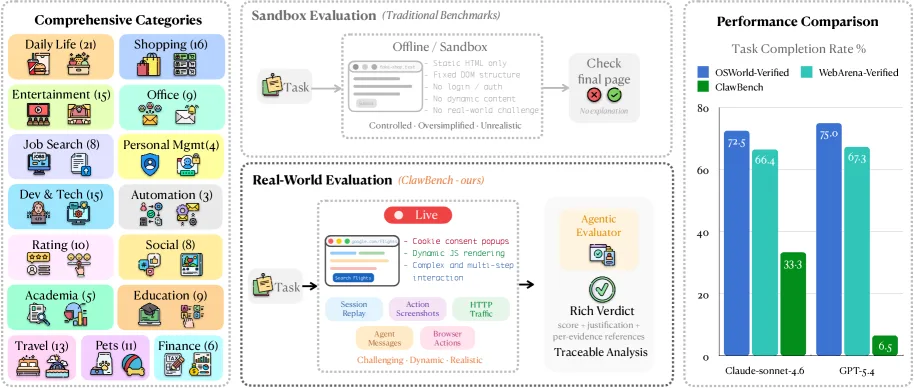
| ClawBench V2 及后续网页环境 | ClawBench 的公开预印本写的是 V1;当前仓库公开 V2 的两阶段评分与轨迹协议,但这本身不是已经完成的 RL 环境实证 | 把可自托管、逐步可观测的网页任务做成安全的训练与评测边界,并保留浏览器、网络和 agent 轨迹 | “到达正确端点”与“提交正确载荷”必须分别报告;训练后只在按网站和流程隔离的任务上验收 |
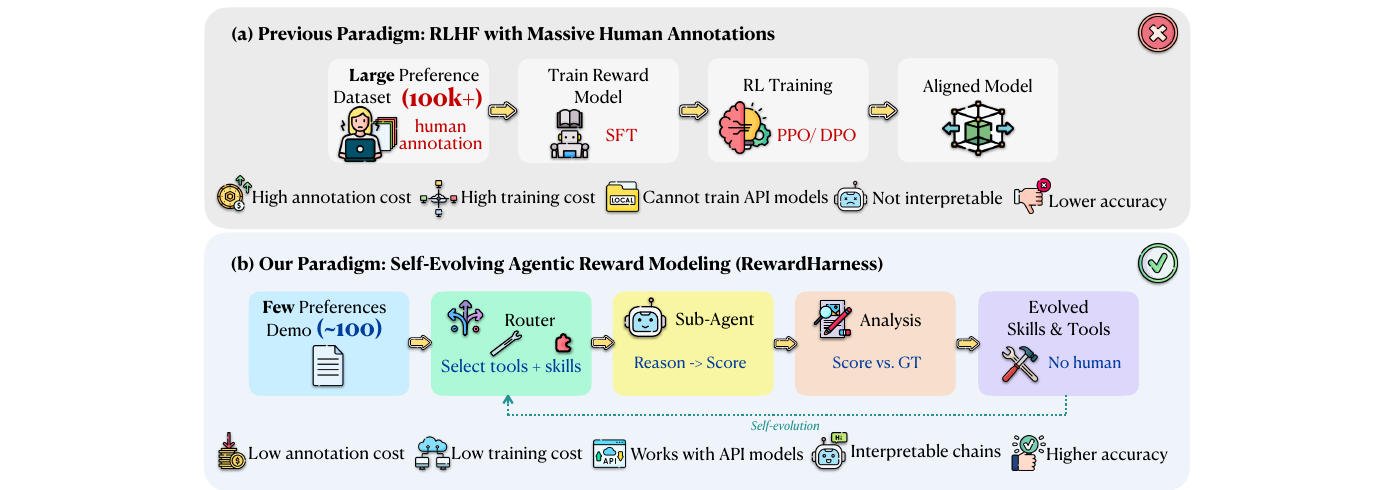
| RewardHarness → RSIBench → OpenRSI | 公开预印本 RewardHarness 在图像编辑偏好上探索 context evolution,而不是更新 reward-model 权重 | 将可审计 reward harness 的思想扩展到数学、代码与 agent 自我改进的任务;本路线图中的 RSIBench、OpenRSI 是工作名,不据此主张成熟公开发布 | 冻结 verifier 后,奖励机制本身的改动是否在保留任务上仍提高真实 outcome,而非仅提高 reward 或格式匹配 |
| WebsiteBench | 本文不把该名称当作已经发布的 benchmark,也不主张其已有结果 | 在同一版本化网站状态下,公平比较 DOM/CDP 浏览器 agent 与截图、鼠标、键盘的 computer-use agent,并用可审计轨迹和终态验证定义任务 | 对同一任务,独立 evaluator 能否仅凭不可篡改工件复核成功;改变观察/动作接口、任务或站点时,结论是否仍成立 |
4. Frontier Auto Research 与现有环境的差别
“自动研究”很容易被误解成“让 agent 自己跑很久”。时长不够,也不是核心差别。autoresearch 展示的是受限文件面、固定实验时间和保留/回退的实验循环;AutoLab 测试在固定时间内改善正确但次优的基线;MLS-Bench 测试一个 ML 方法机制能否跨设置成立;EdgeBench 观察长程环境反馈如何改变 best-so-far 工件。它们都很重要,但各自的测量对象不同。
Frontier Auto Research 的拟议差别是任务的学术产物:不是要求 agent 写出一份貌似完整的论文,而是要求一个任务能够形成足以进入严肃研究讨论的最小证据包。
| 维度 | AutoLab / MLS-Bench / EdgeBench 分别强调什么 | Frontier Auto Research 的拟议要求 |
|---|---|---|
| 任务对象 | 已知基线的经验改进、方法级迁移或环境中的持续改善 | 一个明确的问题以及可被他人重跑和质疑的研究工件 |
| 改动面 | 任务定义的代码、方法组件或工作区 | 预先声明的代码、数据、实验与分析面;评测和保留集不可写 |
| 成功信号 | 分数、质量改进或时间曲线 | 效果量、对照、失败模式、复跑和解释是否共同支持一个窄结论 |
| 失败的价值 | 可能只是未得分 | 应留下可定位的失败谱系,避免下一个 agent 重复无信息的搜索 |
这并不保证“解决一题就会产生顶会论文”。更诚实的要求是:若任务被称为研究任务,它至少应允许形成可审稿的贡献形态,包括清晰问题、可复现实验、合理对照、范围受限的结论与可检查的局限。发表仍是同行评审的决定,不是环境的奖励函数。
5. 网页 Agentic RL:先保护 outcome,再讨论算法
网页 RL 有一个特别尖锐的问题:agent 既能观察页面、生成文本、调用工具,也可能间接影响日志、缓存、表单载荷、评分提示或训练分布。一个高 reward 不足以说明用户意图被完成。
ClawBench 的当前公开两阶段协议提供了很好的直接例子:先确认最终请求被拦截,再由 judge 检查请求体是否满足指令;两个条件都为真才是最终成功。需要保持一个版本边界:arXiv 预印本写的是 V1,而仓库的 V1/V2 说明 和 评分规范描述当前协议。这个分解直接适用于网页环境。它揭露了“走到正确 endpoint”与“完成正确任务”之间的空隙,而不是用一个单一分数掩盖它。
| 风险面 | 可检验的防线 | 对网页环境的适用性 |
|---|---|---|
| 代理优化了 proxy,而非用户 outcome | 把 intercepted_rate 与最终 reward_rate 分开报告;构造“端点正确、载荷错误”和“文本合理、从未提交”的反例 |
直接适用。拦截只是安全及意图提交证据,不是完成证明 |
| 代理或网页内容影响 evaluator | judge prompt、参考轨迹、私密规则和评分服务放在不可写且不可见边界;对 prompt injection 做对抗回归 | 直接适用。网页内容是非可信输入,浏览器 agent 已有专门的 injection 风险研究 BrowseSafe |
| 过程奖励被刷 | 任何中间奖励先做反例审计;将未验证的过程信号作为诊断,而不是训练目标 | 原则直接适用;过程监督优于终局监督的实证主要来自数学推理,不能自动迁移到网页任务 Let’s Verify Step by Step |
| 终局 reward 被平均归因给所有调用 | 记录决策、可见状态、工具结果和 reward 事件;比较 token / call / action 三种归因,而不是盲目广播 session reward | 网页需要新实证。Agent Lightning 的 transition 设计与 Polar 的 token-faithful reconstruction 是相邻领域的有用起点,不是浏览器中的既有结论 |
| 训练集泄漏到 benchmark | 训练和测试按站点、工作流、帐号模板及任务语义隔离;测试任务和 judge 规则不进入合成数据或 prompt 库 | 直接适用。合成网页轨迹可用于训练,但必须把 benchmark 留在冻结保留集之外 |
奖励篡改的更一般形式,来自 agent 对奖励函数或奖励输入本身产生工具性影响的激励。Everitt 等人 的因果分析并非网页论文,但给出一个可移植的设计问题:策略能否通过改变“被评估的证据”而提高 reward,而不改变真实 outcome?如果答案可能是“能”,就必须让该证据通道离开 agent 的控制域。
6. PPO、GRPO 与 2K 合成任务:它们是实验设计,不是结论
Polar 的公开贡献是通过 API proxy 记录 token 级模型交互,并重建与真实 harness 对齐的轨迹;其论文在软件工程 harness 中报告的是 GRPO 训练。它不等于“任何 browser harness 已经可直接 RL”,也不等于 PPO 或 GRPO 在网页上已经胜出。Polar 的价值在于提出了一个很严格的接口问题:训练轨迹必须保留真实调用、采样 token 与可用 reward,而不是训练一个脱离部署系统的替身。
因此,ClawBench 后续 RL 的最小可信实验不应从复杂叙事开始,而应从一个可证伪的矩阵开始:
| 假设 | 最小对照 | 必须同时报告 |
|---|---|---|
| GRPO 是稀疏网页 reward 的可行起点 | 同一可训练模型、同一 harness、同一任务分布、同一 rollout 预算下的冻结基线 | 每题 rollout 的 reward spread、全 0 / 全 1 group 比率、最终成功率与安全失败类别 |
| PPO 在有可信过程状态时更有帮助 | 只在过程状态与过程奖励经过反例验证后,与 GRPO 比较相同预算 | critic 误差、过程 reward 与独立终局 outcome 的相关性、GPU / rollout 成本、保留任务收益 |
| 约 2K 合成实例能带来迁移 | 合成训练任务与最终评测按网站和流程隔离;加入仅 SFT、仅 RL、SFT+RL 对照 | 生成来源、过滤规则、去重、泄漏审计、对未见任务的收益与置信区间 |
PPO 的优势不能由“长轨迹”自动推出:它还需要可信 critic 和可用的中间信息。GRPO 的优势也不能由“不需要 critic”自动推出:若同一题的多个 rollout 全部失败或全部成功,组内相对信号接近零。这里的正确句子不是“PPO 可能比 GRPO 好”,而是:先度量 reward 的分辨率和 credit assignment,再让算法比较回答问题。
7. 成本也是结果的一部分
长程 agent 的成本不是一个 API 单价。一次可比较的报告至少应分开记录:输入、输出与缓存 token;模型调用次数与重试;浏览器或 sandbox 的 CPU 时间;GPU 小时、显存和并发度;外部工具费用;等待、失败和人工介入。否则,一个“更强”结果可能只是通过不可复制的推理预算得到。
选择模型或训练方案时,应报告 Pareto 曲线,而不是只给最佳分数。成本账本先记录不可变的用量,再记录三种金额:measured usage、invoiced cost 与带日期、币种、来源和分配公式的 price-snapshot estimate。特别是在实验性工作中,昂贵的闭源 rollout 可以是有价值的 oracle,却不自动构成可规模化的训练方案。本文不报价具体供应商或型号;价格、可用性和限额会变化,应该在每次实验的时间戳成本账本中独立固定。
8. 两个值得严肃讨论的 workshop 题目
这两条是研究议程,不是活动或赞助公告。
- Auto Research。 什么 benchmark、方法和环境可以支持小时级、天级的研究循环?如何把 evaluator 冻结、保留集、证据谱系和 anti-reward-hacking 变成默认协议?“AI Research Scientist”应该被分解成哪些可反驳的能力主张?
- Agent Harness Engineering。 agent 的能力不只在 prompt 中,也在 context、文件状态、工具权限、loop、并发、恢复、评测和训练接口中。我们怎样系统地设计、实现和评估通用 agent 与 coding agent 的 harness,而不是只比较单个模型输出?
Lilian Weng 的 Harness Engineering for Self-Improvement 之所以值得细读,不是因为它把所有方向都归到 RSI,而是因为它把 workflow、持久状态、子任务、评测、权限和自我改进放进同一套系统视角。这里采用同样的写作原则,但把重点放在每一个循环如何留下可外部审计的证据。
9. 接下来该如何证明,而不是宣告
- 先为每条研究线写一页 pre-registered task card:目标、工件、可改动面、风险动作、可见反馈、隐藏反馈、预算、保留集和终止条件。
- 建立 append-only 的实验谱系:每个 hypothesis、diff、运行环境、结果、选择或回退都具有可核验 fingerprint。
- 让 evaluator 与训练 policy 隔离:任务规则、参考轨迹、judge prompt 和最终测试位于独立访问域,并对每次版本变更做回归测试。
- 用“真实 outcome + 安全 + 成本 + 迁移”四张表报告结果;单一 reward 只能是一项诊断,不能是故事结尾。
- 把 RSI 保留为条件性的结论:只有系统改进了未来改进机制,并且这种收益在冻结、分布偏移的评测上保持,才有资格讨论经验性 RSI 证据。
这条路线的野心不是让 agent 讲一个动人的自我改进故事,而是让每一步进步都能被重跑、质疑、归因和安全地继续。那样得到的,不只是一条更高的曲线,而是更可信的研究能力。
Primary References
- Karpathy, autoresearch; AutoLab; MLS-Bench; EdgeBench.
- Zhang et al., ClawBench and the current scoring specification.
- Zhang et al., RewardHarness and official repository.
- Xu et al., Polar; Luo et al., Agent Lightning.
- Everitt et al., Reward Tampering Problems and Solutions; Lightman et al., Let’s Verify Step by Step; Google DeepMind on specification gaming.
- Xu et al., AgentTrek; Zhang et al., BrowseSafe; Zhang et al., Darwin Godel Machine.
Research Program: Making Agent Progress Auditable
A worthwhile agent-research program is not a collection of benchmark names or one attractive demo. It must answer a harder question: what did a system actually change, why should we believe the change helped, and how do we know it did not merely learn to influence the evaluator? This post places Frontier Auto Research, ClawBench, RewardHarness, RSIBench / OpenRSI, and WebsiteBench on one map. The unifying aim is research-agent systems that preserve evidence, admit refutation, and learn safely.
1. Separate Eight Kinds of Claims First
Research blogs become unreliable when preprints, code, internal plans, and intuitions are written in the same voice. I use nine labels rather than collapsing them into “progress.” This taxonomy adapts COPE’s guidance on preprint transparency, ACM’s distinction between available artifacts and validated results, and ICMJE’s principle of disclosing direct support and a sponsor’s role. It does not replace a venue’s rules: the anonymity, preprint, and workshop policy of the specific venue must still be checked at submission time.
| Label | What it can say here | What it cannot say here |
|---|---|---|
| Peer-reviewed paper | Its paper version, publication venue, and conclusions within the documented scope | That an unreported experiment, code revision, or later plan inherits the paper’s authority |
| Public preprint | The archived version and the authors’ reported method and experiments | That it is “published” or has passed peer review |
| Public code / data | Its access point, version, license, and runnable scope | That downloadability establishes an independently validated result |
| Work-in-progress design | An intended environment boundary, interface, or acceptance criterion | A metric, scale, compatibility guarantee, or research finding not yet obtained |
| Research hypothesis | A causal conjecture that requires an ablation, such as when PPO or GRPO may fit | That “might help” has already become “works better” |
| Internal working name | A label the team currently uses to organize a research line | That the name is a released team, product, paper, or leaderboard |
| Research position | Why a problem and its evidence standard are worth choosing | Claims about another project’s performance, motivation, or limitation without a common experiment |
| Workshop concept | A topic, scientific question, and discussion the organizers would like to convene | That an event is accepted, has a public CFP, or has a fixed schedule |
| Sponsorship / collaboration | Direct support, collaborators, and roles that are both confirmed and cleared for public disclosure | Announcing an intention, treating institutional proximity as funding, or implying endorsement of results |
This is not cautious phrasing for its own sake. Every AutoResearch iteration turns some local metric into selection pressure. When state, evaluator, and experimental lineage are not separated, it becomes hard to know what the system is ultimately optimizing.
Pre-Publication Check
- Attach an accessible primary-source link to every statement that already happened, and record the version, date, and scope. Do not use one status label for a paper, preprint, code repository, and dataset.
- Every result sentence should point to a table, run, or public artifact. Without a frozen holdout, independent rerun, or uncertainty statement, write an observation or pending validation, not a conclusion.
- Mark an internal name as a working label at first use. Do not invent a team, leaderboard, user count, compatibility guarantee, or submission status.
- An algorithm comparison must state the fixed model, harness, data split, budget, seeds, and metrics. “PPO beats GRPO” remains a question until the controlled comparison exists.
- Describe a workshop only as a theme or proposal unless a public CFP or acceptance notice exists. Re-read that venue’s current anonymity and preprint policy before every submission.
- Name a collaborator or sponsor only when the party has agreed and the fact is settled. Disclose direct support, the funder’s role in design, analysis, and writing, and any restrictions. An exploratory conversation is not funding or a collaboration announcement.
- Check permissions, de-identification, and provenance for every external figure, screenshot, trajectory, and live-web datum. Sensitive logs are not automatically reproducibility artifacts.
- Fact-read the Chinese and English versions separately: numbers, status words, qualifications, and negations must be semantically equivalent rather than stronger in one language.
2. One Spine: Action, Learning, and Evidence
I divide a research agent into three mutually constraining layers:
- Action environment. An agent produces a deliverable artifact in a terminal, browser, or computer interface; irreversible actions need explicit safety boundaries.
- Learning and harness. The model, context, tools, memory, and control loop jointly determine actual behavior. Training should not reduce the deployed harness to a different one-turn prompt.
- Evidence and evaluator. Evaluation, logs, held-out data, reruns, and a cost ledger must sit outside the agent’s write boundary. They determine whether “improved” can be externally checked.
The unit of work is therefore not “an agent completed a task,” but an evidence package: problem, permitted interventions, artifact, evaluator version, complete lineage, held-out evaluation, and resource ledger. Without these seven pieces, a result can guide debugging, but not sustain a research conclusion.
3. Project Map: Public Foundations, Working Goals, Decisive Tests
| Research line | Public foundation | Goal described here | The test that would decide it |
|---|---|---|---|
| Frontier Auto Research / ART | autoresearch, AutoLab, MLS-Bench, and EdgeBench provide concrete paradigms for automated experiments, method transfer, and long-horizon feedback | Define a task by a publishable research artifact rather than one score: runnable code, clear comparison, failed attempts, and a testable explanation | With evaluator and budget fixed, does improvement survive on settings, seeds, or tasks that did not select it; can an independent run reconstruct the conclusion? |
| ClawBench V2 and successor web environments | The public ClawBench preprint covers V1; the current repository publishes V2’s two-stage scoring and trace protocol, which is not by itself evidence of a completed RL environment | Make self-hostable, step-observable web tasks a safe boundary for training and evaluation while preserving browser, network, and agent traces | “Reached the right endpoint” and “submitted the right payload” must be reported separately; post-training acceptance uses tasks isolated by website and workflow |
| RewardHarness → RSIBench → OpenRSI | The public preprint RewardHarness studies context evolution rather than reward-model weight updates for image-editing preferences | Extend the idea of an auditable reward harness to math, code, and agent self-improvement; RSIBench and OpenRSI are working names in this roadmap and do not by themselves claim a mature public release | With a frozen verifier, do changes to the reward mechanism still improve true outcomes on held-out tasks rather than only reward or format match? |
| WebsiteBench | This post does not treat this name as a released benchmark or claim existing results for it | Under one versioned website state, compare DOM/CDP browser agents fairly with screenshot, mouse, and keyboard computer-use agents, using auditable traces and end-state verification | Can an independent evaluator reproduce success from tamper-resistant artifacts alone, and does the conclusion survive a changed observation/action interface, task, or site? |
4. Frontier Auto Research Is Not a Longer Run
“Automated research” is easily mistaken for “letting an agent run for a long time.” Duration is not enough, nor is it the key distinction. autoresearch demonstrates a constrained editable surface, fixed experiment duration, and keep-or-revert loop. AutoLab measures improvement of a correct but suboptimal baseline within a time budget. MLS-Bench measures whether an ML-method mechanism transfers across settings. EdgeBench studies how long-horizon environmental feedback changes a best-so-far artifact. All matter, but they measure different objects.
The proposed distinction for Frontier Auto Research is the scholarly product of a task. It does not ask an agent to produce a paper-shaped document. It asks whether the task can produce the minimum evidence needed for serious research discussion.
| Dimension | What AutoLab / MLS-Bench / EdgeBench respectively emphasize | Proposed Frontier Auto Research requirement |
|---|---|---|
| Task object | Empirical improvement of a known baseline, method-level transfer, or persistent improvement in an environment | A clear question and a research artifact that another person can rerun and challenge |
| Editable surface | Task-defined code, method component, or workspace | Predeclared code, data, experiment, and analysis surfaces; evaluator and held-out split are not writable |
| Success signal | A score, quality change, or time curve | Whether effect size, controls, failure modes, reruns, and explanation jointly support a narrow claim |
| Value of a failure | Potentially just a non-score | A localizable failure lineage that prevents a future agent from repeating uninformative search |
None of this promises that “solving one task yields a top conference paper.” The honest requirement is narrower: if a task is called a research task, it should at least permit a reviewable contribution form, including a clear question, reproducible experiment, reasonable controls, scoped conclusion, and inspectable limitations. Publication remains a peer-review judgment, not an environment reward.
5. Web Agentic RL: Protect the Outcome Before Choosing an Algorithm
Web RL has a sharp difficulty: the agent can observe pages, generate text, and call tools, while potentially affecting logs, caches, form payloads, judge prompts, or the training distribution. A high reward is not enough evidence that a user’s intent was completed.
ClawBench’s current public two-stage protocol is a useful direct example: first establish that the final request was intercepted, then ask a judge whether its body satisfies the instruction; only both conditions yield success. One version boundary matters: the arXiv preprint covers V1, while the repository’s V1/V2 note and scoring specification describe the current protocol. The decomposition applies directly to web environments. It exposes the gap between “reached the right endpoint” and “completed the right task,” instead of hiding it behind one score.
| Risk surface | Testable defense | Applicability to web environments |
|---|---|---|
| The agent optimizes a proxy, not the user outcome | Report intercepted_rate and final reward_rate separately; include counterexamples with a correct endpoint but wrong payload, and plausible text but no submission |
Direct. Interception is safety and evidence of commit intent, not proof of completion |
| The agent or webpage influences the evaluator | Place judge prompts, reference traces, private rules, and scoring service behind an invisible, unwritable boundary; run adversarial prompt-injection regressions | Direct. Web content is untrusted input, and browser agents have dedicated injection-risk research BrowseSafe |
| Process reward is gamed | Audit every intermediate reward with counterexamples; treat an unvalidated process signal as diagnosis rather than a training target | The principle applies directly; empirical evidence that process supervision beats outcome supervision is chiefly from mathematical reasoning and does not transfer automatically to web tasks Let’s Verify Step by Step |
| Terminal reward is broadcast to every call | Record decisions, visible states, tool results, and reward events; compare token, call, and action-level attribution rather than blindly broadcasting session reward | New browser evidence is required. Agent Lightning’s transitions and Polar’s token-faithful reconstruction are useful adjacent starting points, not established browser results |
| Training data leaks into the benchmark | Separate train and test by site, workflow, account template, and task semantics; never place test tasks or judge rules in synthetic data or prompt libraries | Direct. Synthetic web trajectories can train an agent, but the benchmark must remain a frozen holdout |
The more general form of reward tampering is an agent’s instrumental incentive to influence the reward function or its inputs. The causal analysis by Everitt et al. is not a web paper, but it yields a portable design question: can the policy raise reward by changing the evidence being assessed, without changing the true outcome? If it can, that evidence channel must leave the agent’s control domain.
6. PPO, GRPO, and 2K Synthetic Tasks Are an Experimental Design, Not a Conclusion
The public Polar preprint proposes proxying LLM API traffic, recording token-level interactions, and reconstructing trajectories aligned with the real harness; its reported agent-training experiments use GRPO on software-engineering harnesses. That does not mean any browser harness is already trainable by RL, nor that PPO or GRPO has won on the web. Polar instead foregrounds a strict interface question: a training trajectory must preserve actual calls, sampled tokens, and usable rewards, not train a surrogate disconnected from deployment.
The smallest credible subsequent web-RL experiment should therefore start with a falsifiable matrix, not a large narrative:
| Hypothesis | Minimum control | Must report alongside it |
|---|---|---|
| GRPO is a viable starting point for sparse web reward | Same trainable model, harness, task distribution, and rollout budget against a frozen baseline | Per-task rollout reward spread, all-zero / all-one group rate, final success rate, and safe-failure categories |
| PPO helps when process state is trustworthy | Compare with GRPO only after process state and reward pass counterexample audits, at equal budget | Critic error, correlation between process reward and independent terminal outcome, GPU / rollout cost, and held-out gain |
| About 2K synthetic instances transfer | Keep synthetic training tasks separate from final evaluation by sites and workflows; include SFT-only, RL-only, and SFT+RL controls | Generation source, filters, deduplication, leakage audit, unseen-task gain, and confidence interval |
PPO does not win merely because trajectories are long: it needs a credible critic and useful intermediate information. GRPO does not win merely because it avoids a critic: if every rollout in a task group succeeds or fails, its relative signal is near zero. The correct sentence is not “PPO may be better than GRPO”; it is: measure reward resolution and credit assignment first, then let the algorithm comparison answer the question.
7. Cost Is Also a Result
The cost of a long-horizon agent is not an API sticker price. A comparable report separates input, output, and cached tokens; model-call counts and retries; browser or sandbox CPU time; GPU hours, memory, and concurrency; external-tool cost; waiting, failures, and human intervention. Otherwise, a “stronger” result may simply be an irreproducible inference budget.
Model and training choices should report a Pareto curve rather than only the top score. A cost ledger records invariant usage first, then three monetary fields: measured usage, invoiced cost, and a price-snapshot estimate with date, currency, source, and allocation rule. In experimental work, expensive closed-model rollouts can be valuable oracles without automatically becoming a scalable training strategy. This post intentionally does not quote specific provider or model prices: availability, limits, and pricing change, and should be fixed independently in a timestamped cost ledger for each experiment.
8. Two Workshop Themes Worth Taking Seriously
These are research themes, not event or sponsorship announcements.
- Auto Research. Which benchmarks, methods, and environments can support hour- and day-scale research loops? How can frozen evaluators, held-out splits, evidence lineage, and anti-reward-hacking become a default protocol? Into which falsifiable capability claims should “AI Research Scientist” be decomposed?
- Agent Harness Engineering. Agent capability is not only in a prompt; it also lives in context, file state, tool permissions, loops, concurrency, recovery, evaluation, and training interfaces. How do we systematically design, implement, and evaluate harnesses for general and coding agents rather than compare isolated model outputs?
Lilian Weng’s Harness Engineering for Self-Improvement is useful not because it collapses every direction into RSI, but because it places workflows, persistent state, subagents, evaluation, permissions, and self-improvement in one systems view. This post follows the same writing discipline while centering a different question: how each loop leaves evidence that an external reader can audit.
9. What to Prove Next, Rather Than Announce
- Write a pre-registered task card for each line: objective, artifact, editable surface, risky actions, visible feedback, hidden feedback, budget, held-out split, and stop condition.
- Keep append-only experimental lineage: every hypothesis, diff, runtime, result, selection, and revert receives a checkable fingerprint.
- Isolate evaluator from training policy: task rules, reference traces, judge prompts, and final tests live in separate access domains and every version change receives regression tests.
- Report four tables: true outcome, safety, cost, and transfer. A single reward is a diagnostic, not the end of the story.
- Keep RSI conditional: only a system that improves the mechanism of future improvement, with gains retained under frozen and distribution-shifted evaluation, earns a discussion of empirical RSI evidence.
The ambition is not to tell an attractive story about agent self-improvement. It is to make every step of improvement rerunnable, challengeable, attributable, and safe to continue. That produces more than a higher curve; it produces more credible research capability.
Primary References
- Karpathy, autoresearch; AutoLab; MLS-Bench; EdgeBench.
- Zhang et al., ClawBench and the current scoring specification.
- Zhang et al., RewardHarness and official repository.
- Xu et al., Polar; Luo et al., Agent Lightning.
- Everitt et al., Reward Tampering Problems and Solutions; Lightman et al., Let’s Verify Step by Step; Google DeepMind on specification gaming.
- Xu et al., AgentTrek; Zhang et al., BrowseSafe; Zhang et al., Darwin Godel Machine.