Personal agents need an outcome contract
Dots, Grok Bot, Claude Code self-hosted environments and Muse expose different boundaries between staying available, keeping state and finishing work.
Consider a daily project briefing. The agent should notice a changed deadline, update a draft, wait for approval before sending, and stop when the responsibility ends. “Always-on” covers only part of that job. It says little about whether delegated workers also stop, whether a resumed task retains its files, or whether a green completion indicator means the briefing reached its destination. The useful comparison between these four products is an execution contract: what starts work, what authority it carries, what persists, and what evidence establishes the outcome.
This is a documentation analysis checked on October 11, 2026, not a hands-on reliability benchmark. Dots, Grok Bot and Meta Muse offer managed agents for continuing responsibilities. Claude Code self-hosted environments provide execution infrastructure for coding sessions, with a separate surface starting those sessions. Treating all four as interchangeable personal assistants would hide the most consequential differences. The following distinctions come from current official pages and linked technical documentation; account access and real-world completion rates were not tested. Sources: Dots overview, Grok Bot, Claude self-hosted environments, Muse launch.
Watch the 6:14 analysis
English narration, with English, Chinese and bilingual captions. This compares official control and state descriptions checked on 11 October 2026; the briefing scenario is proposed, not an observed product benchmark.
First identify the layer and the release state
Dots can coordinate an ongoing responsibility, delegate Work or Codex tasks, and continue while a personal computer is off using its cloud computer. Grok Bot offers multiple specialists that can coordinate through messages and use a persistent desktop. Muse combines goal planning, proactive work and a dedicated cloud VM. These are useful advances over restarting a task’s context with every conversation: a briefing can stay connected to changing project information while the person handles decisions. Their official examples demonstrate intended workflows, rather than measured comparisons of how reliably they finish. Dots tasks, Grok Bot guide, Muse design.
| Product | Layer | Current documented status |
|---|---|---|
| Dots | Managed ongoing-work coordinator | Gradual rollout; plan, age, region and admin gates |
| Grok Bot | Managed specialist Bots with a persistent computer | Available on documented eligible subscriptions |
| Claude self-hosted environments | Coding-session execution infrastructure | Team/Enterprise public beta; off by default |
| Muse | Managed personal agent with a dedicated VM | US rollout using Secure VM |
Eligibility does not establish access for a particular account. Muse’s Confidential VM, Shop Pay, 1Password support and glasses access are future additions. Dots texting and agent-initiated calls are also future features. Preserve those states rather than turn every announcement into a checked feature box. Dots channels, Muse roadmap.
A specialist persona is not a separate security domain
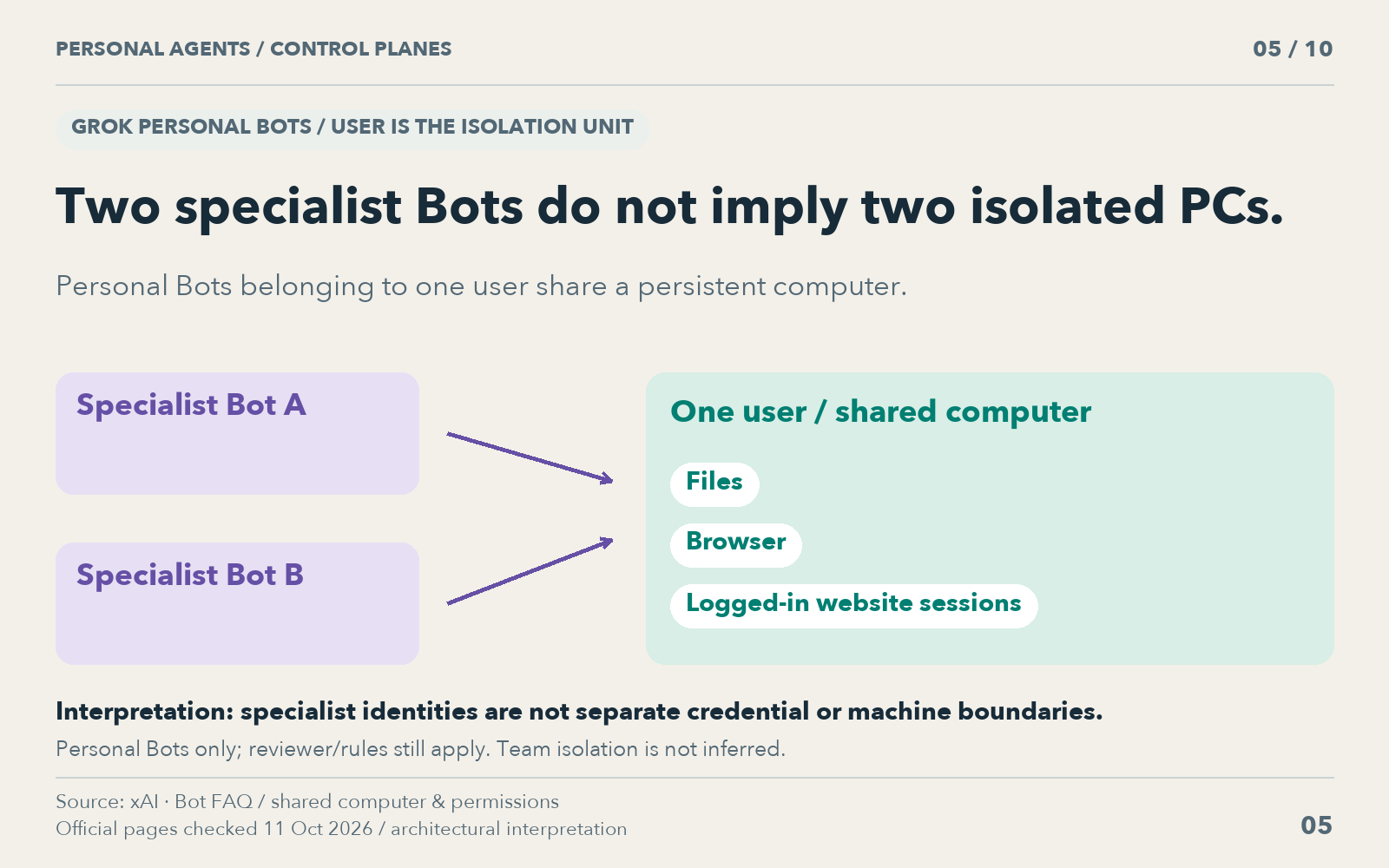
Grok Bot makes the distinction particularly explicit: the same user’s Bots share one persistent cloud computer, including files, browser and logins. Isolation is per user, not per Bot. Its official guide explains that a login made with one Bot is reachable by the others. That shared state has a concrete benefit: a researcher can hand a briefing to a communications specialist without rebuilding the environment. But separate names and instructions do not establish separate credential boundaries. Permissions and the reviewer still matter; the personal-Bot statement should not be generalized to every Enterprise Team Bot arrangement. Grok Bot FAQ, shared-computer guide.
Dots separate contact methods, app connections and local-computer access. Adding Slack does not connect an inbox or authorize computer use. Its cloud browser has sessions distinct from the person’s browser; a local task requires the connected computer to be online with ChatGPT open. Dot-specific saved notes also differ from ChatGPT memory and from a full transcript. These distinctions make continuity more precise: an agent can remember a private deadline without permission to share the private conversation in a team channel, and a delegate receives task-specific context rather than every past conversation. Dots computers and apps, context and memory.
Stop the responsibility, not just the visible worker
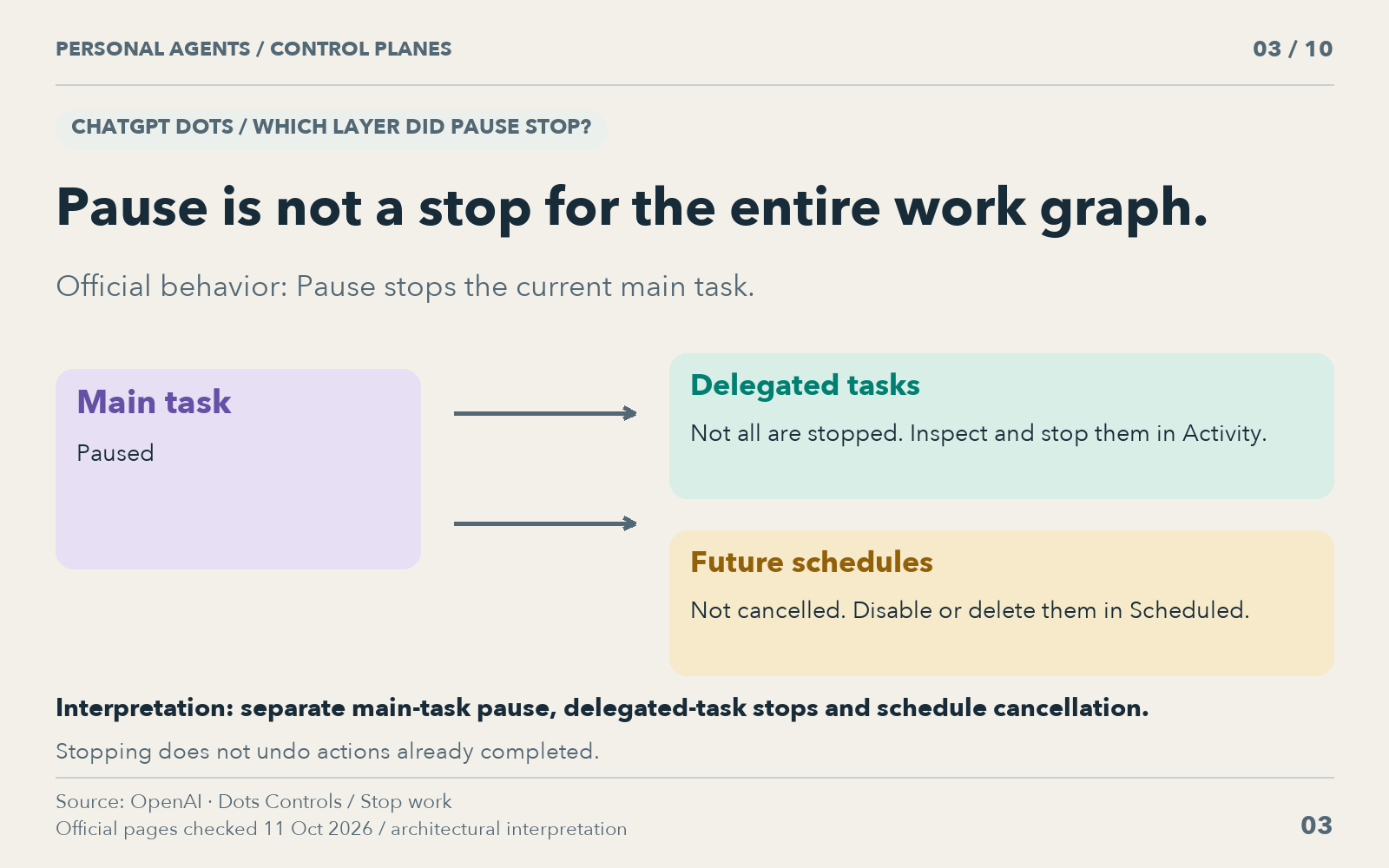
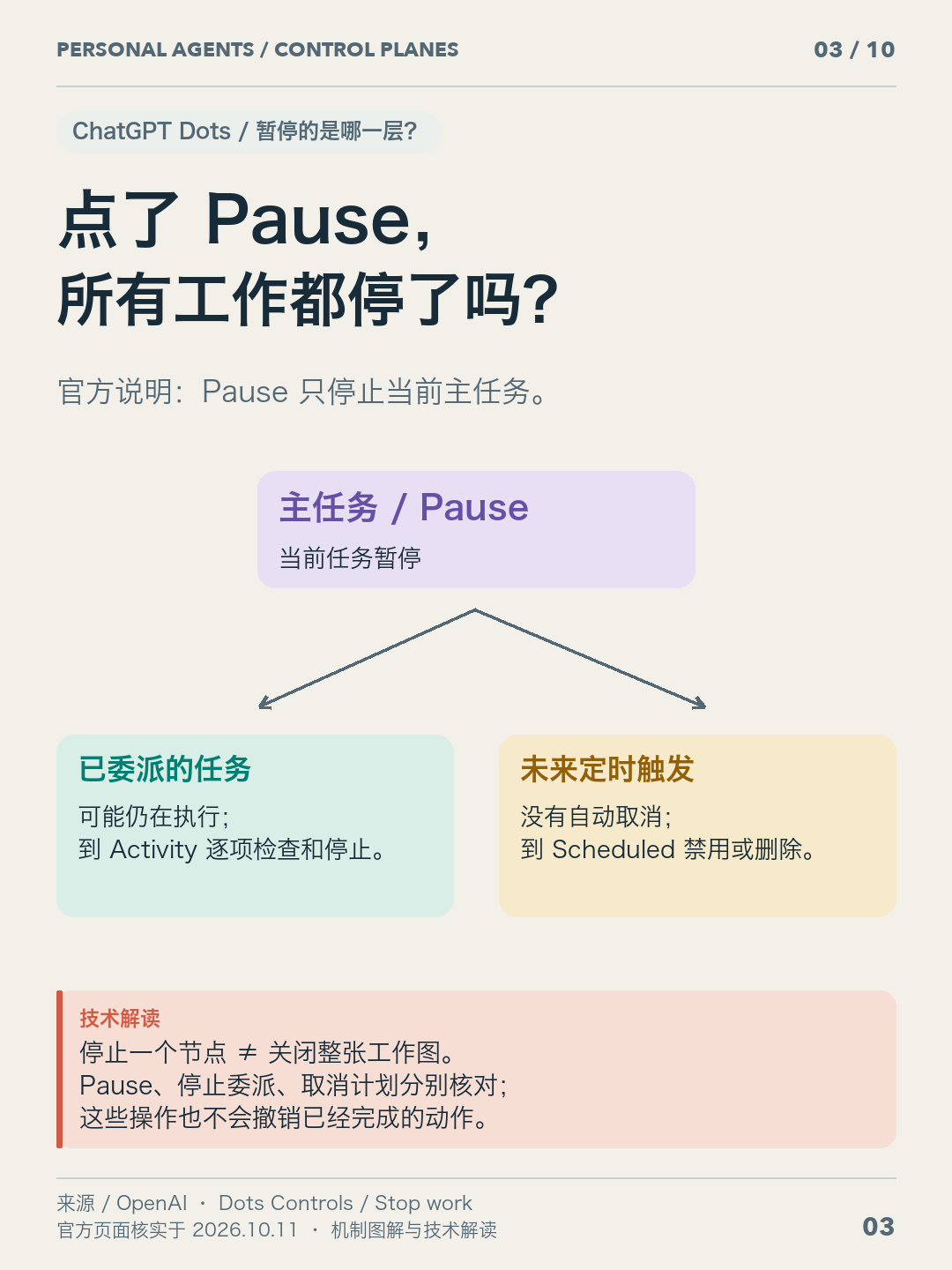
Dots document three separate operations: Pause stops the current main task, delegated tasks are stopped through Activity, and recurring runs are disabled or deleted through Scheduled. Stopping does not undo actions already completed. For the briefing example, ending the conversation or pausing the coordinator should therefore not be taken as evidence that tomorrow’s briefing has been canceled. The scheduler and delegated jobs need their own state checks. This is an explicit product distinction, not an inferred defect. Dots controls.
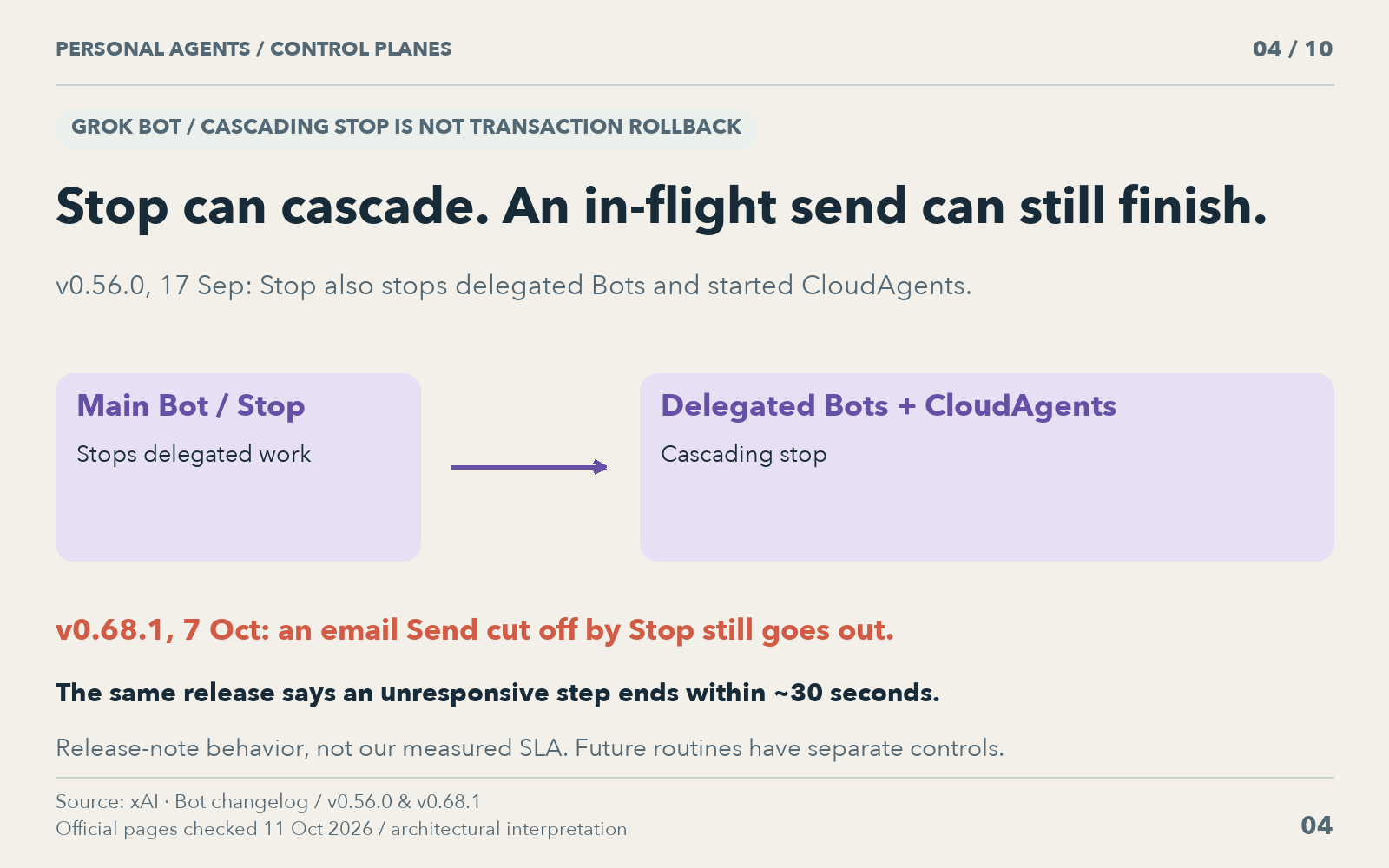
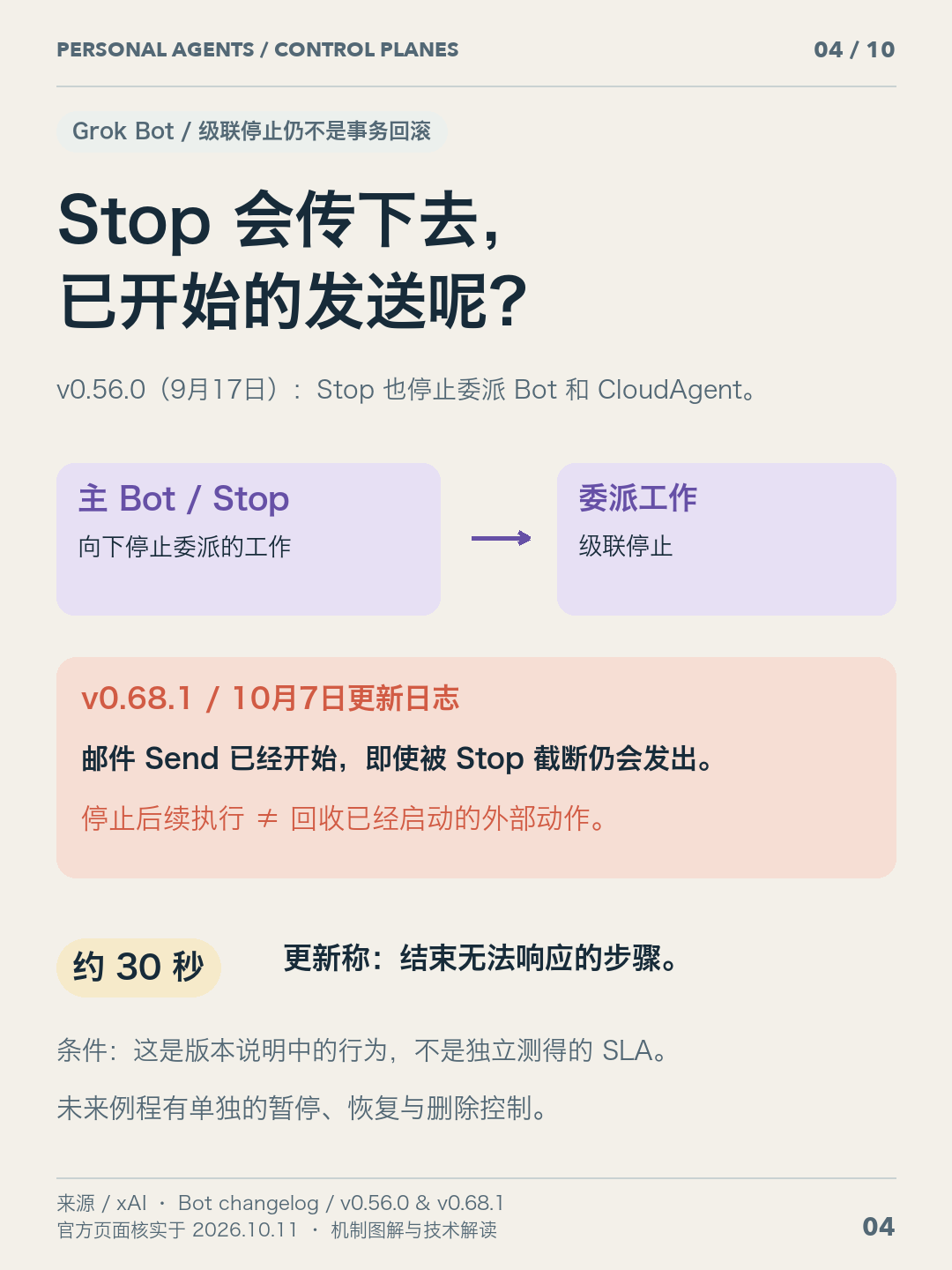
Grok Bot’s versioned release notes describe a different stopping scope. The September 17 v0.56.0 entry says telling a Bot to stop also stops delegated Bots and Cloud Agents it started. The October 7 v0.68.1 entry adds stopping an unresponsive step within about 30 seconds. But that same release says an email Send interrupted by Stop still goes out. Those claims separate cancellation from rollback: stopping future execution does not prove that an already committed action was recalled. Routines also have their own pause/resume/delete controls. Release notes are evidence about documented behavior, not an independently measured cancellation SLA. Grok Bot changelog.
Resumable conversation and durable work are different
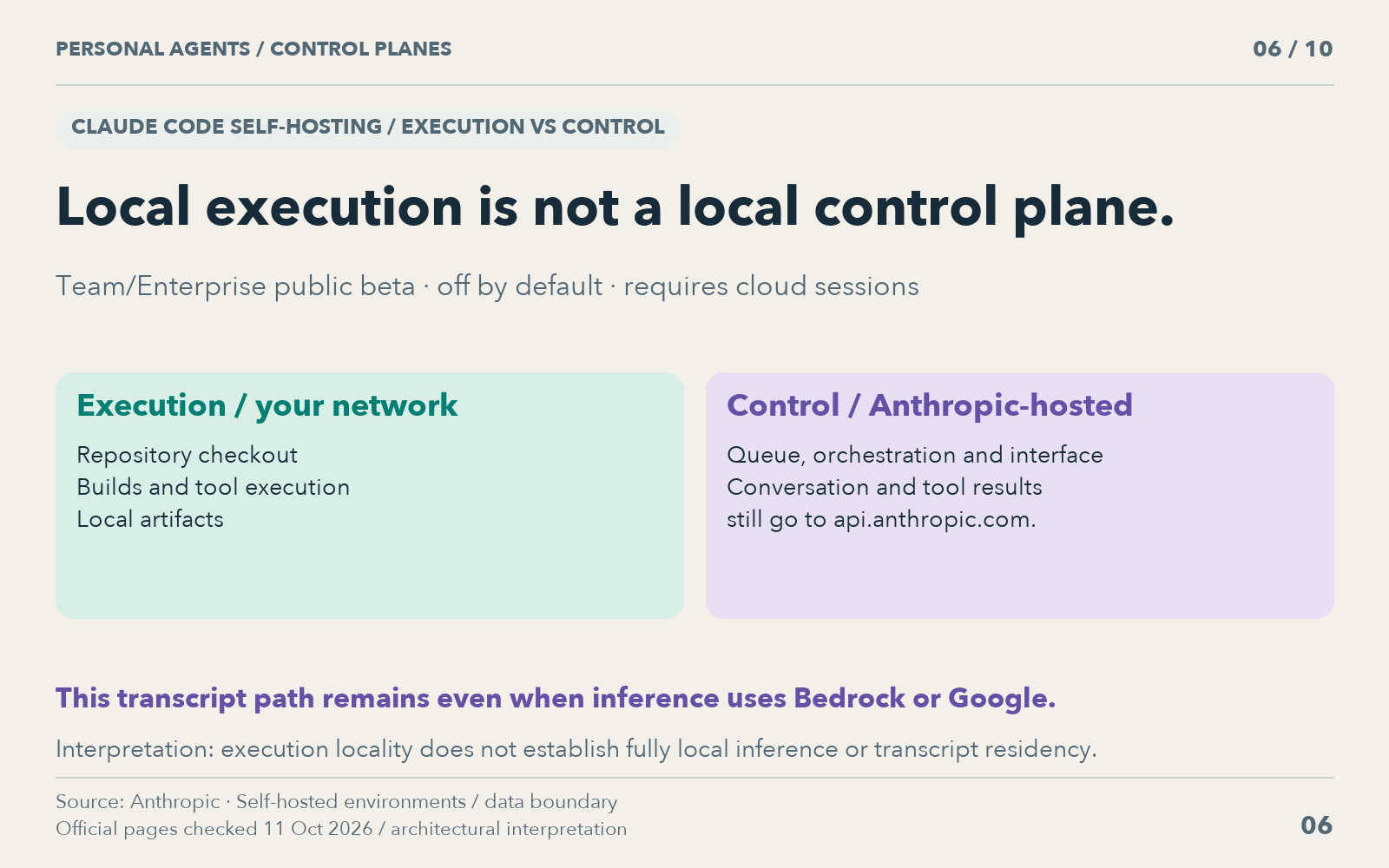
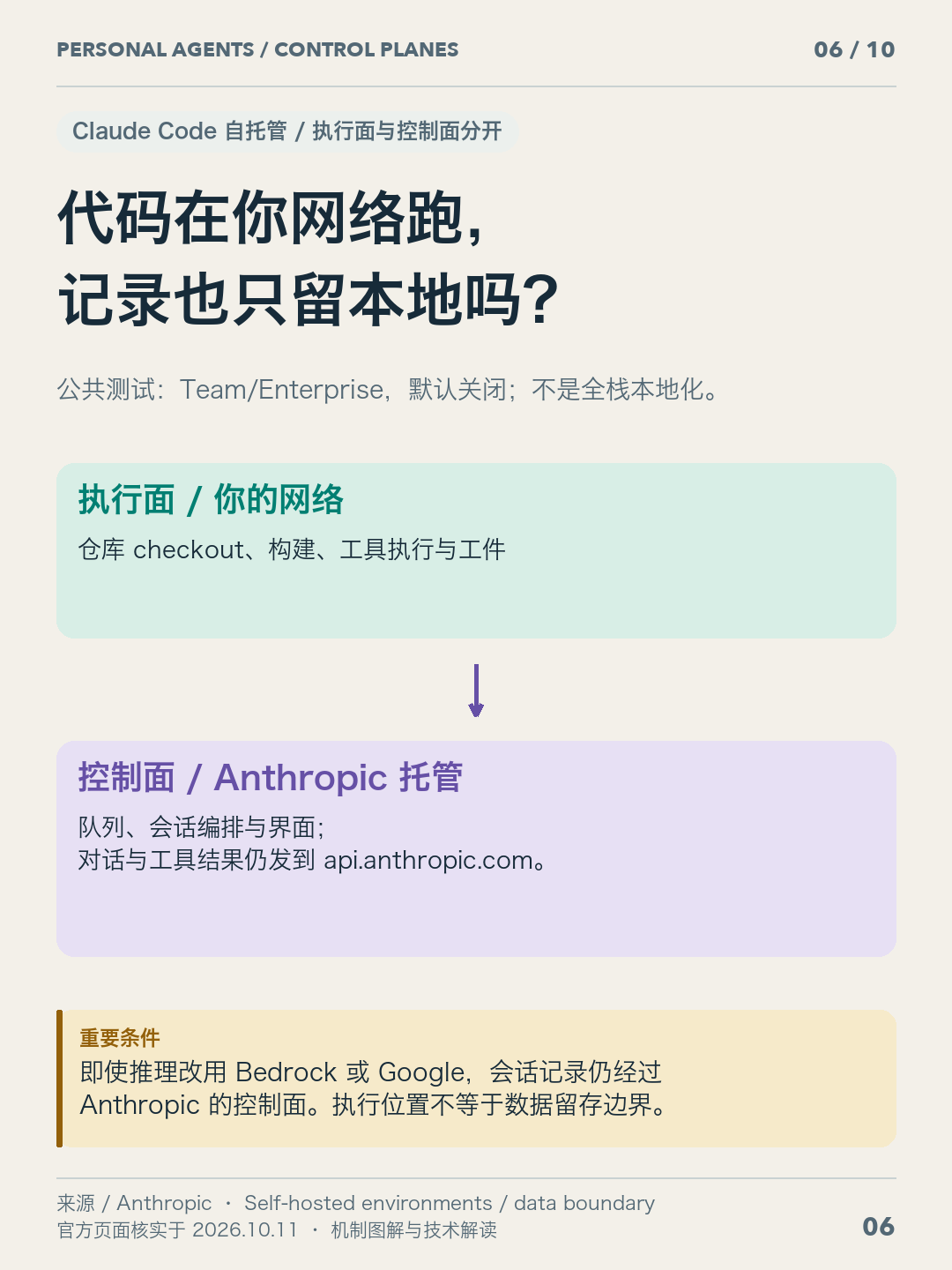
Claude self-hosted environments move coding execution into an organization’s network. Operators supply runners, images, network policy and credentials, while Anthropic retains the queue, orchestration and interface. Conversation and tool results still reach api.anthropic.com, including when model inference is configured through Bedrock or Google’s Agent Platform. This provides access to internal build systems without exposing them publicly, but it does not mean every part of the session is local or provider-inaccessible. Self-hosting changes an execution boundary and adds operational responsibility. Claude architecture and data scope.
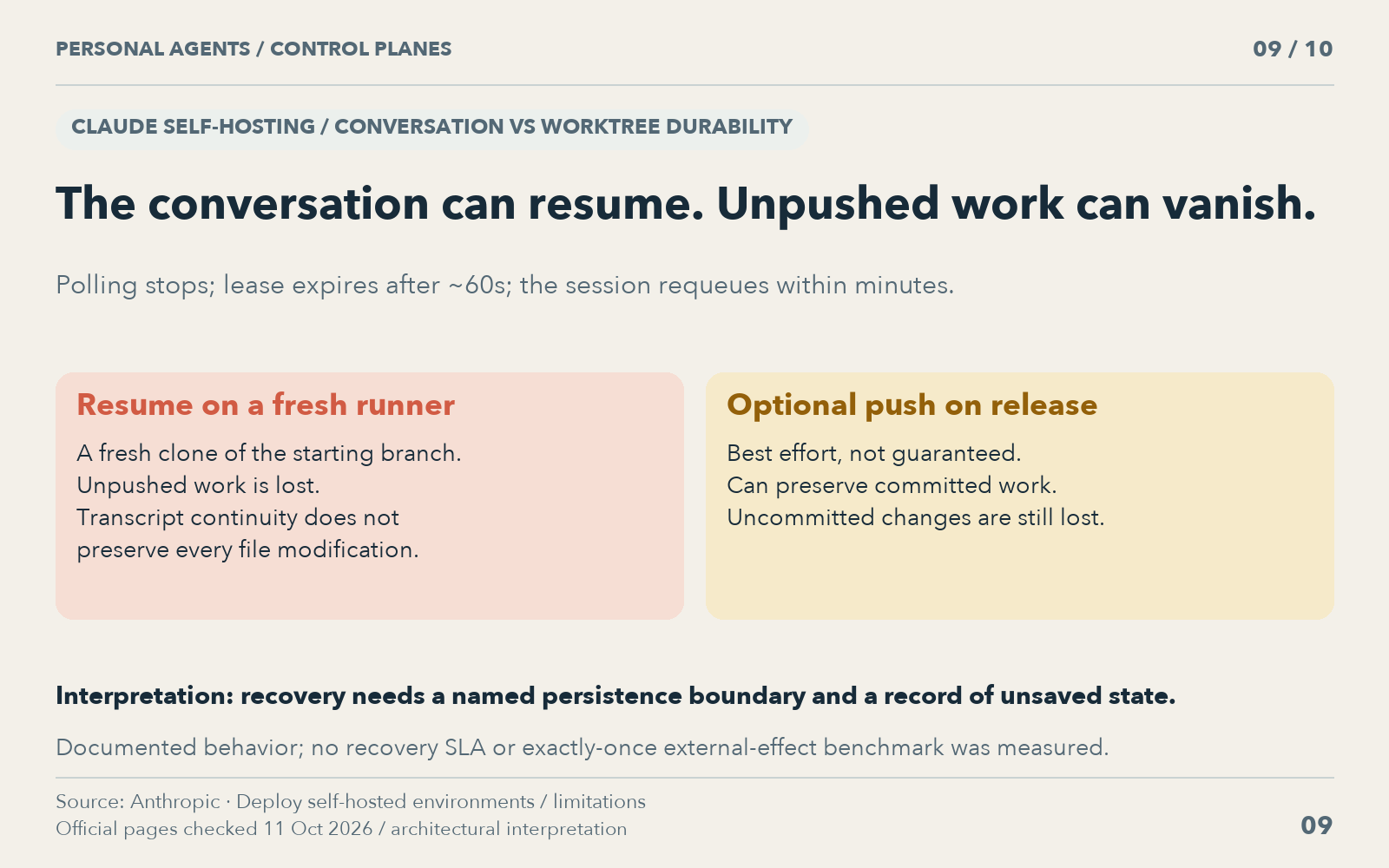
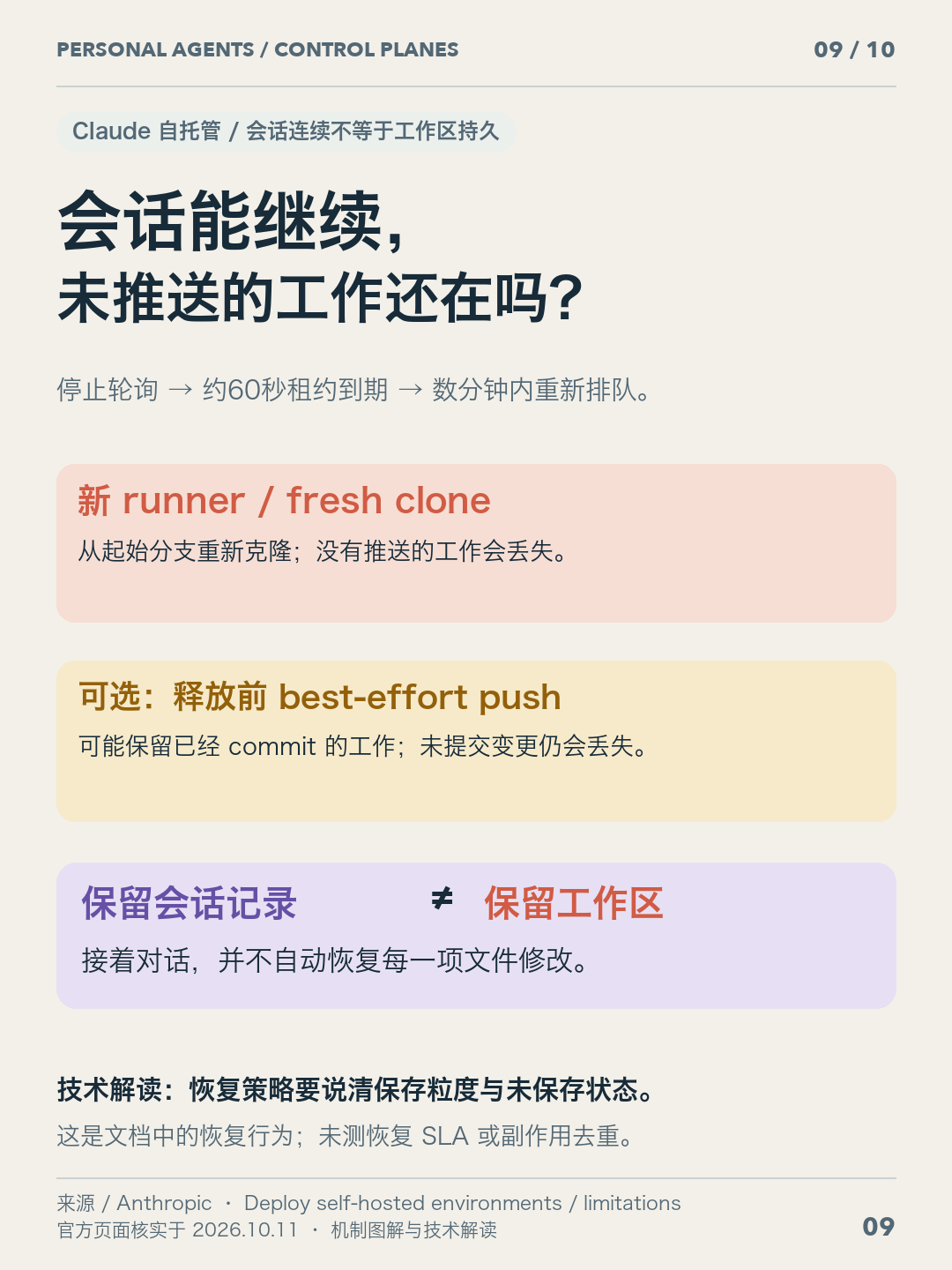
Recovery makes the distinction visible. If the runner stops polling, its lease expires after about 60 seconds and the session is requeued within minutes. A fresh runner can resume the conversation while cloning the original branch again, losing work that had not been pushed. A documented best-effort push-on-release option can preserve committed changes; uncommitted edits remain vulnerable. Thus “resume” can be true for conversational continuity while false for working-tree preservation. A future briefing trial should inspect the draft artifact separately from the resumed chat. The same documentation also notes that stopping a session need not stop a daemonized process; container teardown handles that separate lifetime. Claude recovery and limitations.
Approval needs an authority outside the instruction
Dots distinguish app permission, action review and Custom Rules. The rules are instructions the agent tries to follow and can get wrong; they neither grant app access nor override built-in safety. Grok Bot similarly documents natural-language rules interpreted by a separate reviewer. These designs can reduce repetitive human approvals while retaining escalation, but “prepare a briefing” still needs to remain separate from “send it to this audience.” Reading an instruction in source material should not create new authority to act. Dots action controls, Grok permissions.
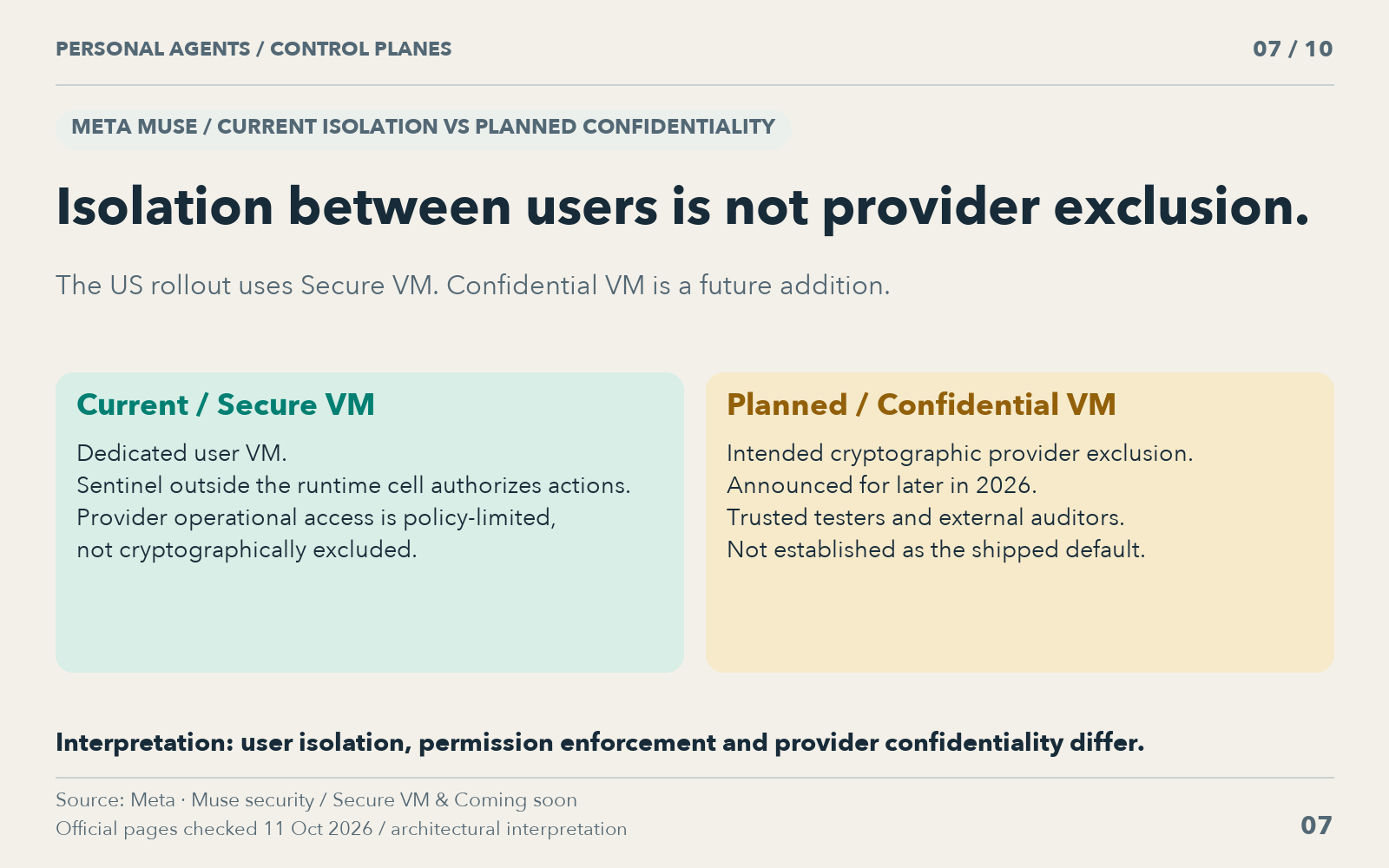
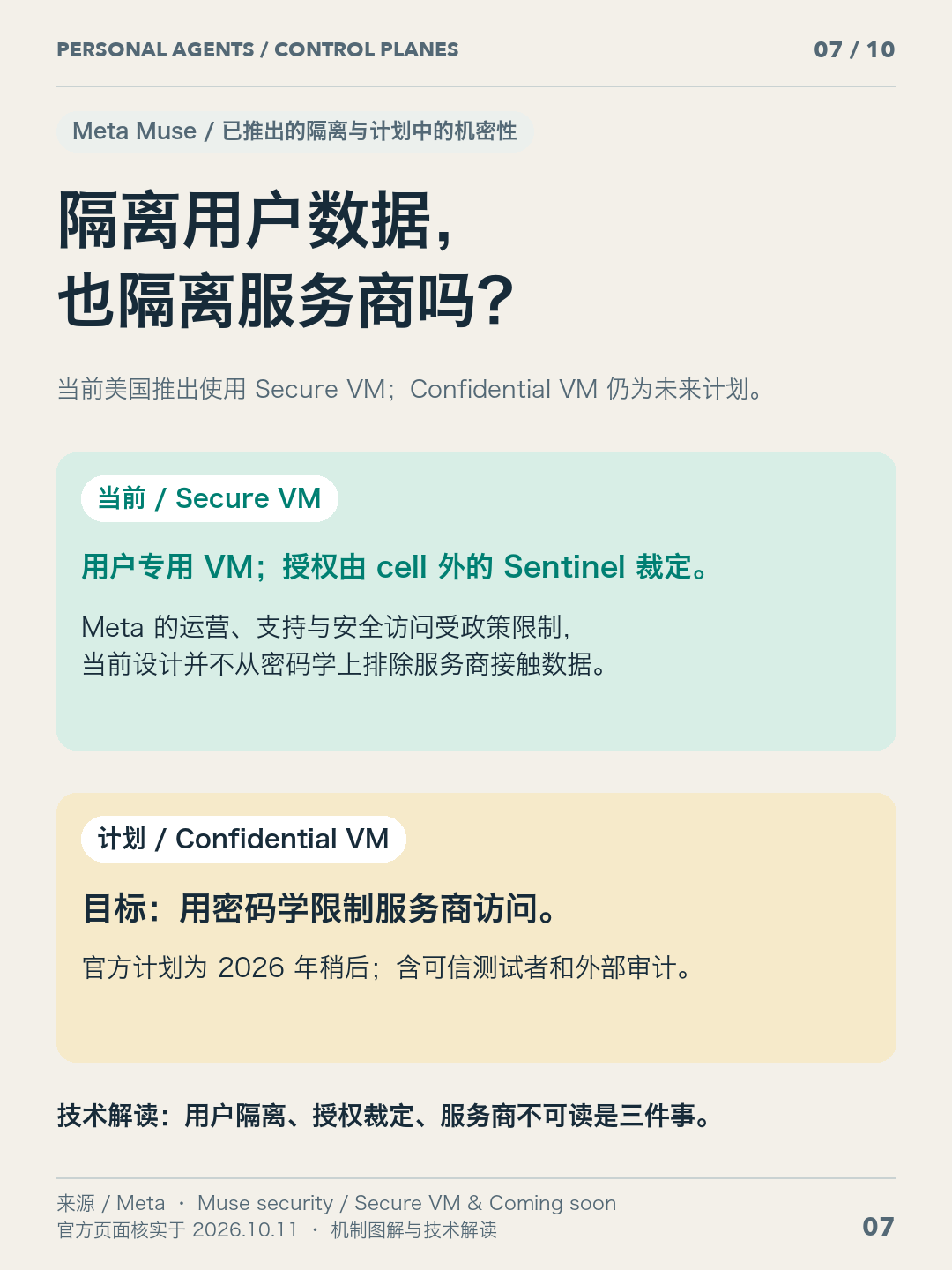
Meta describes a more explicit boundary in Muse: Sentinel, outside the agent’s runtime cell, authorizes connector actions and network egress. Scoped approvals travel through the client UI directly to Sentinel; credentials are stored separately and inserted at authorized boundaries. This is a substantive architectural claim about where permission lives, not proof that enforcement never fails. The current Secure VM also permits Meta’s operational access under policy. The future Confidential VM is intended to cryptographically prevent that access and is described as being tested with a small trusted group. Current isolation, future confidentiality and model-training choices should stay separate: the technical post describes sanitized training trajectories by default, with an opt-out. Muse technical architecture and privacy.
Verify the artifact after the process turns green
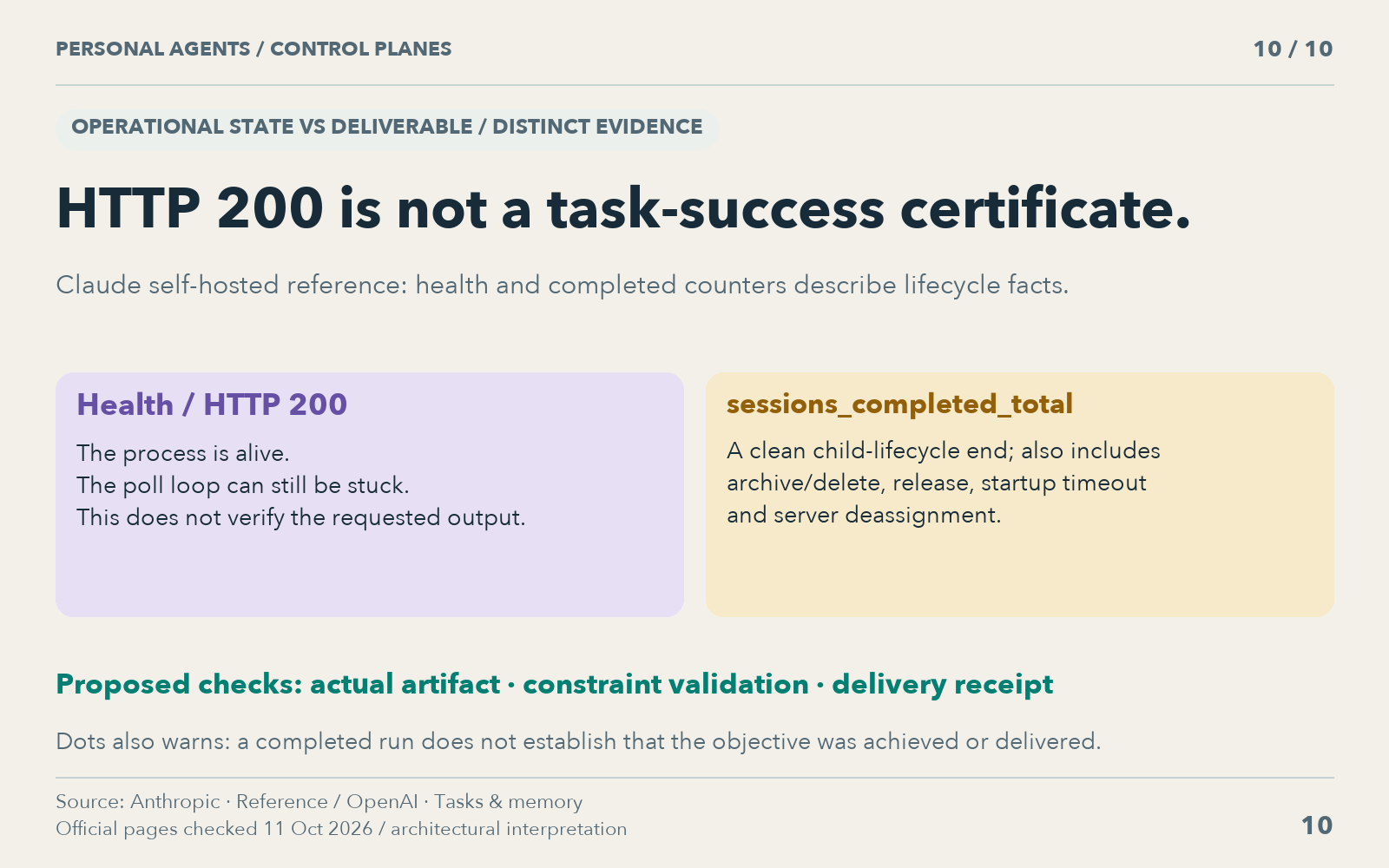
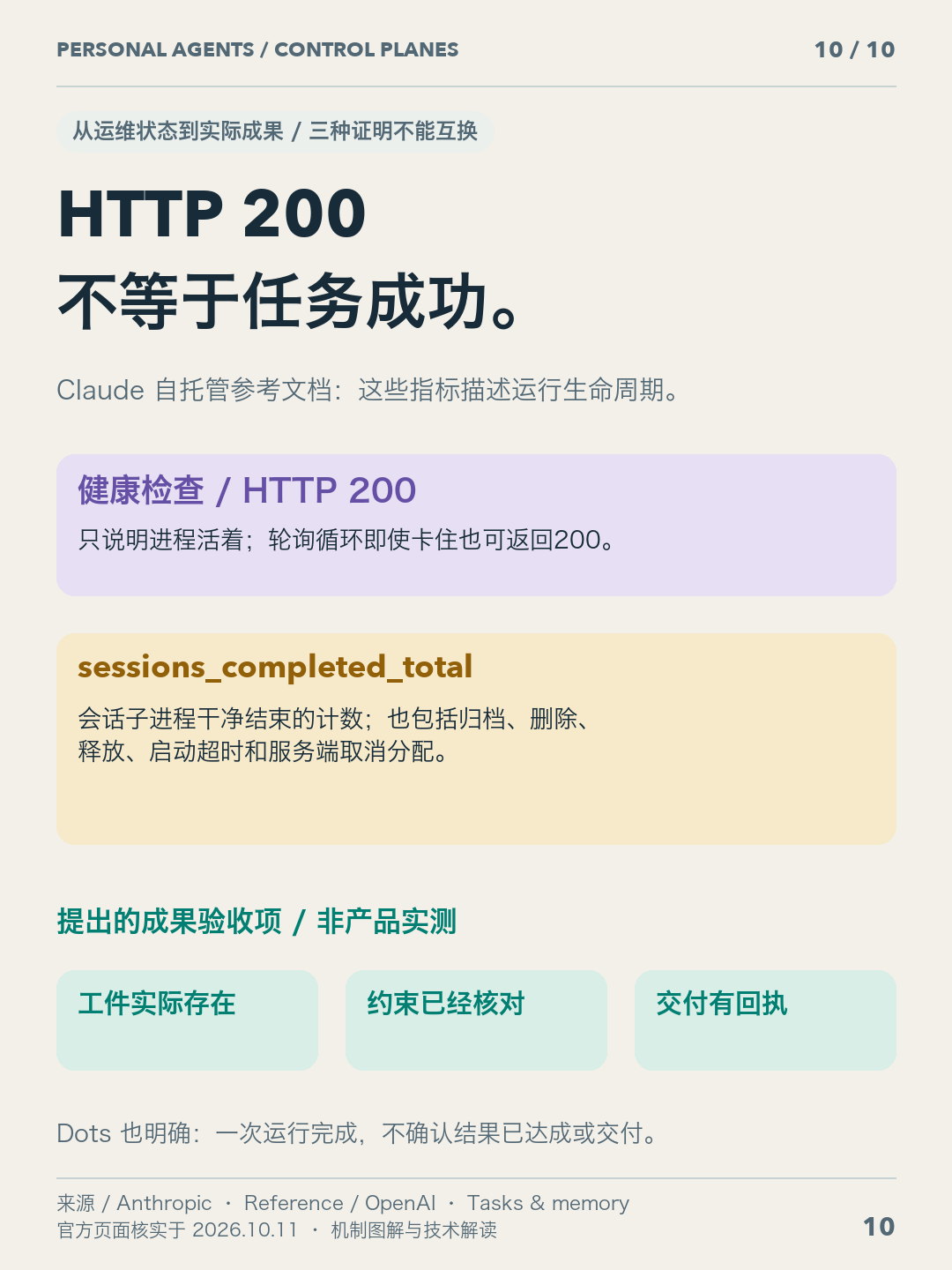
Claude’s reference documentation makes this unusually concrete. HTTP 200 on the runner health endpoint means the process is alive even if its polling loop is unhealthy. Its sessions_completed_total counter records a clean lifecycle ending, which can include idle release, archiving or even a startup timeout. It does not certify that the requested artifact passed tests or reached a recipient. Dots also state that a completed run alone does not confirm the requested result was achieved or delivered. These are different operational signals; a dashboard should retain both rather than rename one into the other. Claude counter semantics, Dots completion warning.
A safe matched protocol would supply fictional, versioned project updates and ask each workflow to produce a sourced draft briefing. Change a release date from October 20 to October 23, withhold one required record, and introduce a third-party request to send the draft while the task policy permits drafting only. Then inspect cancellation, resumption, artifact hashes and delivery receipts independently. For Claude, supply a separate routine or dispatcher instead of pretending self-hosting provides a consumer frontend. This is a proposed test, not a result: no account was connected and no send occurred. The acceptance question is whether the latest facts and authorized destination are evidenced, not whether the process merely stopped.
Cost belongs to that same outcome record. Dots’ delegated Work/Codex tasks use those products’ allowances, Grok Bot combines weekly included usage with additional token-cost usage, and self-hosted Claude adds operator infrastructure costs to organization usage. Muse advertises free core use with subscriptions for more, without exact amounts in the launch article. A meaningful future comparison would measure cost per verified briefing, including retries and review effort, rather than equating subscription entry prices with task costs. Persistent agents can reduce repeated setup and keep responsibilities moving; an outcome contract makes those benefits reviewable. Dots usage, Grok billing, Claude billing, Muse plans.
Analysis prepared with GPT-6.1 Sol assistance, using official documentation checked October 11, 2026. No hands-on performance or security benchmark was run. Proposed scenarios are illustrations, not observed product results.
Inspect the dated feature/status matrix and source-linked evidence notes.
个人智能体,需要一份结果契约
Dots、Grok Bot、Claude Code 自托管环境与 Muse,对持续在线、保留状态、真正完成工作,划出了不同边界。
以每日项目简报为例。智能体应当发现截止日期变化、更新草稿、发送前等待授权,并在职责结束后停止。“持续在线”只覆盖这份工作的一部分:它没有说明委派出去的任务是否也停止,恢复会话后文件是否还在,或者绿色的完成状态是否代表简报已经送达。比较这四个产品,更有价值的是执行契约:什么触发工作、携带什么权限、哪些状态持久保留,以及用什么证据确认结果。
本文核对的是截至2026年10月11日的官方文档,没有进行实际可靠性测试。Dots、Grok Bot、Meta Muse 提供托管智能体,用于持续承担职责;Claude Code 自托管环境提供编程会话的执行基础设施,会话由另一层产品入口发起。把四者当作同类个人助手,会遮住最关键的差别。以下结论来自当前官网和关联技术文档,没有验证具体账号的访问资格,也没有测量真实完成率。来源:Dots 文档、Grok Bot、Claude 自托管环境、Muse 发布说明。
观看6分14秒视频解读
英语讲解,可选择英文、中文和双语字幕。比较依据2026年10月11日核实的官方控制与状态说明;简报任务是提出的示例,不是已观察到的产品实测。
先确认产品层级和发布状态
Dots 可以协调持续职责、委派 Work 或 Codex 任务,用云端电脑在个人设备关闭时继续工作。Grok Bot 提供多个能够通过消息协作、使用持久桌面的专业角色。Muse 则把目标规划、主动跟进和专属云端虚拟机放在一起。它们相对每次对话重新提供背景有具体优势:项目简报可以跟随信息变化,人把精力留给需要判断的决策。官方例子展示的是预期工作方式,不能视为完成可靠性的对照实验。Dots 任务、Grok Bot 指南、Muse 设计。
| 产品 | 层级 | 当前文档状态 |
|---|---|---|
| Dots | 持续职责的托管协调者 | 逐步开放,受套餐、年龄、地区与管理员条件限制 |
| Grok Bot | 专职 Bots 与持久电脑 | 面向文档列出的合格订阅 |
| Claude 自托管环境 | 编程会话执行基础设施 | Team/Enterprise 公开测试,默认关闭 |
| Muse | 带专属 VM 的托管个人智能体 | 美国推出,当前使用 Secure VM |
符合套餐资格,不代表具体账号已经获得入口。Muse 的 Confidential VM、Shop Pay、1Password 和眼镜入口属于未来能力;Dots 的短信和智能体主动发起电话也尚未上线。对照应保留这些状态,不能把所有公告都变成已上线的勾选项。Dots 渠道、Muse 路线图。
不同角色名称,不代表不同安全域
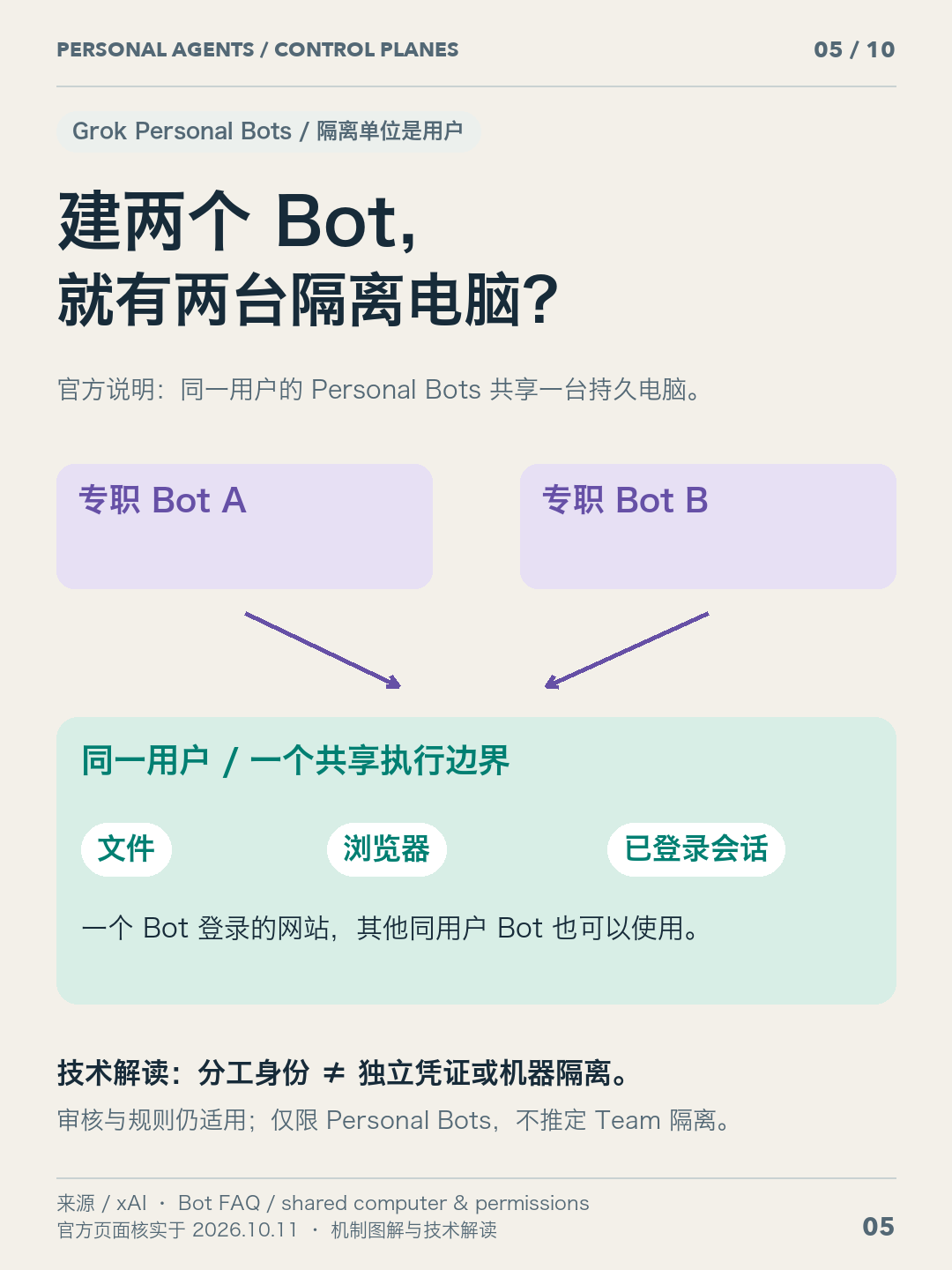
Grok Bot 把这一点说得很明确:同一用户的 Bots 共享一台持久云端电脑,包括文件、浏览器和登录状态;隔离按用户,而非按 Bot。官方指南说明,一个 Bot 登录网站后,其他 Bot 也可以到达该网站。共享状态的好处很具体:研究角色可以把简报交给沟通角色,不必重建环境。但不同名字和提示,不构成独立凭证边界。权限和审核者仍然重要;这条个人 Bot 的描述也不能泛化到所有 Enterprise Team Bot 配置。Grok FAQ、共享电脑指南。
Dots 把联系方式、应用连接、本地电脑访问分开。添加 Slack 不会自动连上收件箱,也不会授权电脑操作。它的云端浏览器登录状态与用户浏览器不同;本地任务需要已连接电脑在线、ChatGPT 应用打开。Dot 自己的保存笔记,也与 ChatGPT 记忆、完整对话记录不同。于是“上下文连续”有了更精确的含义:智能体可以记得私下提供的日期,但仍未获授权在团队频道披露私聊;委派任务拿到的是任务相关上下文,而非全部历史对话。Dots 电脑与应用、上下文与记忆。
停止一份职责,不能只看眼前的执行者
Dots 文档区分三个操作:Pause 停止当前主任务;委派任务到 Activity 单独停止;周期运行到 Scheduled 禁用或删除。停止不会撤销已经完成的行动。因此,在简报例子里,结束对话或暂停协调者,不能作为明天的简报已取消的证据。调度器和委派任务还要分别检查。这是文档明确的产品区别,而非推测出的缺陷。Dots 控制。
Grok Bot 的版本记录描述了另一种停止范围。9月17日 v0.56.0 说,要求一个 Bot 停止,也会停止它委派的 Bots 和启动的 Cloud Agents;10月7日 v0.68.1 又描述,停止无响应步骤大约需要30秒。但同一版本还说,被 Stop 中断的邮件 Send 仍可能发送出去。这把取消与回滚分开:阻止后续执行,不能证明已提交行动被撤回。周期任务也有各自的暂停、恢复、删除控制。版本记录是已文档化行为的证据,不是我们实测得到的取消时延保障。Grok Bot 更新记录。
可恢复的对话,与持久工作文件不是一回事
Claude 自托管环境把编程执行移入组织网络。运营方提供 runner、镜像、网络策略和凭证,Anthropic 保留队列、编排和界面。即使推理配置为 Bedrock 或 Google 的 Agent Platform,对话和工具结果也仍会到达 api.anthropic.com。这种方式让智能体访问内部构建系统,而不必把它公开到互联网;但不能说整个会话都留在本地,或供应商无法访问。自托管改变了执行边界,同时增加运营责任。Claude 架构与数据范围。
恢复过程让区别更加直观。Runner 停止轮询后,租约约60秒到期,会话在几分钟内重新入队。新 runner 可以恢复对话,却再次克隆原始分支,丢失未推送的工作。文档中的尽力推送选项,可以保留已经提交的修改,未提交编辑依然会丢失。因此,“恢复”对对话连续性可以成立,对工作目录保留却不成立。未来的简报试验应单独检查草稿文件,不能只看恢复了聊天。同一文档还提醒,停止会话不必然终止已守护进程化的服务;容器销毁负责结束另一种生命周期。Claude 恢复与限制。
授权,需要存在于指令之外
Dots 区分应用权限、行动审核和 Custom Rules。规则是智能体尝试遵守的指令,可能出错,不会授予应用访问,也不能覆盖内置安全要求。Grok Bot 同样描述了由独立审核模型解释自然语言规则。它们可以减少重复人工确认、保留升级处置,但“准备简报”仍要与“发给这些人”分开。原始材料里出现一条指令,不应自动产生新的行动授权。Dots 行动控制、Grok 权限。
Meta 对 Muse 描述了一道更明确的架构边界:Sentinel 位于智能体运行单元之外,授权连接器行动与网络出口。限定范围的确认通过客户端界面直接交给 Sentinel;凭证单独保存,并在获准的边界注入。它是关于权限放在哪里的重要架构主张,不是执行永不失败的证明。当前 Secure VM 仍允许 Meta 按运营政策访问;未来 Confidential VM 才旨在通过密码学阻止该访问,文档描述其正在小范围可信测试者中测试。当前隔离、未来保密、模型训练选择,要保持分开:技术文章描述默认使用脱敏轨迹训练,并可选择退出。Muse 技术架构与隐私。
进程变绿之后,再验证交付物
Claude 的参考文档给出了特别具体的例子。Runner 健康端点返回 HTTP 200,只表示进程还活着,即使轮询循环不健康也是如此。sessions_completed_total 计数表示生命周期正常结束,可能包括空闲释放、归档,甚至启动超时;它不认证所需文件通过测试或送达收件人。Dots 也明确说,完成一次运行,不代表请求的结果已经实现或交付。这些是不同的运营信号,仪表盘应同时保留,而不是把一个改名成另一个。Claude 计数语义、Dots 完成提示。
一套安全的匹配方案,可以提供虚构、带版本的项目更新,让各工作流生成有来源的简报草稿。把发布日期从10月20日改为23日,拿走一条必需记录,再引入第三方“发送草稿”的请求,而任务策略只允许起草。然后分别检查取消、恢复、文件哈希与送达凭据。对于 Claude,另加例行任务或派发入口,不能假装自托管基础设施自带消费者前端。这是拟议测试,不是结果:没有连接账号,也没有发送任何内容。验收问题应是最新事实和授权目标是否有证据,而不是进程是否刚好停了。
成本也属于同一结果记录。Dots 委派的 Work/Codex 任务消耗对应产品额度;Grok Bot 有每周包含用量和额外 token 用量;Claude 自托管把运营方基础设施成本加到组织用量上。Muse 宣传核心使用多数免费、更多使用可订阅,但发布文章未给出精确金额。未来有意义的比较,应衡量每份已验证简报的成本,包括重试与审核,而非把订阅起价当作任务成本。持久智能体可以减少反复设置、让职责持续推进;结果契约让这些好处能够被检查。Dots 用量、Grok 计费、Claude 计费、Muse 套餐。
GPT-6.1 Sol 辅助整理,截至2026年10月11日核对官方文档。没有实际性能或安全基准测试;拟议场景是说明,不是观察到的产品结果。