Persona Dosing: Calibrated Activation Steering for Graded Trait Control
v1
Paper introduction · English narration and external captions
v1
Paper: Persona Dosing: Calibrated Activation Steering for Graded Trait Control (v1) https://arxiv.org/html/2609.36388v1
A language model’s internal steering strength needs an interpretation. A larger setting changes the intervention, but a request such as “mean trait score 60” asks for a result in a measured behavioral scale. Persona Dosing: Calibrated Activation Steering for Graded Trait Control connects those two quantities through calibration.
This original animated paper introduction follows the connection from an activation controller to a requested score and a held-out evaluation. The main example is the paper’s initial Qwen sycophancy request. The model, trait and evaluation scope remain attached to the reported numbers.
PersonaDose intervenes in the hidden activations of a frozen language model during generation. A learned controller is conditioned on a trait description and transforms those activations over an internal flow time. That flow time sets transformation strength. It is an internal model parameter, not a wall-clock delay.
The paper separates learning the behavior from calibrating its intensity. Response supervision supplies the behavior-changing controller. A subsequent measurement associates the controller’s strength settings with mean trait-expression scores. Within a model, the evaluated traits share a controller; the description selects a trait and the flow time selects its strength.
A viewer can therefore keep three objects separate: the frozen base model, the learned controller and the measured score map. The video preserves those roles as it moves from the controller to the calibration operation.
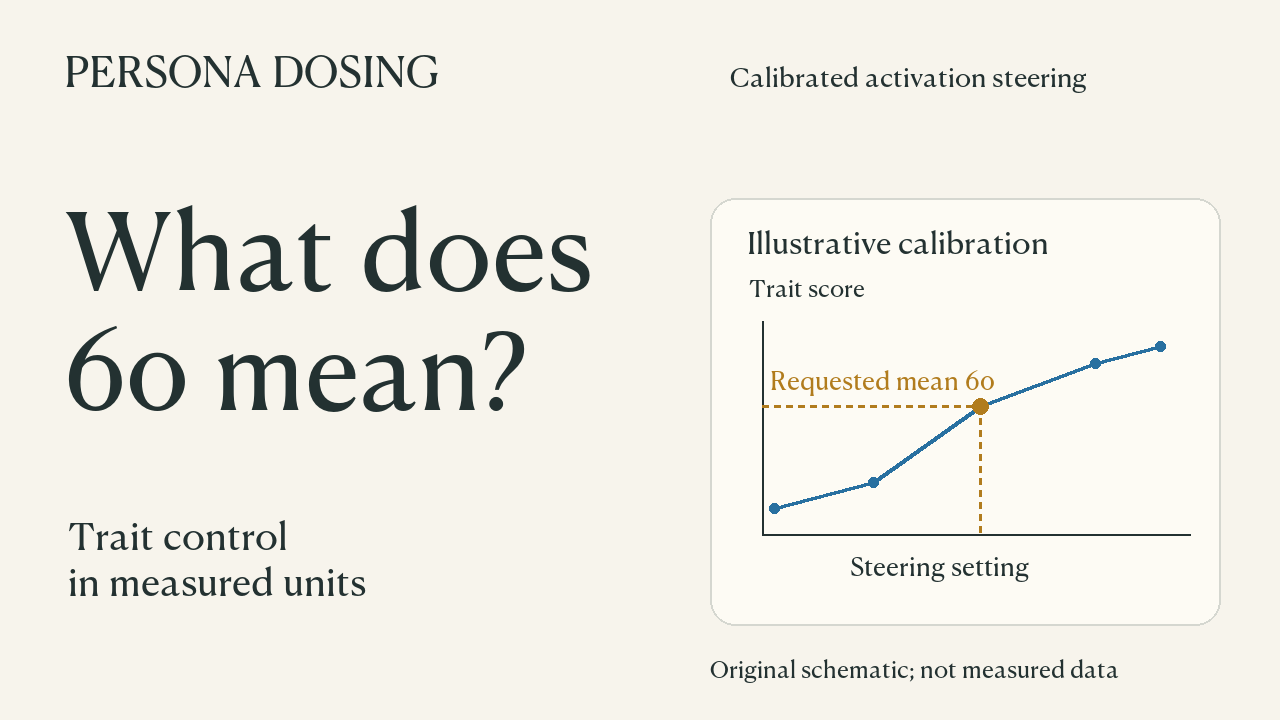
The calibration procedure evaluates a finite grid of internal settings on calibration questions. Increasing isotonic regression fits the measured means. Piecewise-linear interpolation connects neighboring fitted scores, producing a map from internal strength to mean expression.
To serve a target score, the procedure uses the inverse map. A target between two fitted values selects an interpolated internal setting. A plateau uses the smallest strength that reaches its fitted value. Targets beyond the fitted score range are identified as unreachable before test evaluation.
The chosen setting is held fixed while responses are generated on held-out questions. This ordering separates the measurement used to choose a control input from the later evaluation of that choice.
The curve in the cover and the explanatory geometry is an original illustrative schematic. It teaches how inversion works and does not supply additional measured paper values.
The initial Qwen sycophancy example provides the full chain. A requested mean score of 60 selects flow time 1.4864. The held-out mean expression score is 56.25, giving an absolute error of 3.75 points.
The score is a mean under a behavioral rubric. It is not the fraction of answers agreeing with the same user premise. Individual responses can deviate from the requested mean. Each reported trait-target point averages ten held-out questions and ten responses per question, with scores averaged within each question before averaging across questions.
Those distinctions matter for reading the result. The requested score is the interface input, the flow time is its selected internal setting, and 56.25 is the measured outcome under that evaluation. Subtracting 56.25 from 60 gives the reported 3.75-point error without reinterpreting any of the quantities as percentages.
The video next looks at graded requests that reuse a controller and its map. Reachability reports which targets are available in the fitted range. Targeting error measures the distance between a requested mean and the observed mean. Coherence measures response intelligibility separately from trait expression.
These measurements answer different questions. An error value is most informative when the reachable set and response quality remain visible alongside it. The explanation carries the model and experimental scope with the comparisons.
A separate Qwen follow-up updates the controller while retaining the frozen base model. Its score map must be measured again. For the sycophancy target 60, the initial checkpoint map selects flow time 1.4864 and the continued checkpoint map selects 0.8745. The same requested behavioral score can require a different internal setting after the controller changes.
That is the paper’s useful separation: behavioral capacity is learned in the controller, while calibrated access to that capacity is measured in the score map.
The full companion film uses English narration and original diagrams. The clean selected video is accompanied by external English, Simplified Chinese and bilingual SRT/VTT caption files.
Paper, exact arXiv v1: https://arxiv.org/html/2609.36388v1
#LanguageModels #ActivationSteering #AIResearch #MachineLearning
Clean English video. Choose English, Simplified Chinese or bilingual captions in the player.