Distributional Matching for Vector Quantization: A Unified Theoretical and Empirical Framework
v2
Paper introduction · English narration and external captions
v2
v1
Paper: Distributional Matching for Vector Quantization: A Unified Theoretical and Empirical Framework (v2) https://arxiv.org/html/2607.15933v2
Paper: Enhancing Vector Quantization with Distributional Matching: A Theoretical and Empirical Study (v1) https://arxiv.org/html/2506.15078v1
The 2025 and 2026 distribution-matching VQ papers are separate source records with a connected research question: how should a discrete codebook represent the distribution of continuous encoder features? Keeping both records visible prevents a broader later framework from erasing the earlier contribution.
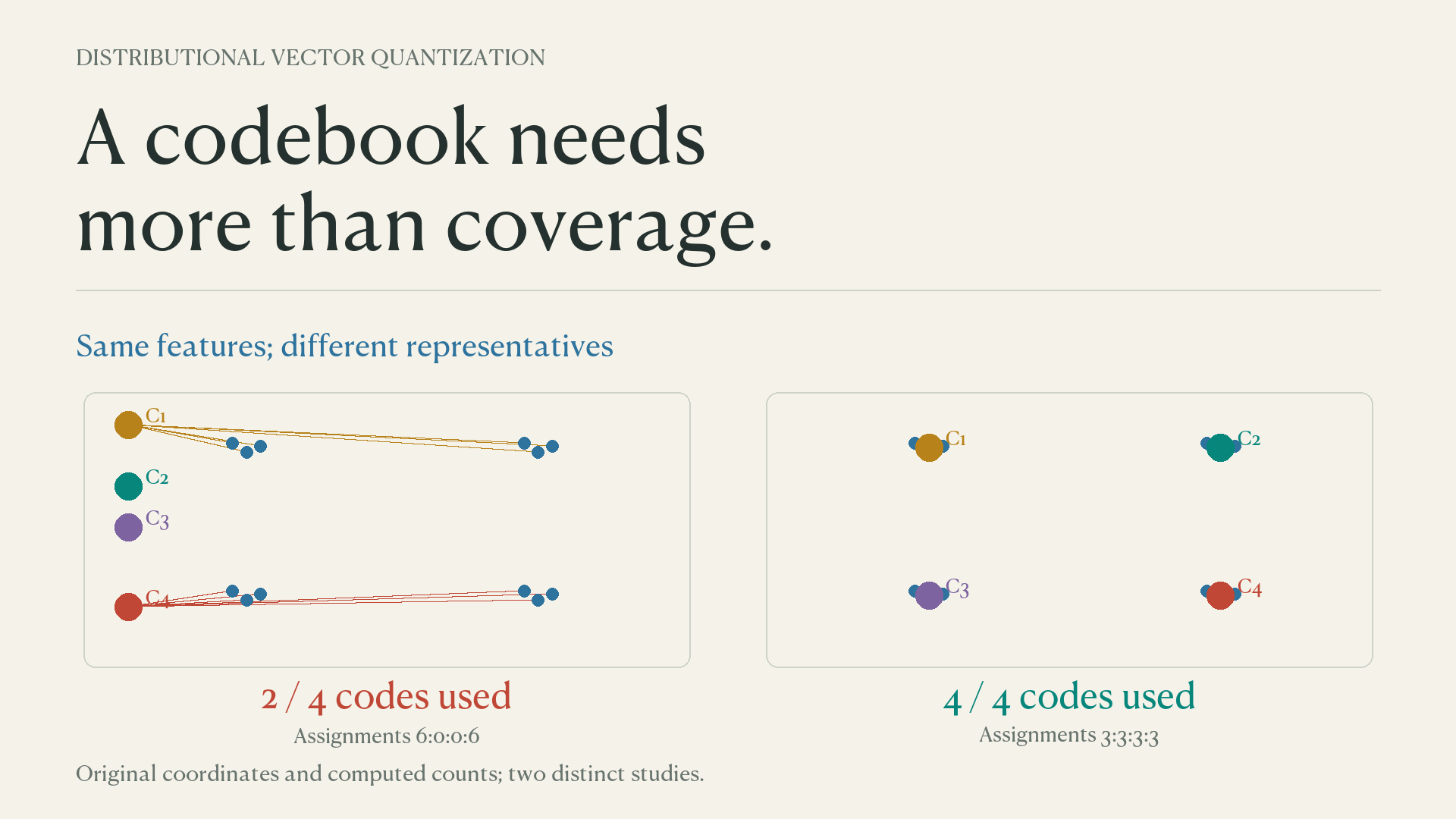
The earlier study already examines a three-part criterion. Quantization error measures how far features move when replaced by selected codes. Utilization asks whether entries are selected at all. Perplexity measures how evenly assignments are distributed. These quantities describe different properties of the same quantizer.
An original feature-cloud example makes the distinction tangible. Some code vectors can attract no features, while others collect many nearby and distant points. Even if every entry is touched once, repeated assignments can remain strongly concentrated. The displayed counts are computed from authored coordinates rather than copied from a model evaluation.
The 2025 matching objective uses a Gaussian approximation and sample means and covariance matrices. The 2026 framework broadens the comparison with MMD, a kernel-based alternative that does not choose a parametric Gaussian distribution. Its auxiliary matching terms update the codebook while detaching encoder gradients for those terms.
The later synthetic comparison holds feature distributions controlled. The methods are comparable near Gaussianity; increasingly separated bimodal features favor MMD’s error and utilization, with additional pairwise computation. Direct raw-error comparisons between unrelated feature scales would not isolate quantizer quality.
The later FFHQ VQ-VAE table provides a separate measured example. At 256 tokens and 16,384 entries, Vanilla VQ reports PSNR 27.83 dB and codebook use 3.8%; Wasserstein VQ reports 29.03 dB and 100%. The companion film keeps these reconstruction measurements distinct from its explanatory point cloud and links both pinned paper versions.
Pinned source versions: 2026 v2: https://arxiv.org/html/2607.15933v2 2025 v1: https://arxiv.org/html/2506.15078v1
#VectorQuantization #MachineLearning #AIResearch
Clean English video. Choose English, Simplified Chinese or bilingual captions in the player.